V-BAT (MQ-35)
Executive Summary
Forensic analysis of Shield AI's V-BAT (MQ-35): Hivemind autonomy, ViDAR sensor, targeting role, export, privacy law and international implications.
V-BAT (MQ-35) by Shield AI: Autonomous ISR, Targeting and the Hivemind Question
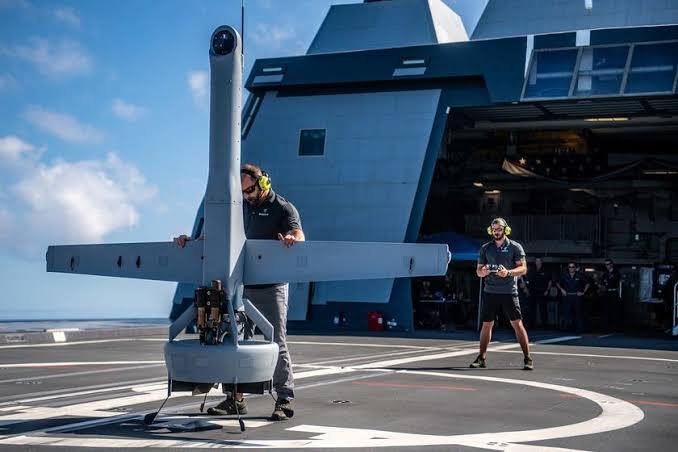
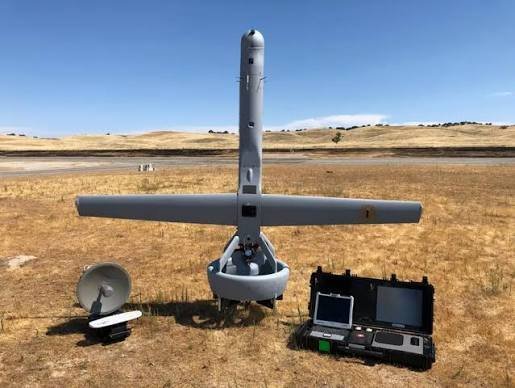
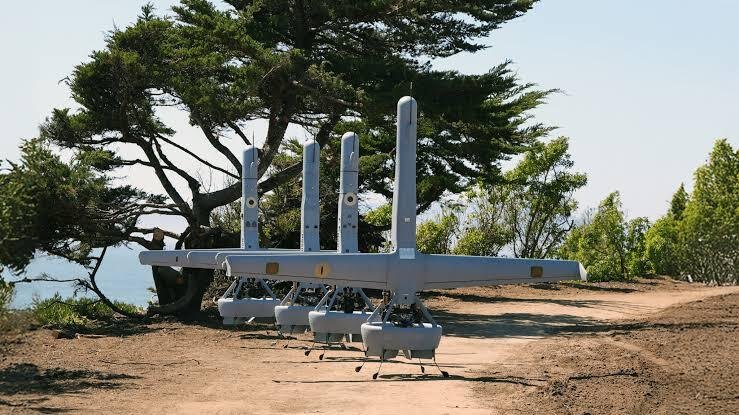
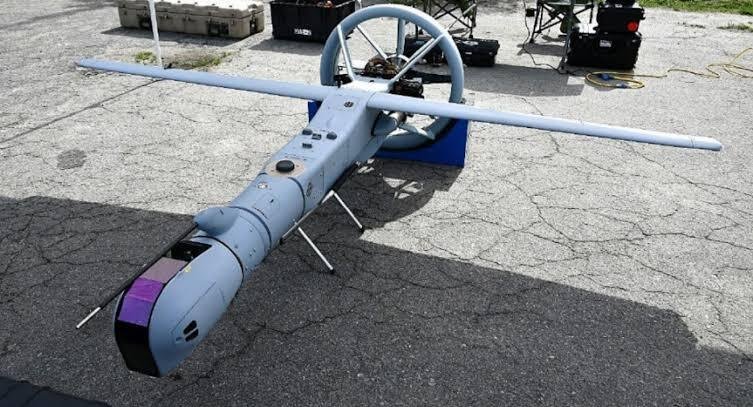
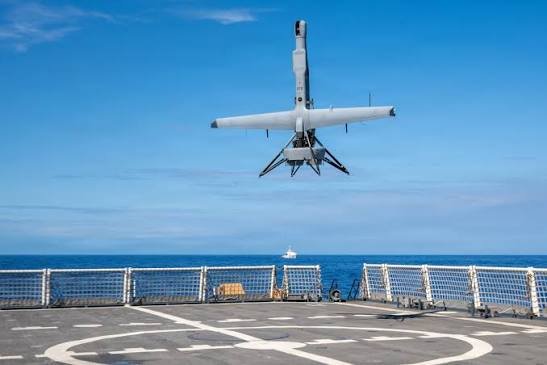
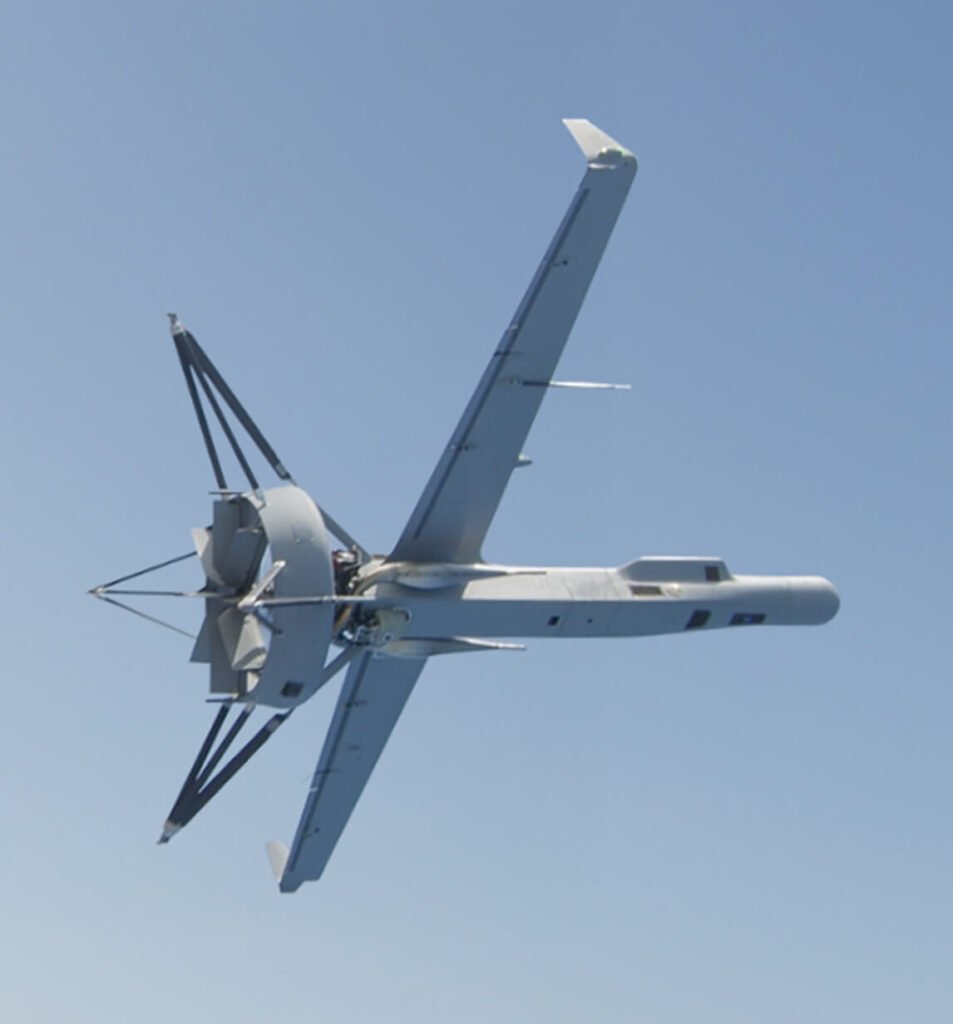
The V-BAT is a vertical take-off and landing uncrewed aircraft system built by Shield AI of San Diego, California, and designated MQ-35 V-BAT in US service. It is a tail-sitting, ducted-fan aircraft that launches and recovers without a runway, flies for more than twelve hours on heavy fuel, and carries sensors for intelligence, surveillance and reconnaissance (ISR) and for targeting. Shield AI’s Hivemind autonomy software flies it, including where GPS and communications are jammed. The company markets it for securing borders, hunting drugs and finding threats, and its own product page lists laser designation and kinetic munitions capability among the payload options. I include it in the AI Weapon Systems Database because it is not a weapon in its basic form, and because that is exactly why it matters when it comes to potential dual-use technologies. An aircraft that finds and designates targets using machine autonomy is a core component of the AI-enabled kill chain, and it faces far less scrutiny than the munitions that complete it.
A note on evidence. The technical data below comes from Shield AI’s product page, which is marketing material, and from financial and trade analysis that relies on company disclosures. Several performance values are absent from the page I reviewed. I mark claims as reported, and I record Unknown where the open record is silent.
Basic Weapon Facts
I. Background
- Manufacturer: Shield AI (San Diego, California). The aircraft design came from Martin UAV, which Shield AI acquired in 2021.
- Suppliers: Hivemind autonomy is in-house. Payload options listed by Shield AI include Hoodtech electro-optical and infrared sensors (6, 9 and 11 series), synthetic aperture radar, AIS, SATCOM, ADS-B Out, M-code and anti-jam GNSS, a laser range finder and a laser target designator. The heavy fuel (JP5) engine supplier and other airframe suppliers are Unknown. Shield AI is acquiring Aechelon Technology, a simulation software firm.
- Country of origin: United States
- Developmental stage: Operational and in serial production. The V-BAT 5.3 upgrade passed US Coast Guard operational evaluation in 2025. Shield AI says it has deployed on nearly every class of US Navy ship and with all seven Marine Expeditionary Units, and has been selected for the US Coast Guard maritime unmanned aircraft services programme. A Coast Guard contractor-owned, contractor-operated services contract has a ceiling of about $198 million, according to the Defense Briefing profile. Customers reported in financial analysis include the Netherlands, Ukraine, Egypt, Romania, Indonesia, Japan and, under an emergency procurement announced in January 2026, the Indian Army.
- System version: V-BAT 5.3 (SATCOM, heavy fuel engine and Hivemind integration). Shield AI is also developing X-BAT, a larger vertical take-off combat aircraft.
- System type: Group 3-class vertical take-off and landing ISR and targeting UAS, with kinetic payload capability. The database has no ISR category that fits, and I recommend a Surveillance and Targeting Support heading.
II. General Specifications
| Parameter | Specification |
|---|---|
| System dimensions | Wingspan 12.5 ft (3.8 m), height 9.6 ft (2.9 m). Landing zone as small as 4.6 m by 4.6 m. |
| Weight | Maximum gross take-off weight 165 lb (75 kg) |
| Max payload | 40 lb (about 18 kg). 600 W of power available for payloads. |
| Max operating time | 12 hours or more, using a heavy fuel (JP5) engine |
| Max operating distance/reach | Unknown from the page reviewed. Shield AI describes beyond line of sight operation through SATCOM and points to a downloadable specification sheet that I did not have. |
| Max speed | Unknown from the page reviewed |
| Operating limits | Launch and recovery in winds up to 25 knots and from moving ships at up to 10 knots. Deployable by two people in under 30 minutes. |
| Sensor coverage | ViDAR passive wide area search rated at 3,140 square nautical miles per hour (company claim) |
| Cost | About $1 million per aircraft in financial analysis, with orders from 4 to 300 aircraft (reported) |
III. Autonomy
Autonomous targeting capabilities:
Sensors. The aircraft carries optical, infrared and radar payloads according to the mission. Its signature sensor is ViDAR, which Shield AI describes as the first passive, multi-domain, AI-enabled optical sensor for sea and land. It uses a camera array to search a wide area and flag contacts, such as vessels, to the operator. Being passive, it does not emit, which matters in an electronic warfare environment. Detection range, classification categories and error rates are Unknown.
Algorithms. Flight and mission autonomy come from Hivemind, which Shield AI calls an AI pilot. It is designed for what the industry calls DDIL conditions: disconnected, degraded, intermittent and low bandwidth. The company says the V-BAT has flown ISR and targeting under GPS and communications jamming deep into enemy territory. The training data, the verification method and the behaviour of the software when it loses contact with a human are Unknown. Shield AI is also the mission autonomy provider in the US Air Force’s Collaborative Combat Aircraft competition, according to the Venture Atlas profile, so Hivemind now spans many platforms.
The kill chain. The V-BAT is a sensor and designator. Its role in the kill chain is to find, fix and track, and, with a laser designator, to mark a target for a weapon launched from elsewhere. The product page describes a result in which a surface-to-air missile site was destroyed after the aircraft performed deep penetration ISR and targeting. Shield AI also says it has run hundreds of targeting operations in Ukraine. Separately, the page lists a kinetic munitions-capable option, which implies an armed configuration whose details are not public. Human involvement therefore varies by configuration. A human operator reviews flagged contacts and authorises engagement in the standard ISR role. In a degraded environment, the aircraft may navigate, search and flag without a link, and what it does with a target nomination when no human is reachable is the unanswered question.
Policy classification. An unarmed ISR aircraft sits outside the heightened review in DoD Directive 3000.09, summarised by the Congressional Research Service, and that is where most of the V-BAT’s use falls. An armed configuration would engage the directive. The directive does not capture the real issue, which is that AI-generated target nominations shape the decisions humans make, without any autonomous weapon being involved.
Origins and Development
Shield AI was founded in 2015 by Brandon Tseng, a former Navy SEAL, and Ryan Tseng, with the idea that troops operating in buildings and contested spaces needed machines that could fly and think without a pilot or a link. Hivemind began as the autonomy stack for its early quadcopter, Nova, and was later separated from the airframe into a portable product. That decision turned a hardware company into a software company. In 2021, Shield AI bought Martin UAV, whose V-BAT gave it a fixed-wing, long-endurance platform. The Navy and the Coast Guard became the aircraft’s first large customers.
Growth has been rapid. Reuters confirmed in March 2026 that Shield AI raised a Series G round at a $12.7 billion valuation, roughly 140 percent higher than a year earlier, according to the financial coverage collected by Tech Insider. Equity research by Sacra reports that V-BATs deployed in Ukraine through 2025 and that the company began selling to the Netherlands, Ukraine and Egypt that year. Taiwan’s NCSIST signed a Hivemind integration contract in February 2026. In 2026 Frontex and the Italian Coast Guard also trialled the aircraft from a patrol vessel in the central Mediterranean, according to a reference summary I reviewed, and I treat the details as unconfirmed.
Strategic Logic
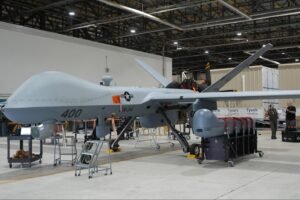
The V-BAT answers a gap in the middle of the market. Large drones such as the MQ-9 Reaper need runways, crews and satellite links, and small quadcopters have short endurance. A twelve hour aircraft that fits in a pickup truck and operates from a ship deck offers persistence at low cost, and it can be flown by almost any military. Ukraine’s war has shown that this kind of drone survives only when it can operate under jamming, and autonomy is the answer to jamming.
The commercial logic is as important as the military one. The model is a platform for Hivemind. If the software spreads to many airframes, including crewless fighters and allied systems, it becomes a layer that shapes how several militaries fight. Analyst commentary notes that the valuation depends on Hivemind becoming a multi-platform standard and not on the V-BAT alone. I treat that as a warning about incentives: a company priced on adoption has reason to sell widely, and the questions of who the buyers are and what they do with it follow the money.
Legal Analysis
Targeting support
Intelligence and reconnaissance are lawful, and no treaty bans an AI-enabled sensor aircraft. The law bites when the product of the sensor becomes a target.
- Duty to verify. Article 57(2)(a)(i) of Additional Protocol I requires those who plan or decide on an attack to do everything feasible to verify that targets are military objectives. If an AI system nominates a contact and the human accepts it with little review, the question is whether that verification was genuine. I examine the same problem in the Lavender entry.
- Weapon review. Article 36 applies to armed variants and to the systems that integrate them. No review of a kinetic V-BAT configuration is public.
- Distinction at sea. Vessels flagged by a passive search sensor may be warships, fishing boats, merchant ships or migrant craft. The San Remo Manual on armed conflict at sea and the Second Geneva Convention set protections that depend on accurate classification, which the public record cannot confirm for ViDAR.
Law enforcement, privacy and migration
The V-BAT’s other mission is policing, and that brings different law. Maritime drug interdiction rests on Article 108 of the UN Convention on the Law of the Sea and Article 17 of the 1988 UN Convention against Illicit Traffic in Narcotic Drugs, with US Coast Guard authority in 14 U.S.C. 522. Persistent aerial surveillance of people raises privacy questions. US courts have allowed some aerial observation, in California v Ciraolo (1986) and Florida v Riley (1989), while Kyllo v United States (2001) and Carpenter v United States (2018) restrict technology that exposes private activity in ways the public cannot expect. A wide-area, twelve-hour sensor falls between those lines and has not been tested in court.
In Europe, the issue is migration. Aerial surveillance in the Mediterranean has been criticised for helping the Libyan coast guard intercept boats, and the European Court of Human Rights held in Hirsi Jamaa v Italy (2012) that pushing migrants back to a place where they face ill treatment violates the Convention. The UN Human Rights Committee examined Italy’s duty to rescue in cases arising from Mediterranean incidents. A sensor that finds drug runners finds refugee boats with equal ease, and the law cares what happens next. I record the Frontex trial as reported and unconfirmed.
Export and governance
The V-BAT is a controlled defence article under US export rules. It also appears on the Blue UAS Cleared List, which reflects the US ban on federal purchase of Chinese drones. The Arms Trade Treaty requires parties to assess risks of serious violations before exports. On autonomy, the CCW Group of Governmental Experts works on lethal systems, and the US Political Declaration on Responsible Military Use of AI and Autonomy applies in principle to systems like Hivemind. Neither addresses AI-enabled decision support in any detail.
International Relations Implications
Allied proliferation. Sales to Japan, the Netherlands, Romania, Indonesia, Egypt, India and Ukraine make the V-BAT a vehicle for spreading US autonomy software across regions with live disputes. Indonesia and Japan operate near contested waters, and Taiwan’s work with Hivemind sits directly in the Taiwan Strait question.
Ukraine as testing ground. The war has become the place where autonomy under jamming is proven or disproven, and companies use it as a sales credential. That makes battlefield results commercial assets, which is an uncomfortable fact about how norms form.
Software dependence. Allied forces that buy Hivemind depend on a US company’s code. Updates, licences and export approvals become levers of influence, and I expect that dependence to become a diplomatic issue.
Decision speed. AI-enabled search compresses the time between detecting a target and striking it. Faster cycles favour whoever has the technology, and they push adversaries to adopt similar systems with fewer safeguards.
Technology and AI
The V-BAT shows where military AI actually lives today. It is rarely in the weapon. It is in the sensor, the search pattern, the contact flagging and the route, and it shapes what a human operator sees and does. My AI Safety page argues that systems which cannot be audited cannot be governed. Software that decides what a human looks at is as hard to audit as software that decides what to shoot, and the operator who relies on it may never know what it missed. Hivemind’s migration to fighters and other drones, including the Ghost Bat class of platform, makes that concern larger.
My Assessment
The company’s stated mission is to protect service members and civilians with intelligent systems, and I do not doubt that the V-BAT does some of that. Finding a drug boat, a downed pilot or a missile site without risking a crew is valuable.
My concern is the word targeting on the product page, set beside a kinetic payload option. A drone that does not shoot can still be the decisive link in a chain that does, and the debate about autonomous weapons tends to look only at the final link. The questions I want answered are about the earlier ones. What does the aircraft do when the link goes down and it has flagged a target? How often has ViDAR misclassified a fishing boat or a migrant craft? How much do operators scrutinise what the machine nominates? My stance on meaningful human control applies to those earlier links as much as to the trigger. I would like to see independent testing of ViDAR classification, published rules for what Hivemind does without a link, and export conditions that bar use against migrants or protesters. States without these systems can record advance objections using the Anticipatory Objection Registry I develop in my research.
More of my thinking is in my story and my articles, and I take on advisory work through the consulting page.
Frequently Asked Questions
What is the V-BAT? The V-BAT is a vertical take-off and landing uncrewed aircraft from Shield AI, used for ISR and targeting, and designated MQ-35 in US service.
Is the V-BAT armed? The standard aircraft is an ISR platform. Shield AI lists a laser designator and a kinetic munitions-capable option among its payloads.
What is Hivemind? Hivemind is Shield AI’s autonomy software, which flies the V-BAT and other aircraft and operates without GPS or communications links.
What is ViDAR? ViDAR is a passive, AI-enabled wide-area optical search sensor that detects contacts over sea and land.
Who uses the V-BAT? The US Navy, Marine Corps and Coast Guard, and reported customers include Japan, the Netherlands, Ukraine, Egypt, Romania, Indonesia and India.
How far can it fly? It can stay airborne for more than twelve hours. Range and speed figures were not in the material I reviewed.
Sources
Manufacturer website: Shield AI, V-BAT
News reports and analysis:
- Shield AI: Financials and Contracts, Defense Briefing, updated August 2026
- Shield AI: Company profile, milestones and funding, Venture Atlas
- Shield AI equity research, Sacra, May 2026
- Shield AI $1.5B Series G at $12.7B valuation, Tech Insider, 2026
- Is Shield AI really worth $12.7B?, New Market Pitch
Military, legal and treaty documentation:
- DoD Directive 3000.09 (updated January 2023); CRS summary IF11150
- Additional Protocol I (1977), Articles 36 and 57: ICRC
- UN Convention on the Law of the Sea, Article 108; 1988 UN Convention against Illicit Traffic in Narcotic Drugs, Article 17; 14 U.S.C. 522
- Cases: California v Ciraolo (1986); Florida v Riley (1989); Kyllo v United States (2001); Carpenter v United States (2018); Hirsi Jamaa and Others v Italy, European Court of Human Rights (Grand Chamber, 2012), via HUDOC
- Arms Trade Treaty; US Political Declaration on Responsible Military Use of AI and Autonomy; CCW Group of Governmental Experts; Campaign to Stop Killer Robots
Related database entries: MQ 9 Reaper, MQ 28 Ghost Bat, IDF Lavender, Bullfrog Autonomous Weapon Station, STM Kargu 2

Avi is a researcher educated at the University of Cambridge, specialising in the intersection of AI Ethics and International Law. Recognised by the United Nations for his work on autonomous systems, he translates technical complexity into actionable global policy. His research provides a strategic bridge between machine learning architecture and international governance.