MQ-9 Reaper
MQ-9 Reaper: Technical Dossier and Legal Analysis
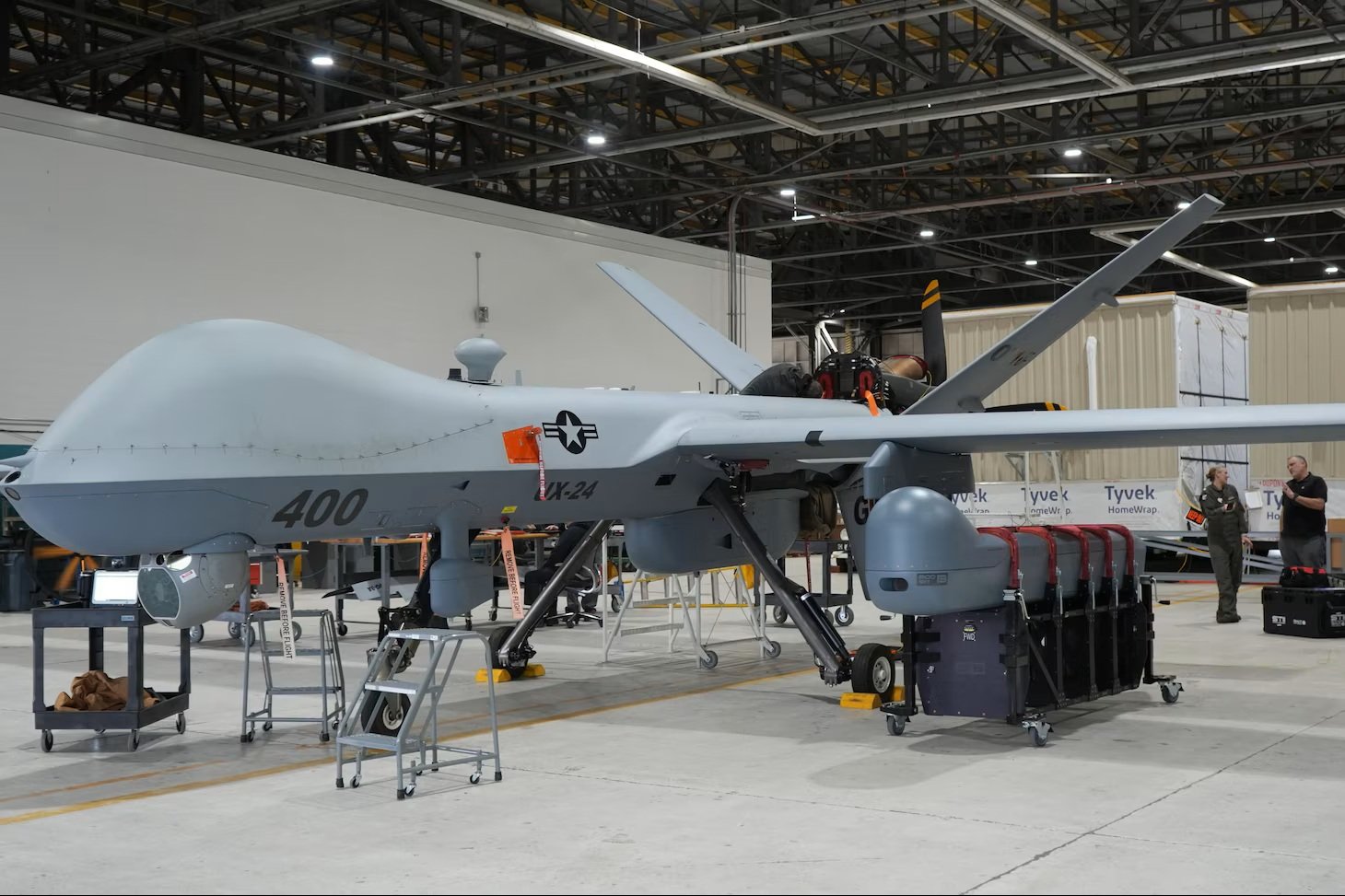
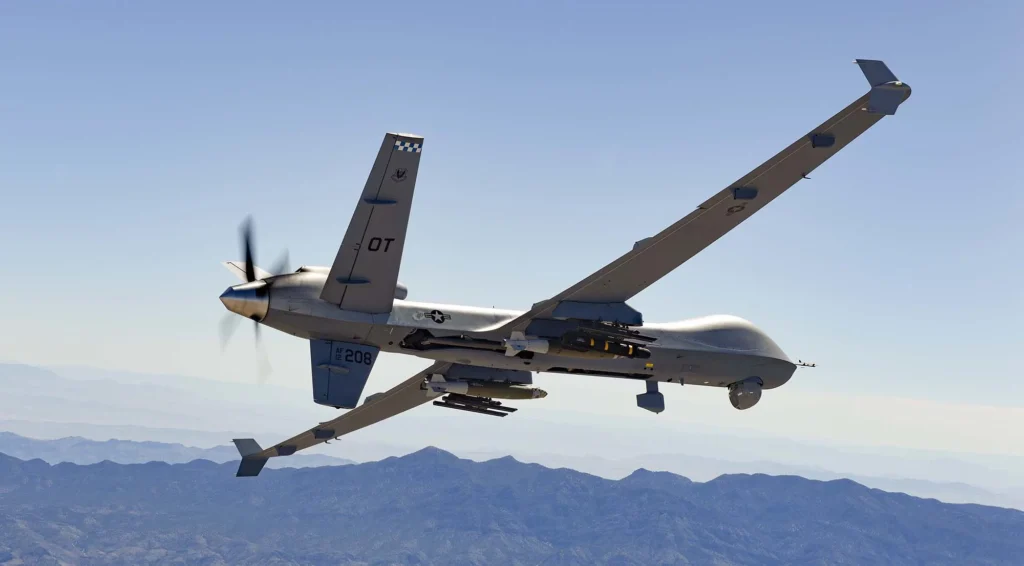
The MQ-9 Reaper and updated MQ-9 Reaper 2 are remotely piloted, armed, medium altitude, long endurance aircraft built by General Atomics Aeronautical Systems in the United States. The US Air Force describes it as an armed multi-mission aircraft employed primarily against dynamic execution targets and secondarily as an intelligence, surveillance and reconnaissance asset. It is not a lethal autonomous weapon system in the strict sense, because a human crew selects and authorises each engagement. I have placed it in this database because it is the baseline against which every claim about autonomy in air warfare has to be measured. It normalised persistent armed overwatch, it compressed the kill chain into a single airframe, and its 2026 combat attrition is now pushing the United States toward cheaper, more numerous and more autonomous successors. af
Key takeaways
- The Reaper is remotely piloted. Its legal significance lies in targeted killing, accountability and the erosion of the battlefield as a legal concept.
- The Air Force inventory stood at 135 MQ-9As in May 2026, down from a peak of 351 in fiscal year 2022. legis1
- The Washington Post reported that 45 Reapers, roughly a quarter of the fleet, had been lost during Operation Epic Fury against Iran as of 13 August 2026. defensescoop
- The CCW Seventh Review Conference meets in Geneva from 16 to 20 November 2026 and will decide whether autonomous weapons regulation moves to formal negotiation. reachingcriticalwill
Basic Weapon Facts
I. Background
| Field | Detail |
|---|---|
| Manufacturer | General Atomics Aeronautical Systems, Inc. (GA ASI) |
| Suppliers | Honeywell (TPE331 turboprop engine), Raytheon (Multi-Spectral Targeting System), Lockheed Martin (AGM-114 Hellfire). Full supplier list: Unknown |
| Country of origin | United States |
| Primary operators | US Air Force, US Marine Corps, Air National Guard, CIA (reported). Also operated or ordered by allied states including France, Italy, the Netherlands and India (MQ-9B) |
| Developmental stage | Operational. The MQ-9A production line is closed and would take two to three years to restart, according to CRS. The MQ-9B continues in production |
| System version | MQ-9A Block 5 (USAF standard). MQ-9B SkyGuardian and SeaGuardian are the export and successor family |
| System type | Remotely piloted aircraft system (RPAS), medium altitude long endurance (MALE), armed ISR and strike militarytimes |
II. General Specifications
| Parameter | Specification |
|---|---|
| System dimensions | Length about 36 ft (11 m), wingspan about 66 ft (20.1 m), height about 12.5 ft (3.8 m) |
| Weight | Maximum takeoff weight about 10,500 lb (approximate, manufacturer data). Empty weight: Unknown (publicly cited figures vary) |
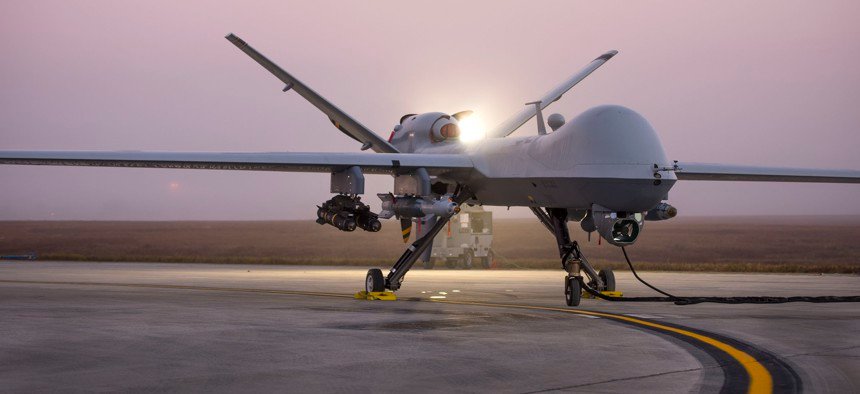
| Max payload | Cited as 3,750 lb by the Air Force and 3,850 lb by General Atomics. Typical armament is four to eight AGM-114 Hellfire missiles, with laser guided bombs and GBU-38 JDAM also associated with the type |
| Max operating time | Roughly 27 hours for the MQ-9A |
| Max operating distance/reach | Unknown officially. Satellite data links permit beyond line of sight control from remote ground stations |
| Max speed | Unknown officially. Typical operating speed is reported at around 194 mph at roughly 25,000 ft. Service ceiling about 50,000 ft General Atomics MQ-9 Reaper — History, Specs & Stories |
The payload spread is worth noting in a database like this one. Three different figures circulate for the same airframe, and the difference reflects what each source counts as payload.
Development and operational history
The Reaper grew out of the Predator line. It is larger and more powerful, and it was designed to carry meaningful ordnance as well as sensors. The Air Force proposed it in response to a Defense Department directive to support overseas contingency operations. It entered US service in the mid 2000s and flew its first reported combat strikes in Afghanistan in 2007. For roughly fifteen years it operated almost entirely in permissive airspace over Afghanistan, Iraq, Syria, Yemen, Somalia, Libya and Pakistan, where nobody could seriously contest it. af
That permissive era is over. Three episodes show how fast.
Black Sea, March 2023. A US Reaper crashed into the Black Sea after a Russian Su-27 intercept in which Russian jets had repeatedly dumped fuel on the drone and flown unsafely in front of it, according to US military accounts. I regard this as the first direct great power collision involving the type. Wikipedia
Red Sea and Yemen, 2023 to 2025. The Houthis have shot down Reapers repeatedly. At least 15 had been brought down by April 2025, since the group began targeting shipping in October 2023. aol
The Iran war, 2026. The conflict began on 28 February 2026 with US and Israeli strikes on Iran. The Reaper was central to the campaign, and the costs have been steep. Air Force Chief of Staff General Kenneth Wilsbach described the MQ-9A in May 2026 testimony as the most valuable player of Operation Epic Fury. CRS notes that the Air Force has not officially disclosed how many were lost, so the 45 figure rests on press reporting from US government sources. Some losses came from data link failures and ground strikes, not only air defences. Officials say the losses accelerated the search for a replacement priced around $10 million, which is the Massed Modular Aircraft programme. The Air Force’s FY2027 request sought no funding for new MQ-9As or for the MMA itself. A system that was due to be retired has become hard to replace. 2026 Iranian strikes on Qatar
Autonomy: a forensic analysis
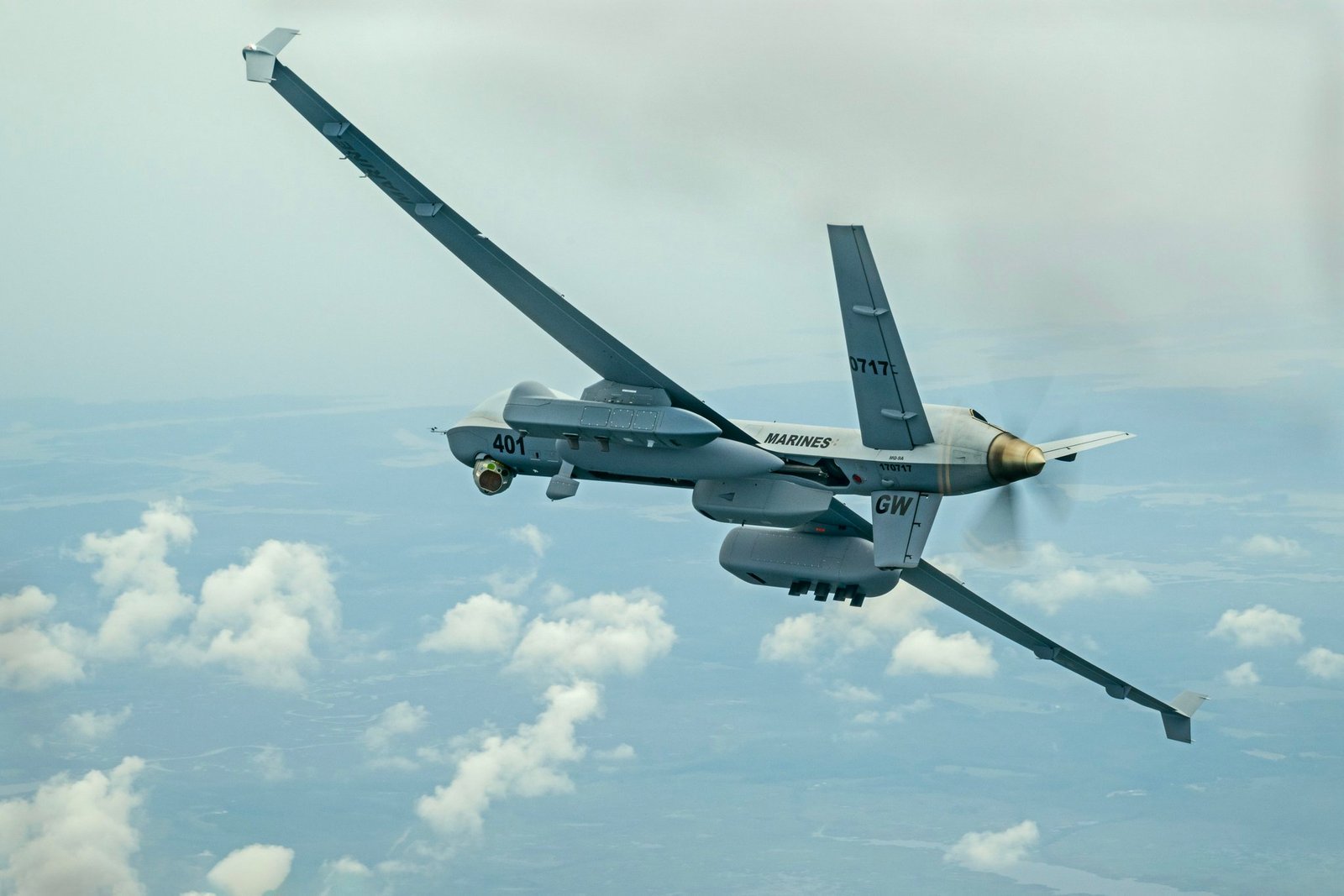
Sensors. The baseline Reaper carries the Multi-Spectral Targeting System, a gimballed turret combining electro optical and infrared cameras with a laser designator and rangefinder. A synthetic aperture radar supports all weather targeting, and the system is associated with GBU-38 JDAM employment. Persistent video is the product that matters. Crews watch targets for hours, and the Kabul case below shows what that can and cannot guarantee. af
Algorithms. The airframe is highly automated in flight and far less so in targeting. Automatic takeoff and landing, waypoint navigation and lost link return procedures are standard features of this class of aircraft. Computer vision tools for object detection on drone video now sit alongside the system at the intelligence layer, which is where Palantir Project Maven enters the picture. The aircraft itself does not select targets. The analytic pipeline around it increasingly proposes them.
Human intervention in the kill chain. Every strike requires a rated pilot and a sensor operator, an intelligence analyst, a legal adviser and an authorising commander, with the exact chain depending on the theatre and the rules of engagement. In my analysis this is human in the loop control at the weapon level. It can still fail the test I set out on my stance page, where meaningful human control requires real understanding, real capacity to intervene and traceable responsibility. A crew watching a screen for hours, cued by algorithmic analytics, under pressure to act on a fleeting window, may be approving a conclusion they cannot independently verify. I wrote about why the term itself is so contested in The Global Shell Game: What Meaningful Human Control Actually Means.
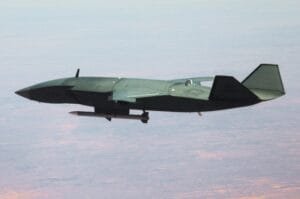
Why the Reaper matters for LAWS. The 2026 losses create a structural pressure toward autonomy. Jammed or severed data links are the Reaper’s weak point. A successor designed to be cheap, numerous and expendable will be built to operate when the link fails, and that is the design logic behind the MQ-28 Ghost Bat and the wider Collaborative Combat Aircraft family. The Reaper is the last mainstream armed aircraft where the human sits outside the airframe but still decides. The systems replacing it will test whether that remains true. US policy on this question sits in Department of Defense Directive 3000.09, updated in January 2023, which requires senior review of autonomous weapon systems and speaks of appropriate levels of human judgment over the use of force.
Legal analysis
International humanitarian law
The Reaper is lawful as a platform. Nothing about it is inherently indiscriminate or of a nature to cause superfluous injury. The legal questions arise in use. In an armed conflict the governing rules are distinction, proportionality and precautions in attack, codified in Articles 48, 51 and 57 of Additional Protocol I, and largely accepted as customary law even by states that are not party to the Protocol. The United States signed Additional Protocol I but has not ratified it. Article 36 requires states parties to review new weapons for legality, and the same logic reaches the algorithmic tools wrapped around a platform like this one. Attacks that intentionally target civilians, or that cause clearly excessive civilian harm, are war crimes under Article 8(2)(b)(i) and (iv) of the Rome Statute.
Jus ad bellum
The Reaper’s most contested legal use has been strikes outside active hostilities. Article 2(4) of the UN Charter prohibits the use of force against another state’s territorial integrity, and Article 51 preserves self defence against an armed attack. States have relied on consent from the territorial state, or on the contested “unwilling or unable” doctrine, which has no settled basis in the Charter.
The clearest test case is the killing of Iranian General Qassem Soleimani by a Reaper near Baghdad airport on 3 January 2020. UN Special Rapporteur Agnes Callamard concluded in report A/HRC/44/38 that the strike was unlawful absent an actual imminent threat to life, and that the US had offered no evidence of one. She also found that killing him on Iraqi soil without Iraq’s consent violated Iraq’s territorial integrity. The United States rejected the findings forcefully. The legal disagreement remains unresolved, and as I discuss below, the precedent has since been absorbed into practice. pressreaderipis
Human rights law and the UN mandate holders
Outside armed conflict, targeted killing is judged under the right to life in Article 6 of the ICCPR, which permits lethal force only as a last resort against an imminent threat. UN Special Rapporteurs have pressed this point for more than a decade: Philip Alston (2010), Christof Heyns (2013, A/68/382), Ben Emmerson (2014, A/HRC/25/59) and Callamard (2020). Their reports consistently identify the same gaps: opaque legal standards, weak investigation and little accountability.
Case law and accountability
Al-Aulaqi v. Obama, 727 F. Supp. 2d 1 (D.D.C. 2010). The father of a US citizen targeted in Yemen sought to challenge the targeting. The court dismissed the case on standing and political question grounds without deciding whether the targeting was lawful. Anwar al-Awlaki was killed in September 2011, and his sixteen year old son Abdulrahman died in a separate strike weeks later.
New York Times Co. v. DOJ, 756 F.3d 100 (2d Cir. 2014). The Second Circuit ordered release of a redacted Office of Legal Counsel memorandum justifying the Awlaki killing. The case matters because it exposed how thin the public legal record behind lethal drone policy had been.
The Ramstein litigation in Germany. The bin Ali Jaber family sued Germany over the role of the Ramstein airbase in relaying data for US drone operations after the 2012 Khashamir strike in Yemen. The Münster court found in 2019 that Germany had a constitutional duty to protect those affected, the Federal Administrative Court overturned that in 2020, and the Federal Constitutional Court ruled on 15 July 2025 that the government was not required to act. The courts accepted that a duty to protect foreign nationals abroad can exist in some cases while leaving the government a wide margin in assessing a partner’s compliance. That is a significant ruling for every European state hosting infrastructure used in remote warfare. The case concerned US armed drone operations broadly, not a single platform. ecchr
Peshawar High Court, 2013. The court held that US drone strikes in Pakistan’s tribal areas were illegal, a judgment that had no practical effect on the operations.
Kabul, 29 August 2021. This is the case I return to most often. A Hellfire strike on a vehicle that had been watched for eight hours killed Zemari Ahmadi, an aid worker, and members of his family. Ten family members died, seven of them children. The Pentagon later said no personnel would face disciplinary action. Eight hours of persistent video did not prevent the error. I read it as a warning about any assumption that more sensor time yields better judgment, because the same assumption underlies the argument that automated analytics will make targeting safer. www.npr.org
UK practice. The 2015 RAF Reaper strike that killed British national Reyaad Khan in Syria, outside any authorised UK operation in that territory, prompted a 2016 report by the Joint Committee on Human Rights on the government’s policy on drones for targeted killing. It remains a useful public record of how a democratic state justified such a strike and what Parliament found lacking.
International relations implications
Targeted killing is normalised. The Reaper made it routine for states to kill named individuals across borders without troops on the ground. Soleimani extended that practice to a serving senior official of a state, and once that threshold has been crossed by one state, others will cite it. Every state that develops this capability, including Turkey, China and Iran, inherits the legal arguments the US built.
Proliferation. The MQ-9B is sold abroad, and rivals sell cheaper armed drones of their own. The restraint regimes governing exports have been loosened over time. My concern is a world where armed drone capability is common and the legal standards governing it remain those of one dominant user.
The end of permissive airspace. The Houthi, Black Sea and Iran war losses show that the Reaper’s model depends on uncontested skies. The strategic response is attritable mass, which means many cheaper, more autonomous platforms. That response moves the system toward the capabilities this database exists to track, and it makes the November 2026 diplomatic moment more urgent.
Sovereignty and the Global South. Reaper operations have fallen overwhelmingly on states in Africa, the Middle East and South Asia, often without clear consent and almost never with accountability. A state’s ability to object early matters here. This is the logic behind the Anticipatory Objection Registry I set out in my research and on my stance page: states should register objections to emerging practices before permissive customary norms harden around them.
The treaty moment. On 5 September 2026 the CCW Group of Governmental Experts reached consensus among 128 states on a document addressing lethal autonomous weapons systems, though critics argue major military powers weakened it. France has said the report clarifies the notion of human control and judgment, and that the Review Conference must decide next steps. The UN Secretary General and the ICRC jointly called on 25 August for the November conference to begin negotiating a binding instrument. The ICRC has urged states to use the Review Conference to launch negotiations on a new protocol. The GGE has deliberated since 2014, and I have said plainly on my site that this record is a diplomatic failure. A text agreed by consensus is progress. It is also non binding. States reach agreement on autonomous weapons regulations in Geneva
My assessment
I do not think the Reaper should be treated as a closed chapter. It shows what happens when a powerful technology is adopted before its legal framework is settled. The law on targeted killing remains contested more than twenty years after the first strikes, the accountability record is poor, and the doctrines that excuse it were built by the user, for the user. That is the template I fear for autonomous weapons, where the same dynamics will play out faster and with less human involvement.
I am not against military technology that reduces risk to aircrew or improves discrimination. I am for accountability, and I explain why in my AI stance and in my story. My work at UNIDIR in Geneva and with the Campaign to Stop Killer Robots rests on the view that meaningful human control has to be designed in and written into law, and cannot be retrofitted once a system has proved militarily useful. For the wider risk picture, see my AI safety page, my research, and the AI Policy Tracker.
Frequently asked questions
Is the MQ-9 Reaper an autonomous weapon?
No. It is remotely piloted, and a human crew authorises each weapon release. It is highly automated in flight, and the analytic tools around it increasingly propose targets, which is why it matters for the autonomy debate.
How many MQ-9 Reapers has the US lost in the Iran war?
Press reports citing US government sources put the figure at about 45 as of mid August 2026, roughly a quarter of the fleet. The Air Force has not officially disclosed a number.
Are Reaper strikes legal?
It depends on the context. Strikes in armed conflict are judged under international humanitarian law. Strikes outside armed conflict are judged under human rights law and the UN Charter, where several UN Special Rapporteurs have found practice lacking, including Callamard on the Soleimani killing.
What is the MQ-9 Reaper’s endurance and payload?
About 27 hours and roughly 3,750 lb according to Air Force figures. General Atomics cites a slightly higher payload.
What replaces the Reaper?
The MQ-9B in the near term and the Massed Modular Aircraft programme in the longer term, both subject to funding decisions in Congress.
Sources
Manufacturer website: General Atomics Aeronautical Systems, MQ-9A Reaper (verify link before publishing)
Official and government documentation
- US Air Force fact sheet, MQ-9 Reaper
- Congressional Research Service, Air Force MQ-9A Reaper: Background and Issues for Congress (23 September 2026)
- UN Special Rapporteur Callamard, A/HRC/44/38 (2020)
- Heyns, A/68/382 (2013); Emmerson, A/HRC/25/59 (2014); Alston, A/HRC/14/24/Add.6 (2010)
- France, GGE communiqué (10 September 2026)
- UNODA, CCW GGE LAWS briefing
- ICRC, Autonomous Weapons advocacy paper (June 2026)
- Department of Defense Directive 3000.09 (updated January 2023)
News and analysis
- Breaking Defense, After concerning losses, Air Force pushes to replace Reaper faster (September 2026)
- DefenseScoop, Air Force moves to accelerate effort to replace MQ-9 Reaper (4 September 2026)
- Military Times, Heavy losses of MQ-9 Reaper to factor in future plans (28 September 2026)
- Military Times, Houthi claim on Reaper shootdown (November 2024)
- ECCHR, Germany is not required to prevent US drone missions in Yemen (15 July 2025)
- NPR, Pentagon calls Kabul drone strike a tragic mistake (2021)
- CBS News, No troops will be charged in Kabul strike
- Al Jazeera, Death by drone: How can states justify targeted killings? (2020)
- Reaching Critical Will, CCW Report (January 2026)
- Reaching Critical Will, Report of the CCW Meeting of High Contracting Parties (November 2025)
Treaties, statute and case law
- Additional Protocol I to the Geneva Conventions, Arts 1(2), 36, 48, 51, 57 (ICRC database)
- UN Charter, Arts 2(4) and 51; ICCPR, Art 6; Rome Statute, Art 8(2)(b)(i) and (iv)
- ICJ, Legality of the Threat or Use of Nuclear Weapons, Advisory Opinion (1996)
- UNGA Resolution 78/241 (2023) on lethal autonomous weapons systems
- Al-Aulaqi v. Obama, 727 F. Supp. 2d 1 (D.D.C. 2010)
- New York Times Co. v. DOJ, 756 F.3d 100 (2d Cir. 2014)
- Bin Ali Jaber v. Germany: OVG Münster (2019), BVerwG (2020), BVerfG (15 July 2025)
- UK Joint Committee on Human Rights, The Government’s policy on the use of drones for targeted killing (2016)

Avi is a researcher educated at the University of Cambridge, specialising in the intersection of AI Ethics and International Law. Recognised by the United Nations for his work on autonomous systems, he translates technical complexity into actionable global policy. His research provides a strategic bridge between machine learning architecture and international governance.