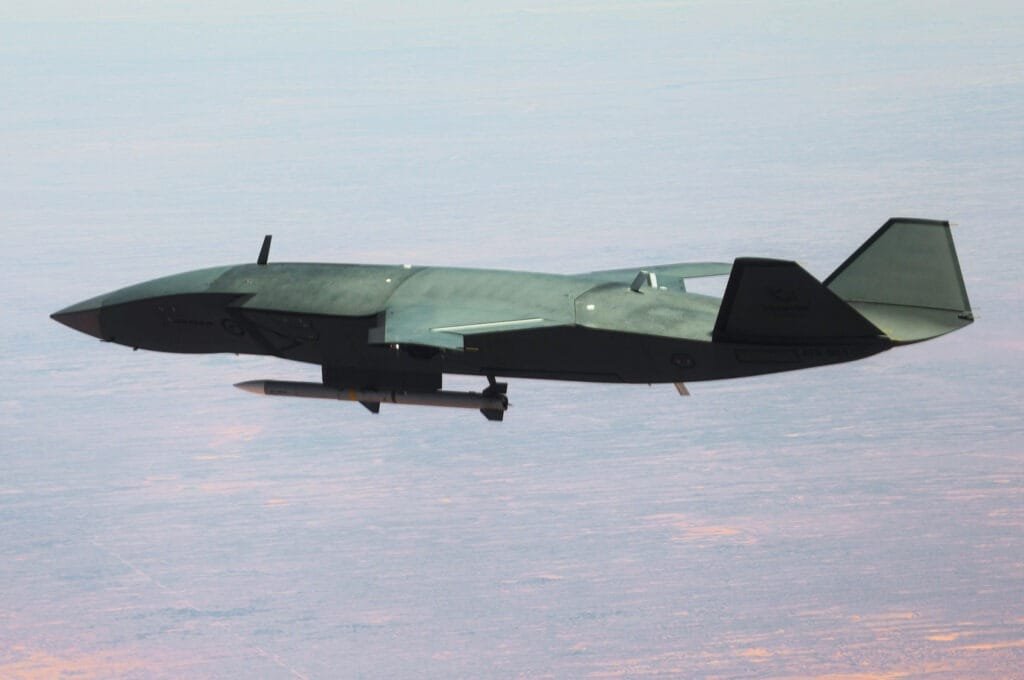
MQ-28 Ghost Bat
MQ-28 Ghost Bat: Technical Dossier & Legal Analysis
Lead Paragraph: The MQ-28 Ghost Bat is an autonomous Unmanned Combat Aerial Vehicle (UCAV) developed by Boeing Australia, designed to act as a “loyal wingman” for manned fighter jets. By leveraging advanced artificial intelligence to fly, manoeuvre, and execute complex tactical missions in formation with human pilots, the Ghost Bat represents a critical inflexion point in aerial warfare. However, its delegation of high-speed, multi-domain sensor processing to an algorithm threatens to dangerously compress the kill chain, diluting the accountability of the human pilot who ostensibly commands it.
⚙️ Technical Specifications & Capabilities
| Parameter | Specification |
| Manufacturer | Boeing Australia |
| State Actor / Primary User | Royal Australian Air Force (RAAF), United States Air Force (USAF – Testing) |
| System Type | Loyal Wingman / Unmanned Combat Aerial Vehicle (UCAV) |
| Dimensions / Footprint | 11.7 meters (38 feet) length |
| Payload / Output | Modular payload nose system (swappable ISR sensors, electronic warfare suites, potential kinetic payloads) |
| Operational Range / Scale | ~3,700 km (2,000+ nautical miles) |
Algorithmic Architecture & Autonomy
The Ghost Bat’s “brain” is built on a decentralised AI architecture designed for “teaming” rather than remote teleoperation. It does not rely on a human flying it with a joystick from a ground station; instead, a pilot in an accompanying manned aircraft (such as an F-35 or F/A-18F Super Hornet) issues high-level, commander-intent directives (e.g., “screen this sector,” “jam that radar”). The Ghost Bat’s onboard AI autonomously translates these broad commands into specific flight paths, threat avoidance manoeuvres, and sensor allocations.
To achieve this, the system relies on a proprietary AI framework that fuses data from its modular nose payloads. These swappable modules can include active electronically scanned array (AESA) radars, infrared search and track (IRST), and electronic warfare sensors. The machine learning models process this multi-domain telemetry in real-time, effectively creating a localised, autonomous neural network that assesses the battlespace and feeds targeting data back to the manned lead aircraft.
In the terminal phase of the kill chain, current operational doctrine dictates a “human-in-the-loop” (HITL) failsafe, where the manned pilot must authorise any lethal strike. However, the system’s architecture is explicitly designed to rapidly process targets at machine speed. As aerial engagements occur faster than human cognition can manage, the cognitive burden shifts entirely to the AI. This dynamic effectively makes the human pilot a rubber-stamp on an algorithmic targeting solution, rather than an active participant in deliberate target verification, paving the way for fully autonomous engagements should policy restrictions be lifted.
🔗 Deployment History & OSINT Verification
The MQ-28 Ghost Bat is the first military aircraft to be designed and manufactured in Australia in over 50 years. It completed its maiden flight at the Woomera Test Range in South Australia in February 2021. Since then, the RAAF has steadily expanded its testing program, validating the system’s autonomous flight capabilities, formation flying, and sensor integration. Open-source intelligence and defence procurement records also verify that the United States Air Force (USAF) has acquired prototypes to evaluate within its broader Collaborative Combat Aircraft (CCA) and Next Generation Air Dominance (NGAD) initiatives, signalling an imminent transition from isolated testing to active deployment in Indo-Pacific theatre strategies.
⚖️ Legal Status & IHL Implications
- Article 36 Compliance: Pending Review. While Australia maintains internal legal review processes for new weapons, there is no public transparency regarding whether the specific machine learning models dictating the Ghost Bat’s autonomous threat-sorting have passed independent scrutiny under Article 36 of Additional Protocol I to the Geneva Conventions.
- Principle of Distinction: The Ghost Bat struggles with the Principle of Distinction primarily due to sensor abstraction and automation bias. If an AI wingman misclassifies a civilian airliner or non-combatant infrastructure as a hostile electronic or visual signature, it feeds that corrupted data to the human pilot. The pilot, operating under the extreme cognitive load of supersonic combat, lacks the time to independently verify the AI’s data, resulting in kinetic strikes based on algorithmic errors or spoofed data.
- Algorithmic Complicity / Human Rights: By design, the “loyal wingman” concept diffuses legal accountability. If an MQ-28 contributes to a war crime by unlawfully identifying a target, the complex neural network driving the drone obscures liability. The human pilot can claim reliance on flawed machine intelligence, while the manufacturer invokes combat conditions or “black box” unpredictability. This creates a vacuum of accountability that facilitates algorithmic atrocities without individual consequence.
Closing Thought: The imminent deployment of “loyal wingman” platforms like the MQ-28 Ghost Bat necessitates an immediate, legally binding international framework to prevent the lethal delegation of high-speed combat decision-making to unaccountable algorithms.

Avi is a researcher educated at the University of Cambridge, specialising in the intersection of AI Ethics and International Law. Recognised by the United Nations for his work on autonomous systems, he translates technical complexity into actionable global policy. His research provides a strategic bridge between machine learning architecture and international governance.