Norinco Fuxi and NUDT Combat Humanoids
Norinco Fuxi and NUDT Combat Humanoids: Technical Dossier and Legal Analysis
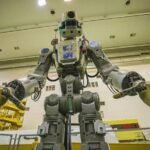
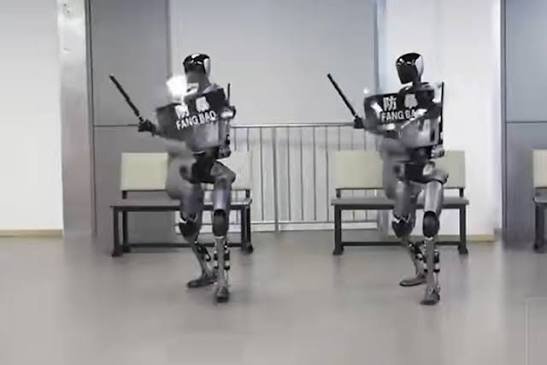
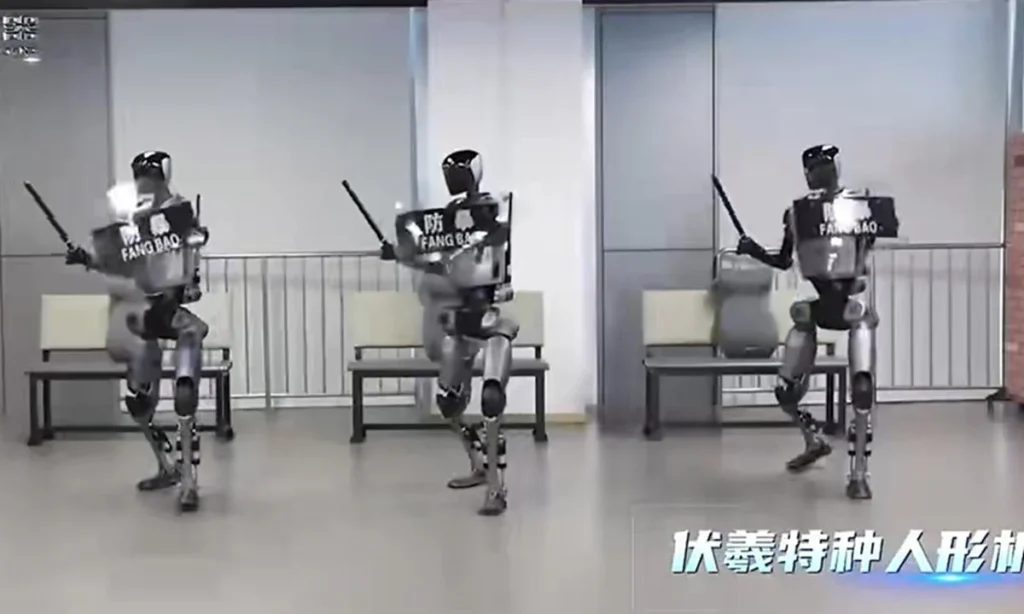
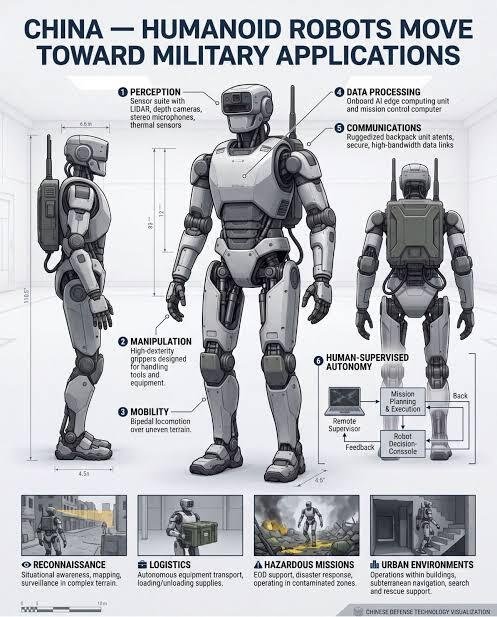
The Fuxi is a full-size humanoid robot unveiled in August 2026 by Norinco Group, the Chinese state-owned defence conglomerate formally known as China North Industries Group Corporation. Norinco says it can conduct reconnaissance, patrol and operations in hazardous areas while a human operator controls its movements remotely, and company materials describe sentry duty and all-weather reconnaissance among its roles. Alongside it sits a separate effort that I have grouped here because the two fit together. The National University of Defense Technology (NUDT), the PLA’s premier research institution, has been framing humanoids as battlefield tools and modelling robot assault teams. The Fuxi is the first clear hardware example from China’s defence industry, and the NUDT work is the doctrine that tells us what it is for. No armed humanoid has been shown in service. I treat both as signals of intent whose capability remains unproven. defensemirror, U.S. News & World Report
Key takeaways
- The Fuxi is a teleoperated avatar. Each robot reproduces a human operator’s movements in real time, and Norinco has not published detailed specifications beyond a weight of about 90 kg. defensemirror
- “NUDT combat humanoids” describes a programme of competitions, papers and procurement notices. I found no named NUDT platform.
- Reuters found no evidence that China has deployed an armed humanoid with an operational PLA unit as of 7 September 2026. tribune
- China’s defence ministry said on 11 March 2026 that human primacy must be upheld in military AI and that relevant weapon systems must be under human control. The Fuxi’s teleoperation design is consistent with that line, and the formation mode and PLA commentary on firing authority test it. chinadailyhk
- The CCW Seventh Review Conference meets in Geneva from 16 to 20 November 2026.
Basic Weapon Facts
I. Background
| Field | Detail |
|---|---|
| Manufacturer | Norinco Group (China North Industries Group Corporation), Beijing, China. The Fuxi was developed by Norinco’s innovation institute. |
| Suppliers | Unknown. Norinco says the robot uses fully domestically developed technologies. |
| Country of origin | China |
| Developmental stage | Unveiled and demonstrated. Fuxi was to be shown at the 2026 World Robot Conference in Beijing, where Norinco led an exhibition area for central state-owned enterprises. In service: Unknown, and no evidence of it |
| System version | Fuxi (first generation). NUDT programme: no platform designation published |
| System type | Full-size humanoid robot, teleoperated avatar with some autonomous functions China’s NORINCO Unveils “Fuxi” Humanoid Battlefield Robot |
II. General Specifications
| Parameter | Specification |
|---|---|
| System dimensions | Unknown (described only as full size) |
| Weight | About 90 kg |
| Max payload | Unknown |
| Max operating time | Unknown |
| Max operating distance/reach | Unknown. Teleoperation link type and range not disclosed |
| Max speed | Unknown |
| Control | Human motion sensing, movement transfer between platforms and whole body coordination, using homegrown technologies |
| Sentry functions | Personnel identification and alerts in abnormal situations |
| Unit cost | Unknown NORINCO Unveils Special Purpose Humanoid Robot Fuxi and Telepresence Avatar Technology |
The table is thin because Norinco has chosen to disclose little. One report says Norinco has not disclosed detailed specifications, and the same applies to the NUDT work, which Reuters could only reconstruct from tenders, papers and university web pages. nextgendefense
Origins and history
Norinco. Norinco is one of China’s largest defence groups, with products ranging from armoured vehicles and artillery to small arms and ammunition. Its record on arms transfers is long. In May 2003 the United States imposed sanctions that barred its exports to the US, the first time a Chinese firm had been barred from exporting to the United States under such measures, over transfers to Iran that the US said could help missile development. The State Department called Norinco a serial offender on such transfers. I mention this because a company with that history now sells a humanoid body, and the question of who might buy it is not abstract. I covered another Norinco ground system in my Sharp Claw entry. washingtontimesdefenseindustrydaily
The name. Fuxi is a figure from Chinese mythology, a legendary culture hero credited with teaching people the arts of civilisation. I leave the choice to speak for itself.
NUDT. NUDT is the PLA’s leading military university, sometimes called the Military Tsinghua, and in 2000 its Changsha team completed Xianxingzhe, China’s first bipedal humanoid robot. In 2017 it absorbed five PLA colleges, consolidating military technical education. The institution has been in the humanoid business for a quarter of a century. National University of Defense Technology
The humanoid turn, 2024 to 2026. Reuters reconstructed the sequence from more than 100 military procurement notices, studies, patents and company materials:
- In 2024 NUDT and the Academy of Military Sciences hosted a defence technology forum with a session on military applications for humanoid systems. yahoo
- A June 2025 NUDT competition featured an event simulating infiltration behind enemy lines, in which robots had to enter an area, map it and locate targets, and the university described the competition partly as a proving ground for humanoids to eventually move toward the battlefield. yahoo
- In May 2025 the PLA tendered for a humanoid robot with installation and training, and four months later a notice listing an NUDT contact sought an embodied humanoid intelligent perception and dexterous operation system. yahoo
- An August 2025 paper from NUDT’s test centre in Xi’an modelled an urban assault force of six combat robots split between two assault teams, clearing a building floor by floor and room by room. It projected equipment available within five to ten years and did not specify rules of engagement, weapons or the handling of civilians. insideaiyahoo
- In June 2026 the PLA budgeted about $300,000 for a system to collect and label camera, radar, motion and terrain data for humanoids. oafnation
- In the days after the 2026 World Humanoid Robot Games, PLA Daily called for faster transfer of the technology to training grounds for robotic combatants, and a July 2025 PLA Daily article argued that humanoid missions could evolve from supporting combat toward primary combat and discussed authorising robots to fire on a living target verified by a human.
What is missing. Reuters could not determine whether the tenders were filled or which firms won. Reuters is explicit that current humanoids remain energy intensive and unreliable outside controlled demonstrations. I would not claim anything stronger.
Autonomy: a forensic analysis
Sensors. The Fuxi’s published sensing is about people. It can identify personnel and issue alerts in abnormal situations during sentry duty. The method of identification, whether by face, gait, badge or thermal signature, and the database behind it are not disclosed. The operator interface is also a sensor system, built on human motion sensing and movement transfer. defensemirrornextgendefense
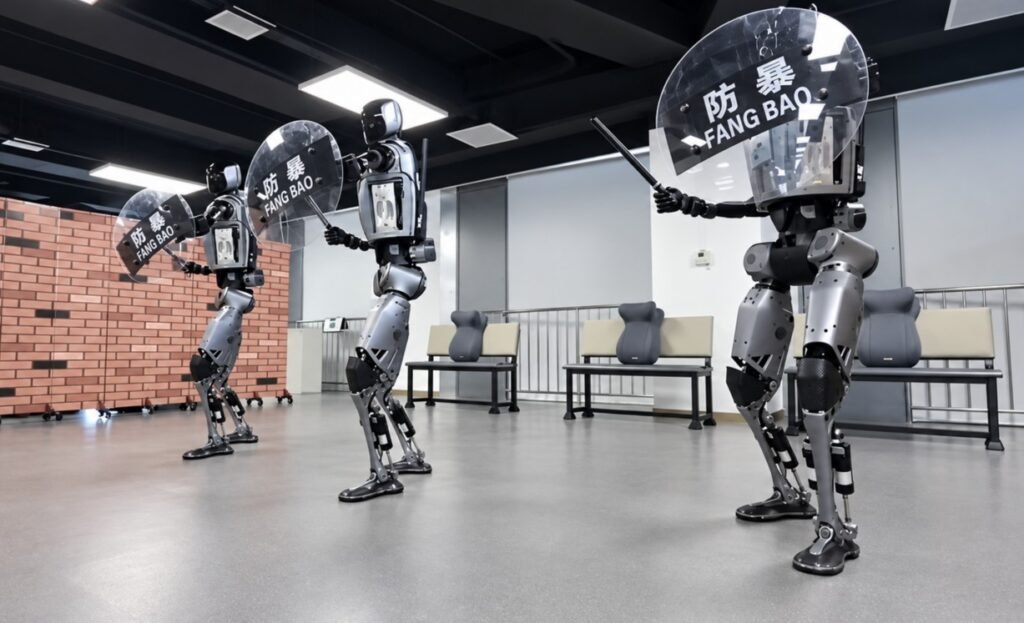
Algorithms. The core of the system is motion retargeting, in which the operator’s body movements are mapped onto a robot of different proportions in real time. The robot can also work independently or in coordination with other Fuxi units, forming a squad for patrolling or other functions. The software that decides how it patrols alone, and what triggers an alert, is Unknown. defensemirror
Human intervention in the kill chain. There is no kill chain in the published design. The teleoperation model is, on its face, the strongest form of human control available, because a person’s own movements drive the machine. If a Fuxi ever held a weapon, the operator’s hand would operate the trigger, and no model decides to fire. I think that deserves to be said clearly, because most of the humanoids in this series have been criticised for the opposite reason. Two features qualify it. First, teleoperation introduces requirements for reliable communications and sustained operator awareness, and leaves the system open to electronic warfare and communication disruption. Second, the formation and independent modes mean one operator may supervise many robots, which is where control thins out. I discuss the logic of link loss in my MQ-9 Reaper entry, where it pushed a remotely piloted aircraft toward successors that can act when the link fails. The same pressure will apply to the Fuxi in any contested environment. humanoidtechtimes
What the NUDT concept adds. The assault paper describes humanoids, robot dogs or unmanned vehicles working with troops to clear rooms. It does not say who decides to fire on whom. The PLA Daily’s discussion of authorising a robot to fire on a target that a human has verified points toward a semi-autonomous model, in which the human confirms and the machine acts. That is a different thing from the teleoperation avatar, and the two models should not be conflated.
Classification. On the public record the Fuxi is a teleoperated humanoid for reconnaissance and sentry duty, and it is not a weapon or a lethal autonomous weapon system. The NUDT work is research and doctrine. I include both because the Chinese state’s defence industry and military academy have now each shown their hand, which makes this the most institutionally serious humanoid militarisation effort in the series. For the commercial platforms underneath see my Unitree H1 and H2 entry, and for the US counterparts see the IHMC Alex entry and the Foundation Phantom entry.
Legal analysis
Weapons review and the lack of visibility
China is a party to Additional Protocol I, so Article 36 obliges it to review new weapons. A West Point Lieber Institute analysis notes that Beijing offers precious little visibility into those review processes. The Fuxi illustrates the problem. A humanoid whose software mode, sensing method and payload are all undisclosed cannot be assessed from outside, and no one has said whether it has been assessed from inside. westpoint
Distinction and the reasonable commander standard
The NUDT concept puts robots in front of troops in occupied buildings, where Articles 48, 51 and 57 and Article 41 on persons hors de combat are hardest to apply. A teleoperated robot makes the legal question one about the operator’s information. In Prosecutor v. Galić, IT-98-29-T (ICTY, 2003), the Trial Chamber said that proportionality in attack is judged by what a reasonably well-informed person in the perpetrator’s position, making reasonable use of the information available, could have expected. I cite it from memory and recommend checking the paragraph. A remote operator sees what the robot’s cameras show, with latency, a narrow field of view and no sense of smell, sound or the feel of a room. That is a thinner information position than a soldier standing in the doorway, and I think a court applying the Galić test would have to account for it. Remote warfare has always raised that issue. A humanoid body in a building raises it at close range.
Automated identification and sentry duty
The sentry role, in which the robot identifies personnel and issues alerts, raises its own questions. Automated identification of people engages privacy and the right to life if the alert can lead to force. The UN Human Rights Committee’s General Comment 36 of 2018 addresses new weapons and the right to life under Article 6 of the ICCPR, and I cite it from memory. China signed the ICCPR in 1998 and has not ratified it, so the treaty does not bind it directly, and I would say so plainly. The comparison I find most useful is the Samsung SGR-A1 sentry gun deployed on the Korean border, which also identified targets and was designed with a human decision step. The Fuxi differs in having a humanoid body that can approach, speak and, in principle, restrain. I regard the armed sentry question as the one to watch.
Exports, sanctions and state responsibility
Norinco’s sanctions history, described above, sets the context for any export of Fuxi variants. I understand Norinco Group to be on the US Department of Defense’s Section 1260H list of Chinese military companies, which I cite from memory and recommend verifying. Articles 6 and 7 of the Arms Trade Treaty require exporting states to assess the risk of serious violations of humanitarian and human rights law, and China acceded to the treaty in 2020, which I also cite from memory. A teleoperated humanoid sold to a government with a record of internal repression is a transfer where that assessment would matter. The ILC Articles on State Responsibility add Article 16 on aid and assistance, and Common Article 1 of the Geneva Conventions adds a duty to ensure respect for the law.
Accountability
Article 28 of the Rome Statute on command responsibility would reach superiors of a robot operator in principle, though China is not a party to the Statute. The operator is a PLA soldier and a lawful combatant, so there is no direct participation problem of the kind that arises for civilian contractors. The accountability gap is a practical one, as it is in most military systems. It lies in a state that publishes nothing about its reviews, rules of engagement or investigations.
International relations implications
Institutionalisation. The significant fact is who is now involved. The Unitree story in my H1 and H2 entry is one of a commercial firm with military shadows. The Fuxi is a state-owned defence prime, building its own humanoid and showing it at an exhibition it leads for central state enterprises. That tells me humanoids have moved from academic curiosity to defence industrial planning.
Declaratory policy and doctrinal drift. China’s public line is consistent. On 11 March 2026 the defence ministry spokesman said all relevant weapon systems must be under human control, and criticised giving algorithms the power to determine life and death. China told the UN General Assembly’s First Committee in 2024 that weapon systems should remain under human control and that the CCW is the most appropriate forum. The Lieber analysis describes a two-tier approach of prohibiting unacceptable fully autonomous systems and regulating the rest to ensure appropriate human involvement, and warns against reading China as a defender of IHL against military AI. China’s 2016 position paper called for a strict definition of the human role and said it should not be replaced by vague concepts such as meaningful human control. The March statement was a response to US reports, and it illustrates that human control has become a rhetorical weapon in the great power relationship as well as a legal standard. The PLA commentary on robots primary in combat and firing authority sits in tension with it, though the two can be reconciled if verification by a human remains the rule. Published: 18:18, March 11, 2026
The Taiwan dimension. The PLA Eastern Theater Command released an AI-generated montage in December showing robots, including humanoids and quadrupeds, overwhelming Taiwan’s defences. An urban assault concept, a propaganda montage and a state defence prime’s humanoid together shape how Taiwan and its partners read Chinese intent. A Taiwanese analyst quoted by Reuters notes that humanoids could suit buildings, tunnels and ship interiors, while simpler platforms remain cheaper for most tasks. I think that is the right sober assessment, and it also shows why cheap robots may be the more consequential development. tribune
A mirror with the United States. The US Army has run its own xTechHumanoid competition, which I cover in the Alex entry, and an American company openly courts weapon use in the Phantom entry. Both powers describe human control as their policy, and both are building the bodies. I do not think either can credibly lecture the other.
Teleoperation as an arms control idea. The Fuxi suggests an option I find interesting. If the norm were that armed humanoids must be teleoperated, with one operator per armed robot and a physical link between the operator’s movements and every use of force, it would give states a concrete, checkable rule that goes beyond slogans about human control. It would also give inspectors something to ask about: the operator-to-robot ratio, the latency and the interface. I offer this as my own proposal, and I recognise the verification problems.
The treaty moment. On 5 September 2026 the CCW Group of Governmental Experts reached consensus among 128 states on a document addressing lethal autonomous weapons systems, though critics argue major military powers weakened it. France says the text clarifies human control and judgment and that the Review Conference must decide next steps. The UN Secretary General and the ICRC jointly called on 25 August for the November conference to begin binding negotiations, and the ICRC urges states to launch negotiations on a new protocol. I recall that China abstained on UN General Assembly resolution 78/241 in 2023, and I flag that for verification. China’s stated support for human control is the sort of commitment negotiations could test, and the Fuxi gives delegates a concrete system to ask about.
My assessment
The Fuxi is the humanoid in this series that I find hardest to dislike on design grounds and hardest to ignore on principle. A soldier’s own movements, copied by a machine at a distance, is the oldest dream of remote warfare. It keeps a human at the controls, it avoids the unpredictable software that worries me in other systems, and it would be a defensible basis for a rule. If I could write one sentence into the next protocol, I might well choose something close to it.
What troubles me is the distance. A machine that carries your body into a room while you sit elsewhere removes the physical risk that has always disciplined the decision to enter. I worry less about the robot’s judgment than about the operator’s. A reasonable person in a doorway feels fear, and fear is information. A reasonable person at a console may not. That is a moral question as well as a legal one, and the law has not caught up with it.
I also notice what we do not know. A state-owned defence firm has shown a humanoid and told us almost nothing about it. A military university has modelled robot assault teams and left out rules of engagement, weapons and civilians. I would ask China to say how it reviews such systems under Article 36, to define what human control means in its own doctrine, and to bring the answer to Geneva in November. My position is the one on my stance page. Meaningful human control has to be specified, attached to identifiable people, and written into law that binds every state. I explain how I came to this work in my story, the wider risks are on my AI safety page, and I track the response in my research and the AI Policy Tracker. See also my article on meaningful human control.
Frequently asked questions
What is the Norinco Fuxi?
A full-size, roughly 90 kg humanoid robot unveiled by China’s state-owned defence group Norinco in August 2026. It is controlled by a human operator whose movements it reproduces, and it is designed for reconnaissance, patrol and sentry duty.
Is the Fuxi armed?
Norinco has not disclosed any armament. No armed Fuxi has been shown.
What are the NUDT combat humanoids?
Not a single system. NUDT, the PLA’s leading military university, has run humanoid competitions, published an urban assault concept with robot teams, and appears in procurement notices for humanoid perception and manipulation systems.
Has China deployed armed humanoid robots?
Reuters found no evidence of an armed humanoid with an operational PLA unit as of 7 September 2026.
What is China’s position on autonomous weapons?
China says weapon systems should remain under human control and that the CCW is the right forum. Analysts note that China prefers a strict definition of human involvement to the term meaningful human control.
Sources
Manufacturer website: Norinco Group (Fuxi announcement came via Global Times and Norinco materials)
News reports and investigations
- Reuters via The Express Tribune, From dance floor to war: China readies humanoid robots for combat (7 September 2026)
- Reuters via US News, From Dance Floor to War: China Readies Humanoid Robots for Combat
- Defense Mirror, China’s NORINCO Unveils “Fuxi” Humanoid Battlefield Robot
- The AI Insider, China’s State-owned Defence Company Norinco Unveils Humanoid Robot (24 August 2026)
- NextGen Defense, China Develops Fuxi Humanoid That Copies Soldiers’ Moves in High-Risk Zones
- Humanoid Guide, China accelerates research into military humanoid robots
- Humanoid Guide, China expands military research programs for humanoid robots
- Clash Report, China Accelerates Plans to Put Humanoid Robots on the Battlefield (8 September 2026)
- Al Jazeera archive, US slaps sanctions on Chinese, Iranian firms (2003)
- Washington Times, Norinco sanctions (23 May 2003)
- Defense Industry Daily, USA Sanctions 9 Firms Under Iran Nonproliferation Act
Government, military and diplomatic documentation
- Xinhua via China Daily HK, Human primacy must be upheld in military AI applications (11 March 2026)
- China Daily, China calls for human control over military AI to prevent risks (11 March 2026)
- PRC Ministry of Foreign Affairs, Statement at the First Committee, 79th UNGA (October 2024)
- PRC position paper to the CCW Fifth Review Conference (December 2016)
- Lieber Institute, West Point, Human Oversight with Chinese Characteristics (27 March 2026)
- ICRC, Autonomous Weapons advocacy paper (June 2026)
- France, GGE communiqué (10 September 2026)
- UNODA, CCW GGE LAWS briefing
- Reaching Critical Will, CCW Report (January 2026)
- National Defense Authorization Act for FY2021, Section 1260H; UN Human Rights Committee, General Comment 36 (2018)
Treaties, statute and case law
- Additional Protocol I, Arts 36, 41, 48, 51, 57 (ICRC database)
- Arms Trade Treaty, Arts 6 and 7
- Rome Statute, Art 28
- ICCPR, Arts 6 and 17; ILC Articles on State Responsibility, Art 16; Geneva Conventions, Common Article 1
- UNGA Resolution 78/241 (2023)
- Prosecutor v. Galić, IT-98-29-T (ICTY, 2003)

Avi is a researcher educated at the University of Cambridge, specialising in the intersection of AI Ethics and International Law. Recognised by the United Nations for his work on autonomous systems, he translates technical complexity into actionable global policy. His research provides a strategic bridge between machine learning architecture and international governance.