
The Governance Gap: UN’s 2026 Science and Technology Report
Every July, a fairly unglamorous document lands on the desks of UN Member State delegations. It has none of the drama of a Security Council resolution or the visibility of a climate summit. It is simply titled Current developments in science and technology and their potential impact on international security and disarmament efforts, and this year’s edition, A/81/246, released on 21 July 2026, is the most consequential one I have read in years.
I work on this material for a living, mostly on the lethal autonomous weapons file at the CCW in Geneva, and through my research with UNIDIR and the Campaign to Stop Killer Robots. So when a report like this lands, I read it the way a lawyer reads a new set of facts: not for what it says about any single weapon, but for what it says about the gap between what states can build and what states have actually agreed to govern.
The report covers seven areas: artificial intelligence and autonomy, uncrewed systems, digital technologies, biology and chemistry, space and aerospace, electromagnetic weapons, and materials science. Read individually, each section is a competent technical update. Read together, they describe something the report itself only gestures at in its final paragraphs: a set of technologies converging faster than the institutions meant to oversee them.

AI is no longer a single problem
The report opens with a definition worth sitting with. The UN’s newly formed Independent International Scientific Panel on AI, co-chaired by Turing Award recipient Yoshua Bengio and Nobel Peace laureate Maria Ressa, describes AI systems in its July 2026 preliminary report this way: “AI systems are machine systems that, broadly speaking, perceive, learn and act.” It’s a deliberately plain definition, and it needs to be, because the applications the Secretary-General’s report goes on to describe range from maritime security and humanitarian relief coordination to command-and-control systems that could, in the wrong configuration, shape life-or-death targeting decisions.
The report’s real concern isn’t capability. It’s data. Unreliable sensors, unrepresentative training data, information that goes stale before anyone notices- these aren’t abstract worries. They’re the exact failure modes that make an AI-enabled decision support system dangerous in ways a flawed human analyst is not: confidently wrong, at scale, and fast.
One detail stood out to me as genuinely encouraging. In describing a 2026 AI model capable of generating DNA sequences across a wide range of organisms, the report notes that its developers deliberately excluded sensitive virus sequences and ran additional safety testing before release. That’s safety built in at the design stage rather than bolted on afterwards, and it’s rare enough in this field that the Secretary-General thought it worth flagging as a model for others to follow.
On the governance side, the CCW’s Group of Governmental Experts on lethal autonomous weapons systems keeps grinding forward, still tasked with formulating, by consensus, the elements of a possible instrument. Three General Assembly resolutions on LAWS now exist, and Geneva hosted informal exchanges on military AI from 15 to 17 June 2026. Progress, but slower than the pace of deployment the rest of the report describes.
Drones did not wait for a treaty
The uncrewed systems section confirms what anyone following recent conflicts already suspects: aerial drones remain the dominant uncrewed platform, and states are increasingly able to build them domestically. That indigenous manufacturing capacity is quietly doing more to undermine export control regimes than any single arms transfer ever could, because it removes the choke point those regimes were built around.
The report also flags a shift toward swarm technology, driven partly by a practical concern: systems that depend on continuous communication links are vulnerable to the same electronic warfare tools described later in the report. Distribute the intelligence across many cheap units instead, and jamming one link stops mattering as much.
Existing governance here rests mostly on soft instruments: the 2017 Security Council resolution 2370, the Delhi Declaration, and the 2023 Abu Dhabi Guiding Principles, none of which bind states the way a treaty would.

Q-Day got closer, not further away
The digital technologies section is where I’d point a non-specialist reader first, because the quantum computing update is genuinely startling. The report cites new research showing that the resources needed to break RSA and elliptic curve cryptography have dropped by roughly an order of magnitude in under a year. One Quantum Insider analysis cited in the surrounding literature puts it starkly: factoring a 2048-bit RSA key once required an estimated 20 million qubits, and recent work suggests it may now take under a million, achieved through algorithmic improvements rather than new hardware.
That matters for reasons beyond cryptography trivia. Data encrypted today, including military and diplomatic communications, can be harvested now and decrypted later once a sufficiently capable quantum computer exists. The report is blunt about this: states are already playing a long game with information whose sensitivity has no expiry date.
The same section notes a less headline-grabbing but arguably more immediate trend. Through 2025, governments increasingly folded commercial AI and analytics platforms directly into defence, intelligence, and law enforcement operations, a shift that is blurring the line between civilian and security data environments and concentrating enormous analytical power inside vendor-controlled systems states do not themselves fully control.

The biology section is the one to watch
Biology and chemistry get less public attention than autonomous weapons, and I think that’s a mistake. The report describes an autonomous biotechnology laboratory, reported in 2025, capable of running full experimental cycles, culturing, measurement, analysis, hypothesis generation, without a human directing each step. That could accelerate legitimate vaccine and drug research considerably. It could also lower the expertise threshold for less benign work, which is precisely the dual-use dilemma that keeps biosecurity specialists up at night.
On the positive side, the report notes real momentum on DNA synthesis screening standards, and growing interest in using AI itself to help verify compliance with the Biological Weapons Convention. On the chemistry side, 2025’s Nobel Prize in Chemistry went to the development of metal-organic frameworks, porous materials with genuine humanitarian applications in water harvesting, alongside advances that are steadily dissolving the old line between chemistry and biology through synthetic cells built entirely from chemical components.
The risk side of that same convergence is spelt out plainly. AI tools that help design new compounds and select synthesis routes can be pointed at chemical weapons development just as easily as at chemical weapons defence, and cheap commercial drones remain a plausible delivery mechanism regardless of which side of that line an actor sits on.

Space is getting crowded, and a little tense
The space and aerospace section reads like a catalogue of capabilities that are individually defensible and collectively destabilising. Rendezvous and proximity operations, satellites manoeuvring close to other satellites, have entirely legitimate uses: inspection, refuelling, repair, debris removal. They also look, from the ground, indistinguishable from the early stages of an attack, which is why some states are now developing what the report calls “bodyguard satellites,” equipped with sensors and, in some cases, robotic arms or lasers, to defend their own assets.
More concerning are the unattributed allegations that one state has tested deploying an object in a high-radiation orbit, possibly connected to stationing nuclear weapons in space, alongside another state’s announced plans for a space-based missile defence system. Both would sit uneasily against the Outer Space Treaty’s prohibition on placing weapons of mass destruction in orbit.

Electronic warfare gets a brain, and a handheld railgun shows up
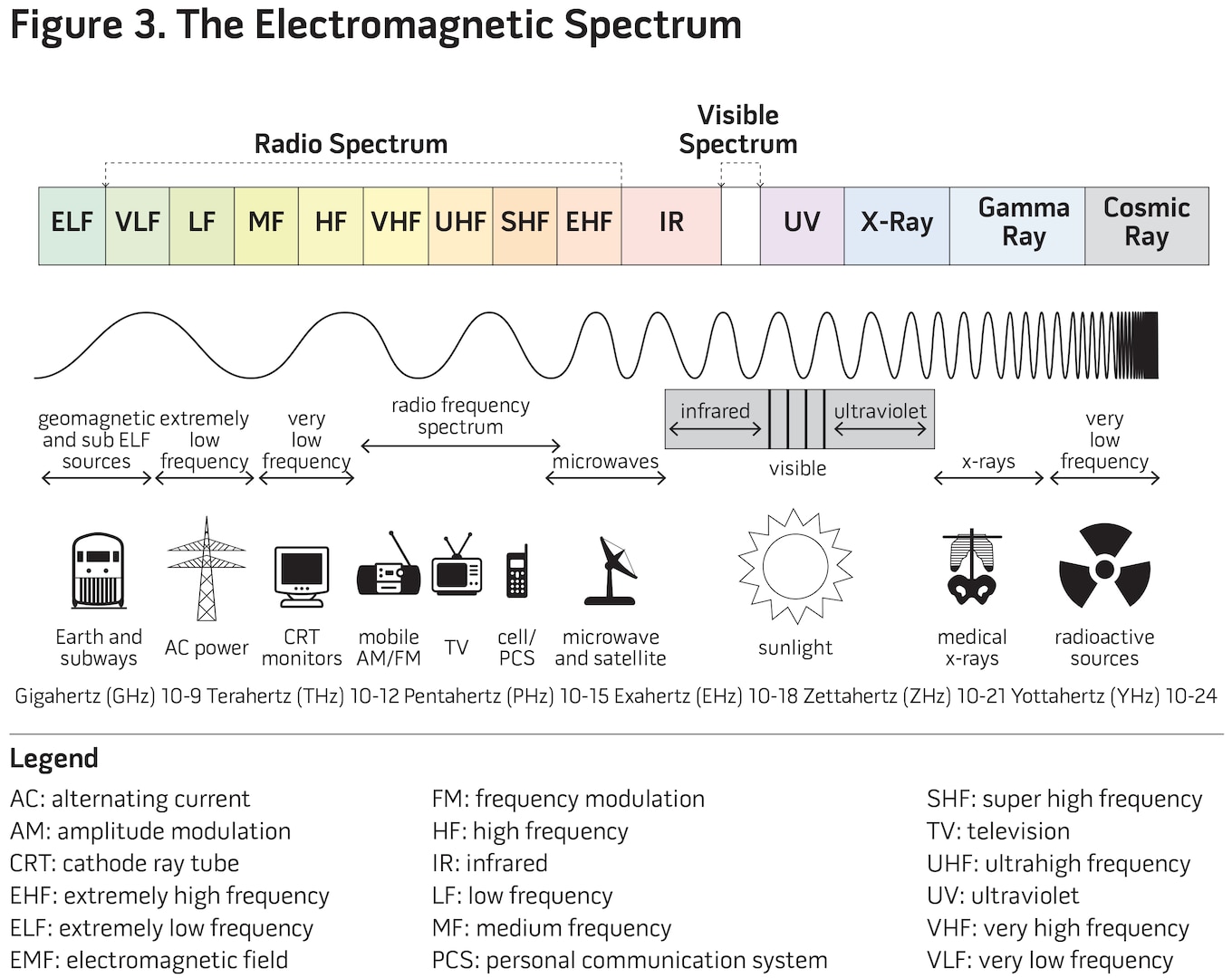
The electromagnetic technologies section introduces a term I expect to hear a lot more of: cognitive electronic warfare, AI-enabled systems that detect and respond to changes in the electromagnetic spectrum in real time rather than relying on pre-programmed responses. Combined with a broader shift in targeting toward dual-use systems like commercial drones and satellite services, this is pushing rapid innovation in jamming-resistant navigation and communications.
Directed-energy weapons, lasers, high-power microwaves, particle beams, are advancing largely because they’re cheap relative to kinetic interceptors, a straightforward economic argument in an era of drone saturation attacks. And in April 2026, media reports described a handheld electromagnetic coil gun, a genuine miniaturisation milestone, though the report is careful to note that power supply requirements and component durability remain unresolved obstacles to fielding these at scale.
The 3D printer problem hasn’t gone away
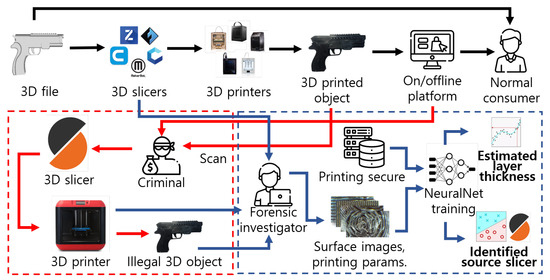
Materials technologies round out the substantive sections, and the additive manufacturing discussion will be familiar to anyone who has followed the “ghost gun” debate. What’s newer is the report’s note that 3D printing is increasingly capable of producing nuclear-related hardware, lowering the barrier to acquiring components relevant to enrichment capability. Modular weapons, built from interchangeable parts that can change a firearm’s calibre or appearance, are also complicating the marking and tracing obligations states committed to under the International Tracing Instrument.
I recently heard from Rueben Dass discussing the changing landscape of 3D-printed firearms, drones and similar evolving risks at a UN Disarmament meeting. It was incredibly enlightening to see the trends, case studies and data he presented, and I would recommend for anyone who wants to learn more about this field to refer to him and his work.
Review mechanisms are multiplying, but not converging
The report’s third section catalogues something genuinely interesting: a proliferation of dedicated scientific advisory bodies across the disarmament architecture. The Treaty on the Prohibition of Nuclear Weapons has its Scientific Advisory Group. The General Assembly created a 20-member Scientific Panel on the Effects of Nuclear War in 2024, the first such study since 1989. The Biological Weapons Convention is negotiating a hybrid review mechanism ahead of its 2027 Review Conference. The OPCW’s Scientific Advisory Board has been running since 1998. A new Global Mechanism on ICT security launches this year.
Each of these is a reasonable, even necessary, response to its own treaty regime. None is positioned to look at the thing the Secretary-General flags as the real gap in his conclusions: the convergence between technologies, not any one of them in isolation. He says it outright: states have not given the same attention to synergies between technologies as they have to individual ones, and he recommends Member States find forums to discuss that convergence directly.

What I take from this
Read as a single document, the report is really making one argument, spread across seven technical domains: governance is still organised around technology categories that no longer describe how these systems actually get built or used. AI does not stay inside the artificial intelligence section. It shows up designing DNA sequences, jamming radar, flying drone swarms, and running laboratories. The institutions built to govern each domain separately are doing careful, credible work. What’s missing is a forum built for the seams between them.
That’s not a reason for pessimism, and I don’t think the Secretary-General intends it as one. The report closes by asking Member States to strengthen multi-stakeholder engagement, protect the benefits of dual-use technology without stifling it, and fold science and technology review into every relevant disarmament body, including treaty review conferences themselves. Those are achievable asks. Whether states move on them before the next July report lands is, as always, the open question.
I track the CCW’s Group of Governmental Experts on LAWS, UN GGE processes, and AI governance more broadly through my research with UNIDIR and the Campaign to Stop Killer Robots. Reach me through aviperera.com for questions or consulting inquiries.
Further reading and sources
- Report of the Secretary-General, Current developments in science and technology and their potential impact on international security and disarmament efforts (A/81/246), 21 July 2026
- Preliminary Report of the Independent International Scientific Panel on AI, 1 July 2026
- UNIDIR, Framework of Responsible Industry Behaviour for AI in the Military Domain
- Afina, Y. and Grand-Clément, S., “Bytes and Battles: Inclusion of Data Governance in Responsible Military AI,” CIGI Paper No. 308, 2024
- The Quantum Insider, “Q-Day Just Got Closer: Three Papers in Three Months Are Rewriting the Quantum Threat Timeline,” 31 March 2026
- Nature, AI model for genetic variation and DNA sequence generation, 2026
- Nature Scientific Reports, autonomous biotechnology laboratory system, 2025
- OPCW Scientific Advisory Board, Final Report of the Temporary Working Group on Artificial Intelligence
- Nobel Prize in Chemistry 2025, press release on metal-organic frameworks
- UNODA, Lethal Autonomous Weapon Systems overview
- Campaign to Stop Killer Robots

Avi is a researcher educated at the University of Cambridge, specialising in the intersection of AI Ethics and International Law. Recognised by the United Nations for his work on autonomous systems, he translates technical complexity into actionable global policy. His research provides a strategic bridge between machine learning architecture and international governance.