
PredPol (Geolitica)
PredPol (Geolitica): Technical Dossier & Legal Analysis
Lead Paragraph: PredPol (recently rebranded as Geolitica before ceasing operations) was a predictive policing algorithm designed to forecast the time and location of future crimes, effectively serving as an algorithmic targeting system for domestic law enforcement. By transposing mathematical models of earthquake aftershocks onto human behaviour, the system operationalised systemic bias, directing armed state actors into feedback loops of disproportionate surveillance and enforcement. Although ostensibly a civilian law enforcement tool, its deployment represents the domestic normalisation of automated target generation, paving the way for the militarisation of civic space through algorithmic complicity.
⚙️ Technical Specifications & Capabilities
| Parameter | Specification |
| Manufacturer | Geolitica (Formerly PredPol) |
| State Actor / Primary User | US Domestic Law Enforcement (e.g., LAPD, Santa Cruz PD, Atlanta PD), various international constabularies |
| System Type | AI Decision Support System / Predictive Policing Algorithm |
| Data Inputs | Historical crime records (Crime Type, Location/Coordinates, Time/Date) |
| Processing Capacity | Geospatial mapping and temporal forecasting across entire municipal districts |
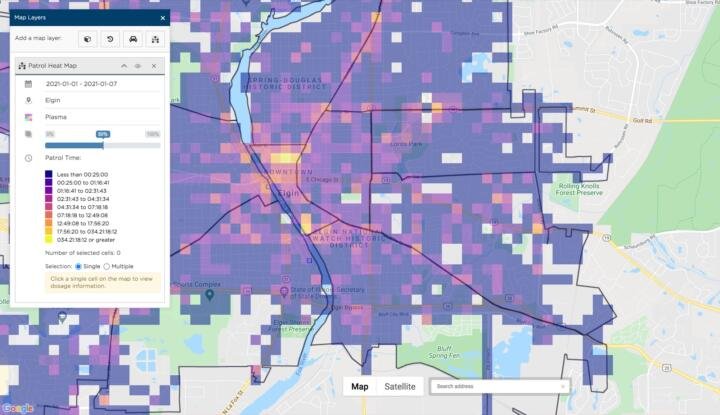
| Output Mechanisms | 500-by-500 foot predictive “hotspot” boxes overlaying digital patrol maps |
| Operational Scale | Municipal and regional domestic deployment |
🧠 Algorithmic Architecture & Autonomy
PredPol’s underlying architecture is based on the Epidemic-Type Aftershock Sequence (ETAS) model, a seismological algorithm originally designed to predict earthquake aftershocks. The system’s “brain” operates on a contagion theory of crime, assuming that certain offences (like burglaries or vehicle theft) trigger subsequent crimes in the immediate spatial and temporal vicinity. By ingesting historical arrest and crime report data, the machine learning model calculates the highest-probability zones for future infractions, autonomously generating 500-by-500-foot red boxes on a digital map for patrol officers to target during their shifts.
Unlike aerial reconnaissance algorithms that utilise real-time computer vision, PredPol relies exclusively on historical data aggregation. This creates a dangerous mathematical vulnerability known as “runaway feedback.” Because the system directs officers to heavily patrolled, historically over-policed neighbourhoods, the officers inevitably discover more infractions (often minor or nuisance crimes) in those areas. These new arrests are fed back into the dataset as fresh “crime,” mathematically justifying even heavier armed patrols in the same grid, while ignoring unreported or white-collar crimes in other sectors.
In the terminal phase of this domestic “kill chain”—which culminates in police interception, arrest, or use of kinetic force—the system operates strictly as a decision-support tool. A human officer must physically navigate to the box and execute the enforcement action. However, the algorithm establishes an environment of extreme automation bias and presumed guilt. Officers enter these algorithmic hotspots cognitively primed to expect criminal activity, significantly lowering the threshold for suspicion and escalating the likelihood of state violence against civilians under the guise of mathematical objectivity.
🔗 Deployment History & OSINT Verification
PredPol was one of the most widely deployed predictive policing platforms in the United States. Following initial pilot programs in 2011 with the Santa Cruz Police Department and the Los Angeles Police Department (LAPD), OSINT records—including leaked internal databases analysed by Gizmodo and The Markup in 2021—verified its use by dozens of police departments nationwide. Facing mounting public pressure, civil rights lawsuits, and independent audits proving its discriminatory feedback loops, major departments like the LAPD terminated their contracts. The company rebranded to Geolitica in 2021 and officially wound down operations at the end of 2023, though its underlying methodologies continue to proliferate in proprietary law enforcement tech globally.
⚖️ Legal Status & IHL Implications
- Article 36 Compliance: N/A (Civilian Software). As a domestic policing tool, PredPol is entirely exempt from Article 36 weapons reviews. However, its use of military-style algorithmic targeting in civic spaces highlights the dangerous legal void where domestic security technologies evade both international humanitarian oversight and stringent civil rights regulations.
- Principle of Distinction: While IHL’s Principle of Distinction governs armed conflict, PredPol violates its domestic equivalent: the presumption of innocence and individualised reasonable suspicion. By labelling entire geographic blocks as “high-risk,” the algorithm fails to distinguish between historical data trends and the actual individuals currently occupying that space, effectively treating all residents within a 500-foot box as latent threats.
- Algorithmic Complicity / Human Rights: PredPol is a textbook engine for digital dehumanisation and algorithmic racism. By laundering historical police bias through a proprietary “black box,” the system allowed state actors to justify the mass surveillance and disproportionate harassment of minority and low-income communities as “data-driven” policing. It actively eroded human accountability by allowing commanders and policymakers to blame a mathematical formula for systemic civil rights violations.
Closing Thought: The rise and eventual collapse of PredPol serves as a critical warning that algorithmic targeting systems, whether deployed by the military or domestic police, inherently launder human bias into automated violence, necessitating a total ban on predictive software in state security operations.

Avi is a researcher educated at the University of Cambridge, specialising in the intersection of AI Ethics and International Law. Recognised by the United Nations for his work on autonomous systems, he translates technical complexity into actionable global policy. His research provides a strategic bridge between machine learning architecture and international governance.