The Illusion of Affordability: Why We Are Rich in Distractions and Poor in Sovereignty
Executive Summary
An unvarnished analysis of price divergence over the last 20 years based on Mark J. Perry's Chart of the Century. Explore why critical services skyrocket while tech plummets.
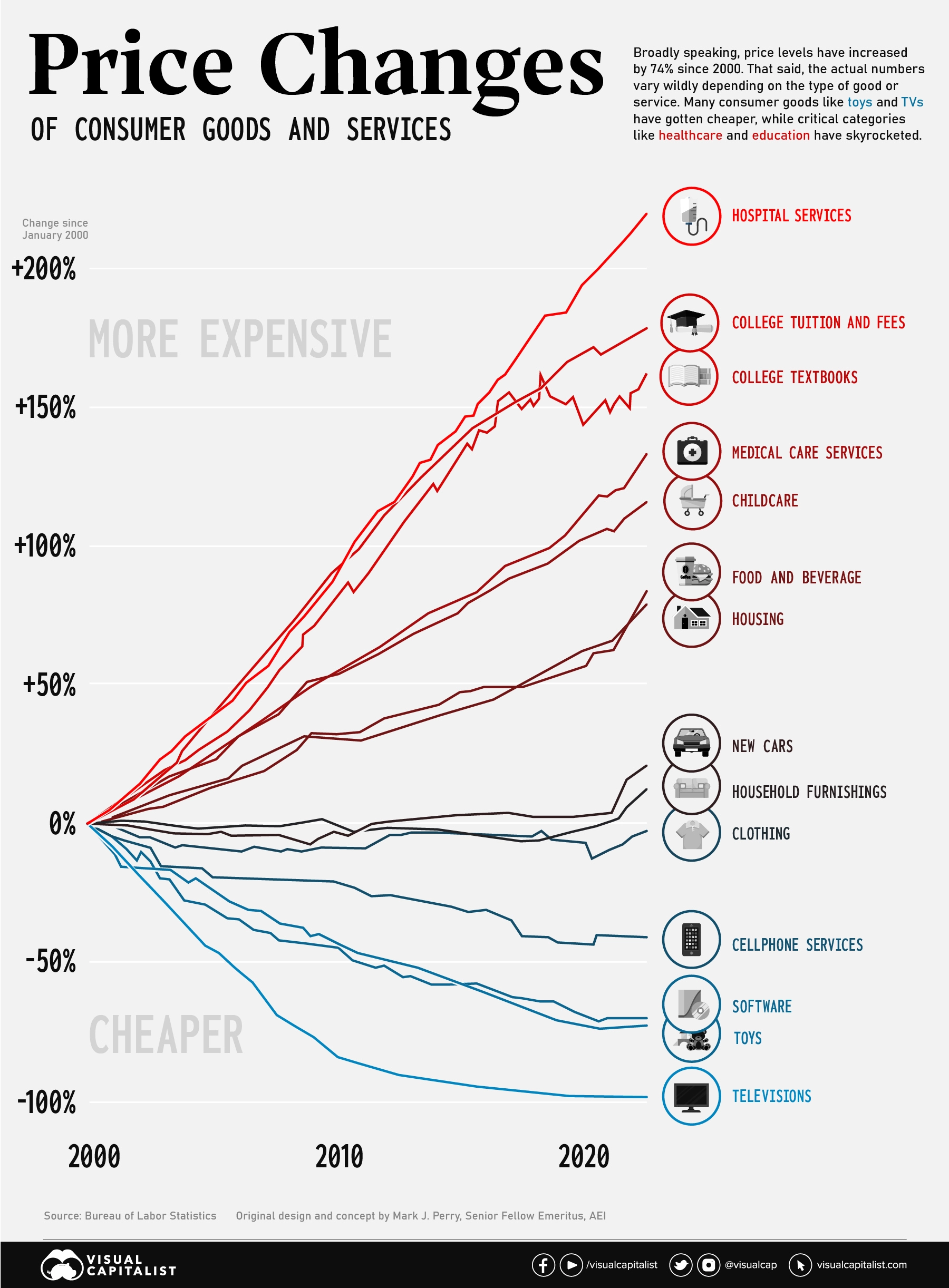
Look closely at the chart below. Conceptualised by economist Mark J. Perry, it is frequently hailed as the “Chart of the Century” for a definitive reason: it captures the underlying structural paradox of modern life.
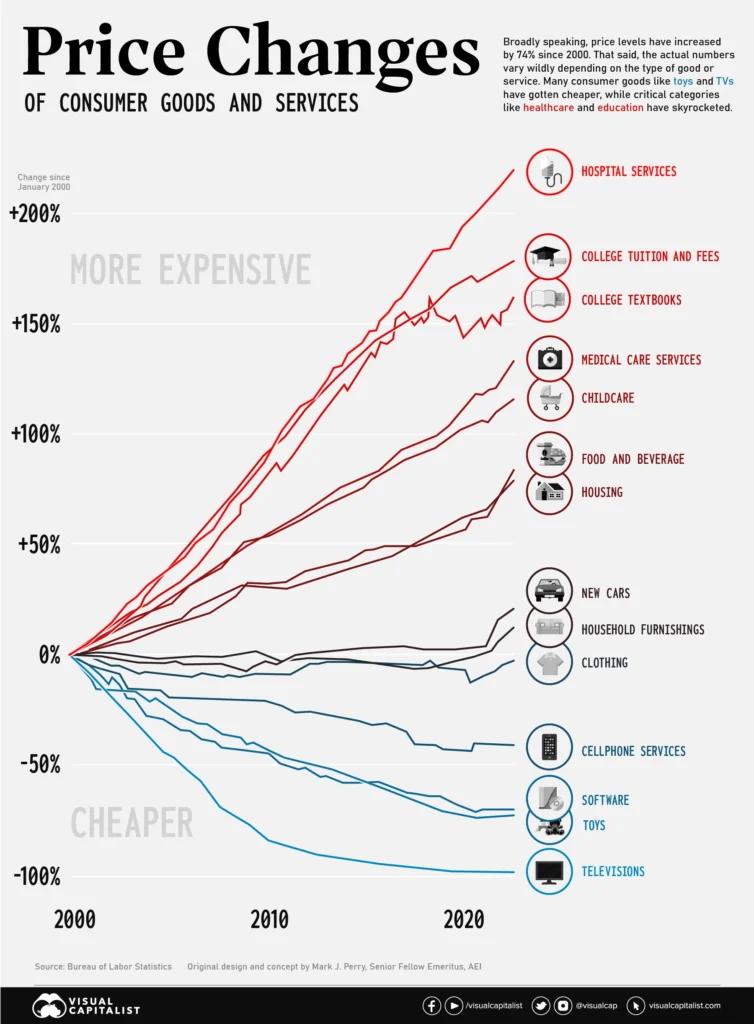
On one end of the spectrum, the prices of televisions, software, and toys have utterly cratered—dropping by nearly 98% in relative terms since the turn of the millennium. On the opposite end, the costs of hospital services, college tuition, and childcare have surged relentlessly upward, climbing between 150% and 200%.
This is not a random economic anomaly. It is a highly engineered blueprint of a society that has become hyper-efficient at manufacturing distractions while systematically restricting access to the foundational pillars of human development, health, and institutional autonomy. We are living in an era where it has never been cheaper to be passively entertained, and never more expensive to be truly free, educated, or resilient.
The Economic Paradox: Baumol’s Disease Meets Institutional Design
Standard macroeconomic theory often explains this divergence through the lens of Baumol’s Cost Disease. The premise is simple: technologically progressive sectors—primarily manufacturing and digital goods—benefit from explosive productivity gains. Automating a microchip facility or duplicating a software package drives marginal production costs down to near zero.
Conversely, labour-intensive sectors—the “stagnant” sectors—cannot substitute human capital without destroying the core quality of the service. A single professor cannot effectively mentor 50,000 students simultaneously; a surgeon cannot operate at three times the speed without catastrophic legal and physical consequences.
| Category Type | Examples (from price-changes-goods-services.jpg) | Price Trajectory | Dominant Structural Driver |
| Tradable / Progressive Goods | Televisions, Software, Toys, Clothing | Steeply Downward | Global Supply Chains, Automation, Open Market Competition |
| Non-Tradable / Stagnant Services | Hospital Services, College Tuition, Childcare, Housing | Aggressively Upward | Regulatory Capture, State Subsidies, Inelastic Demand |
However, attributing this reality entirely to Baumol’s disease ignores the profound role of state intervention, legal frameworks, and regulatory capture. The sectors experiencing hyper-inflation are precisely those shielded from raw market forces by protectionist state policies, strict licensing requirements, and unconditional financial subsidies.
The Legal Framework of Inflation: Subsidies Without Ceilings
From a legal and public policy perspective, the astronomical rise of higher education and healthcare is a masterclass in the unintended consequences of legislative mandates. When a government injects liquidity into a sector—whether via guaranteed student loan frameworks or heavily mandated private-public insurance systems—without introducing corresponding price ceilings, it fundamentally breaks the price discovery mechanism.
In both domestic governance and international institutional law, artificial demand paired with restricted supply yields structural exploitation. When administrative cartels are permitted to restrict the supply side (such as caps on medical residency slots or rigid university accreditation barriers) while the state guarantees an endless pipeline of funding on the demand side, hyper-inflation is legally codified.
The consumer ceases to be the actual customer; they become a mere conduit through which state-backed capital is transferred to bloated institutional bureaucracies.
Biopolitics and the Mechanics of Digital Pacification
There is an even more profound, systemic implication to this data that touches upon international relations and modern governance models. If an authority structure sought to design a society where the populace remains politically compliant despite facing starkly diminishing upward mobility, the pricing structure in price-changes-goods-services.jpg is exactly how they would construct it.
By driving the cost of high-definition displays, mobile devices, and endless software loops to near-zero, the modern economic apparatus creates a highly effective shock absorber against systemic stagnation. It is a digital transformation of the classic Roman doctrine of panem et circenses (bread and circuses):
The Pacification Loop: Make the tools of passivity, compliance, and short-term dopamine cheap and ubiquitous. If citizens can no longer afford land, a premier un-automated education, or sovereign healthcare, but can purchase an immersive 4K display and instant global streaming for less than a fraction of a week’s wages, the friction of structural inequality is profoundly blunted.
This dynamic actively subsidises a form of intellectual and physical laziness. When the barriers to entry for real-world capability (advanced analytical thinking, pristine physical health, non-intermediated wealth) are scaled to insurmountable heights, the path of least resistance becomes digital escapism. This is not a failure of individual human will; it is an optimisation problem where the system makes passive consumption the only affordable default mode of existence.
The Sovereignty Imperative
Ultimately, we must look beyond nominal prices and evaluate what these diverging trajectories actually represent:
- The Downward Trajectory: Items that automate human thought, outsource local labour, encourage passivity, and collect our behavioural data.
- The Upward Trajectory: Items that preserve human biological life, cultivate high-level cognitive sovereignty, and establish intergenerational independence.
When the price of becoming a highly specialised, healthy, independent actor increases exponentially while the price of becoming a distracted, algorithmically managed consumer drops to absolute zero, the balance of power shifts permanently away from individual agency.
To counter this trajectory, our approach to personal strategy, legal protection, and systemic positioning cannot rely on mainstream advice. True sovereignty requires a deliberate, aggressive choice to bypass the cheap digital shortcuts and invest heavily in the exact human-centric capabilities the market is trying to price us out of.

Avi is a researcher educated at the University of Cambridge, specialising in the intersection of AI Ethics and International Law. Recognised by the United Nations for his work on autonomous systems, he translates technical complexity into actionable global policy. His research provides a strategic bridge between machine learning architecture and international governance.