The Digital Dragnet: 4 Surprising Ways the U.S. Immigration System Became a Fully Automated Machine
Executive Summary
The U.S. immigration system has shifted from judicial review to a fully automated machine. Explore four surprising ways digital dragnets, algorithms, and data brokers are fuelling mass deportation and surveillance.
1. Introduction: The Invisible Border in Your Pocket
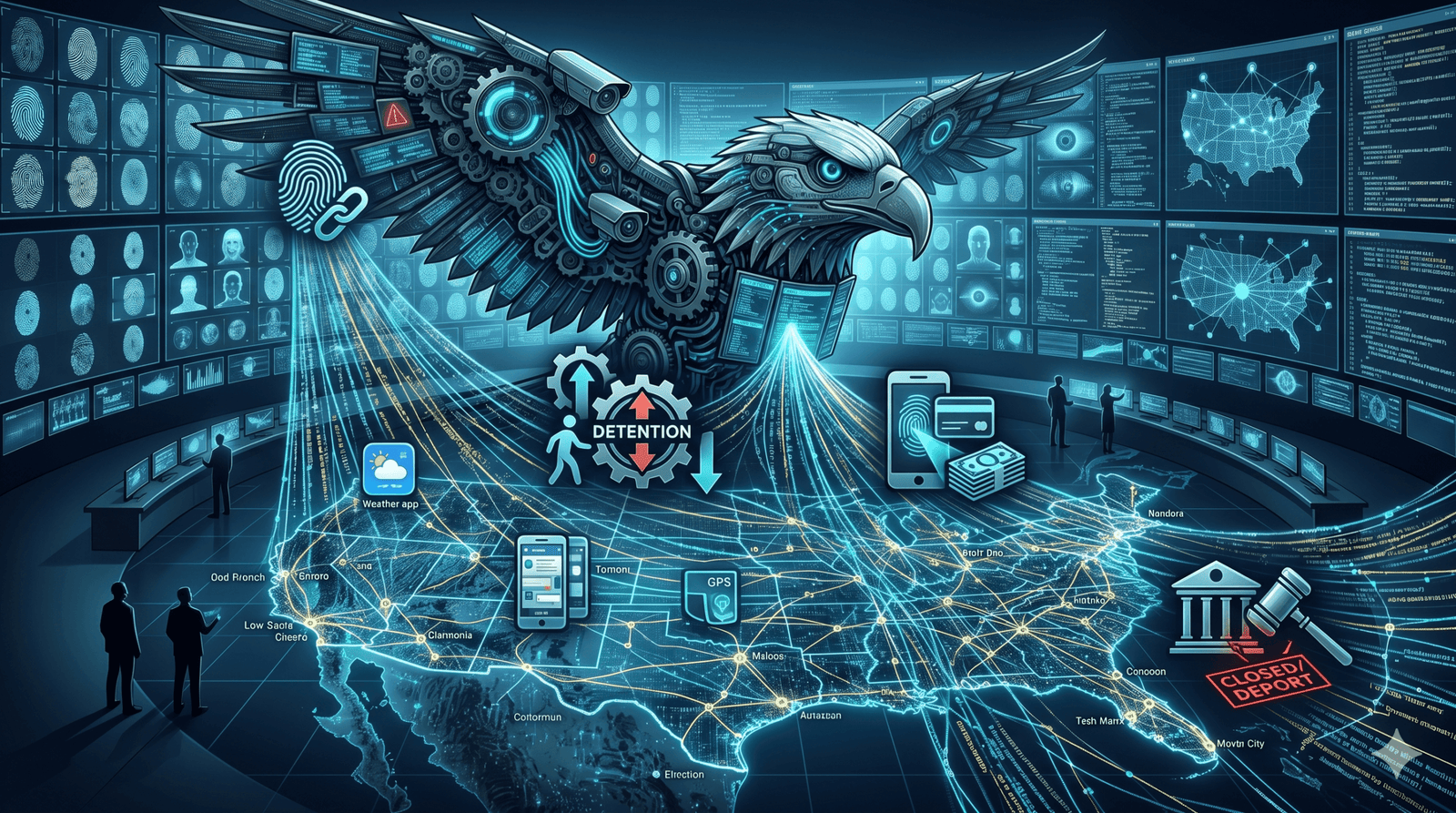
Most of us start our day with a routine check of a weather app or a quick scroll through social media. These digital conveniences feel harmless, part of the background noise of modern life. Yet, behind the interface, an interoperable machinery is at work, transforming these everyday interactions into a biometric data vacuum. For millions of people, the same GPS data that tells you if it will rain is being fed into a “black-box” algorithm designed to facilitate a quasi-punitive regime of deportation.
The U.S. immigration system has undergone a radical transformation. What was once a process governed primarily by judicial review and individual testimony has shifted into a fully automated machine. Driven by automated data-sharing and preemptive enforcement strategies, this “digital dragnet” operates largely outside the public eye, creating a permanent, searchable “digital history.” Every “encounter”—the technical term for any contact with the system—acts as a digital tether, ensuring that even those with legal status are subject to algorithmic continuous trolling. Drawing on recent litigation and policy reports, this post reveals four surprising ways the immigration system has automated enforcement, creating feedback loops of endless criminalisation.
——————————————————————————–
2. The “Sanctuary” Paradox: Why Local Laws Can’t Stop the Automated Cross-Check
Many believe that “sanctuary” jurisdictions provide a shield against federal immigration enforcement by limiting local police cooperation with ICE. However, the reality of “interoperability” between state ID bureaus, the FBI, and the Department of Homeland Security (DHS) has created a silent pipeline that local policies are structurally incapable of blocking.
The Automation of Collaboration
The “Sanctuary Paradox” is fueled by specific automated conduits: Nlets (the International Justice and Public Safety Network) and NCIC (National Crime Information Center). When a local police officer books an individual for any reason—even if the charges are eventually dismissed—their fingerprints are automatically forwarded to these databases. Through programs like Secure Communities (S-Comm), these prints are instantly cross-checked against DHS immigration records.
If a match is found, the system automatically generates an “Immigrant Alien Query” (IAQ). This data flows directly to ICE nerve centers, specifically the Law Enforcement Support Center (LESC) and the Pacific Enforcement Response Center (PERC), which operate 24/7 to issue detainers. The efficiency of this digital hand-off is staggering: according to a 2020 DHS Office of the Inspector General audit, “516,900, or 79 percent of [ICE’s] 651,000 total arrests, were based on in-custody transfers from the criminal-justice system.”
This reveals the central secret of the modern system: the primary driver of deportation isn’t the high-profile physical raid; it is an automated data loop that nullifies local sanctuary protocols at the database level.
——————————————————————————–
3. The Risk Tool That Forgot How to Release People
In 2012, the U.S. government introduced a tech-driven solution ostensibly aimed at solving over-detention: the Risk Classification Assessment (RCA) tool. Notably, the RCA was modelled on evidence-based criminal justice reforms used in the pretrial setting. It was marketed as a way to use “objective” data to limit detention to only those who posed a genuine risk.
Inside the RCA’s Punitive Black Box
The history of the RCA is a cautionary tale of how reformist goals are subverted into instruments of mass incarceration. What was designed to be an objective assessment was systematically re-engineered into a digital rubber stamp for detention.
- 2012: Launched to “limit detention” by identifying low-risk individuals for release.
- 2015: The algorithm was manipulated to remove bond eligibility recommendations from the output.
- 2017: The recommendation to “release” was suspended entirely by administrative fiat.
- 2019: The subversion was complete; the tool resulted in detention without bond for nearly every migrant processed, regardless of their actual “low-risk” score.
“The story of the RCA is one of manipulation, subversion, and bias… ICE officers’ punitive use of detention defeated attempts at top-down reform and resulted in detention without bond for nearly every migrant.”
By co-opting the language of reform, the RCA provided a veneer of “scientific” legitimacy to a system that had abandoned individualised review in favour of categorical imprisonment.
——————————————————————————–
4. Surveillance for Sale: Bypassing the Fourth Amendment with a Credit Card
The government no longer needs a search warrant to track a person’s movements; it simply needs a credit card. By partnering with third-party data brokers, immigration authorities have exploited a massive loophole in the Fourth Amendment to perform what is essentially a warrantless search of a person’s entire life.
Your Weather App as a Tracking Device
DHS and CBP purchase real-time location data from vendors like Venntel and LexisNexis. This data is harvested through Software Development Kits (SDKs) embedded in everyday smartphone applications. While this GPS data is technically “anonymised,” it is notoriously easy to cross-reference. By identifying where a phone rests at night and where it stays during the day, authorities can easily unmask home and office locations, turning a person’s digital history into a map for targeted enforcement.
This represents a total shift in surveillance logic:
- From Target to Trawl: The system has moved from the “blacklist” model of the past to “migrant and traveller stalking.”
- Nerve Center Integration: The location data bought from these brokers feeds into the same LESC/PERC nerve centers that process jail bookings, creating a 360-degree surveillance net.
The technology in your pocket has become a mobile informant, feeding data into the Homeland Advanced Recognition Technology (HART) system—a massive biometric repository that catalogues faces, irises, and even “non-obvious relationships” between individuals.
——————————————————————————–
5. The Courtroom Trap: When Justice Becomes an Enforcement Mechanism
The final pillar of this automated machine is the erosion of the Executive Office for Immigration Review (EOIR). Rather than serving as independent arbiters, immigration courts have been functionally integrated into the enforcement pipeline.
The Erosion of Judicial Independence
The crisis in the immigration court system is defined by a mathematical and procedural impossibility, where due process is sacrificed for the sake of high-speed “case completion.”
- Mass Firings: Between 2025 and 2026, the administration fired or forced out nearly 100 trial judges and 13 appellate judges from the Board of Immigration Appeals (BIA). This included the dismissal of 12 judges from the San Francisco Immigration Court, leading to the total closure of that court and destabilising one of the nation’s busiest jurisdictions.
- The Impossible Quota: A 2025 directive imposed a 95% case-completion goal within one year. This is a “mathematical impossibility” given that the total case backlog has reached 4 million, with a BIA backlog of 220,000 cases, and an average pending time of 636 days.
- Courthouse Arrests: The withdrawal of policies preventing ICE arrests at court locations led to a 40% increase in failure-to-appear rates. The courthouse has been transformed from a place of sanctuary into a trap.
By treating judges as DOJ employees rather than independent bench officers, the system ensures the “machine” continues to move regardless of the legal merits of individual cases.
——————————————————————————–
6. Conclusion: The Legacy of 1996 and the Path Forward
The automated dragnet we see today is the logical conclusion of a legal architecture rooted in the 1986 IRCA and, most significantly, the 1996 Illegal Immigration Reform and Immigrant Responsibility Act (IIRIRA). The IIRIRA provided the legal fuel for this digital engine by expanding the definition of “aggravated felonies”—a category that often includes non-violent misdemeanours—to trigger mandatory detention and strip judges of discretion.
This framework has enabled a system of continuous criminalisation, where administrative status is treated as a permanent criminal threat. As we look at a system governed by “black-box” algorithms and impossible quotas, we must ask: Can a humane immigration system exist within a framework designed for automated exclusion?
The path forward requires more than software updates; it requires a fundamental decoupling of technology from punitive enforcement and the restoration of independent, fair, and efficient courts. Without these structural changes, the digital dragnet will only continue to tighten, prioritising the efficiency of the machine over the requirements of justice.

Avi is a researcher educated at the University of Cambridge, specialising in the intersection of AI Ethics and International Law. Recognised by the United Nations for his work on autonomous systems, he translates technical complexity into actionable global policy. His research provides a strategic bridge between machine learning architecture and international governance.