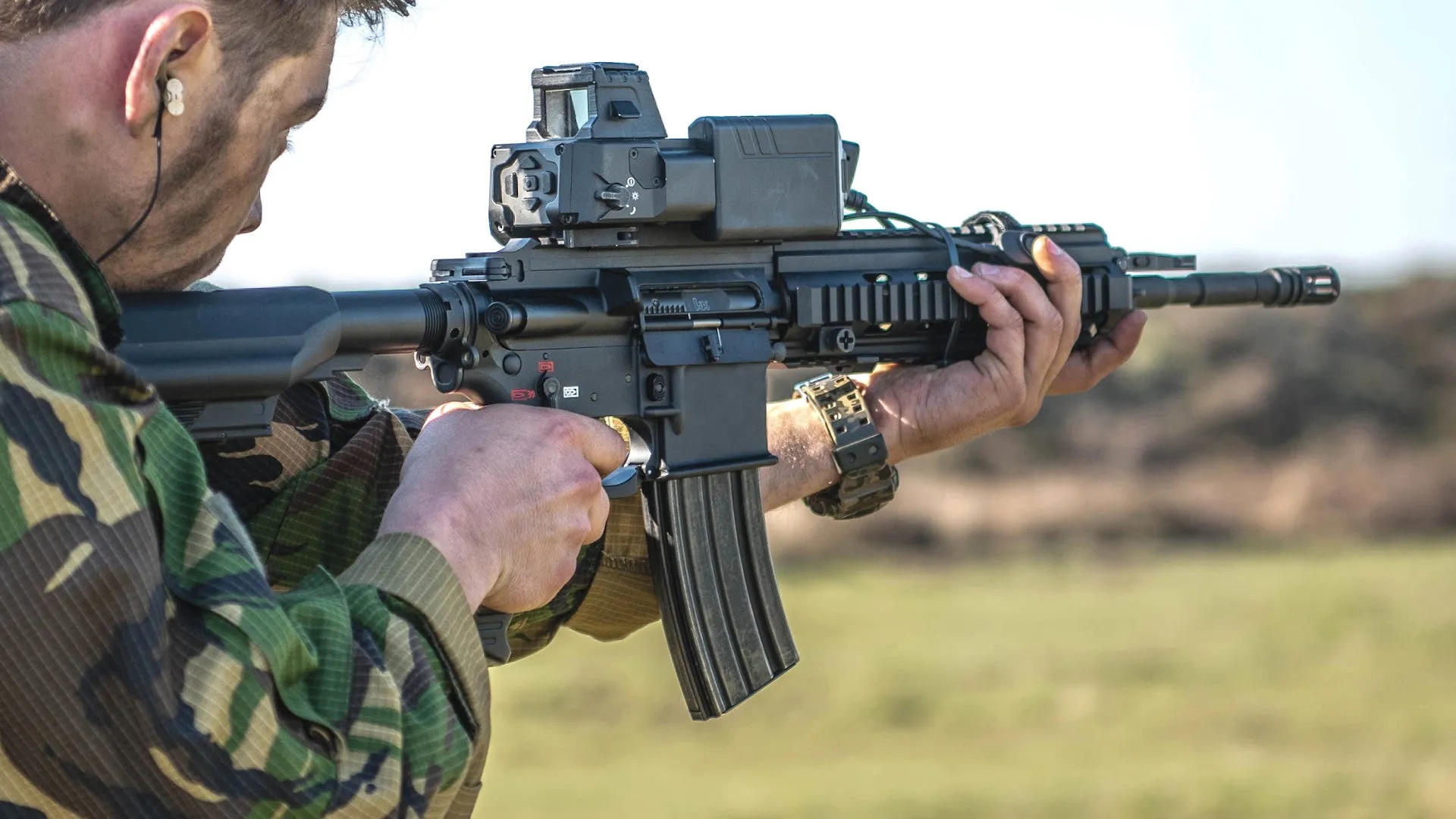
IDF SMASH 2000
SMASH 2000: Technical Dossier & Legal Analysis
Lead Paragraph: The SMASH 2000 is a “smart” fire control system developed by Smart Shooter, designed to be mounted on standard infantry rifles to automate target acquisition and the moment of discharge. By utilising computer vision to “lock on” to targets and preventing the weapon from firing until a hit is algorithmically guaranteed, the system represents the democratisation of lethal autonomy at the individual soldier level. This shift significantly erodes the traditional cognitive link between a soldier’s intent and the kinetic act, delegating the final decision to pull the trigger to a proprietary software loop.
⚙️ Technical Specifications & Capabilities
| Parameter | Specification |
| Manufacturer | Smart Shooter |
| State Actor / Primary User | Israel |
| System Type | Smart Fire Control System (Optic) |
| Dimensions / Footprint | External add-on for standard assault rifles (e.g., M4, Tavor) |
| Payload / Output | Precision kinetic fire (optimized bullet discharge) |
| Operational Range / Scale | Effective infantry engagement ranges (up to 300m – 600m) |
🧠 Algorithmic Architecture & Autonomy
The SMASH 2000 utilises an integrated suite of optical sensors and computer vision algorithms to perform real-time target recognition and tracking. The system’s “brain” identifies human or drone targets within the shooter’s field of view and generates a persistent digital lock-on. Unlike traditional optics, the SMASH system is wired directly into the rifle’s trigger mechanism. When the operator engages “SMASH mode,” they choose the target and depress the trigger, but the weapon does not immediately fire.
Instead, the algorithm waits for the precise moment when the barrel’s alignment and the target’s predicted movement coincide perfectly. The system effectively takes control of the discharge: the human operator holds the trigger to express “lethal intent,” but the machine decides the “lethal timing.” This creates a human-on-the-loop dynamic where the human is responsible for the initial classification, but the algorithm manages the terminal engagement of the kill chain.
🔗 Deployment History & OSINT Verification
The SMASH 2000 has seen extensive operational deployment by the Israel Defense Forces (IDF), particularly in the Gaza Strip and the West Bank. Its use has been documented in urban combat scenarios and for the interception of small, high-manoeuvrability Unmanned Aerial Systems (sUAS). As indicated in image_946fba.jpg, the system is actively tracked within the Geneva Command Center under “Legal Compliance & Oversight,” with intel updates verified as recently as May 2026. Beyond Israel, the system has been tested by various NATO special forces and the U.S. Army as part of broader anti-drone initiatives.
⚖️ Legal Status & IHL Implications
- Article 36 Compliance: Claimed Compliant. While the state actor maintains the system is compliant with international humanitarian law, this remains unverified by independent international bodies.
- Principle of Distinction: The system’s reliance on visual pattern recognition poses a severe risk to the Principle of Distinction. Algorithms trained to recognise “combatant behaviour” or “weapon signatures” may struggle in asymmetric urban environments where civilians carry objects (e.g., cameras, farm tools) that the machine misclassifies as threats, leading to automated lethal mistakes.
- Algorithmic Complicity / Human Rights: The SMASH 2000 facilitates digital dehumanisation by reducing the complex moral decision of ending a human life to a “green-box” confirmation on a digital screen. This erosion of Meaningful Human Control (MHC) shifts accountability into a grey zone; if an unlawful killing occurs, the operator can claim they only held the trigger while the “machine” chose to fire, creating a shield of algorithmic complicity for potential war crimes.
Closing Thought: The proliferation of fire-control autonomy in small arms necessitates an immediate international ban on systems that decouple human physical action from the moment of lethal discharge, ensuring that the burden of a life-and-death decision remains solely with a human agent.

Avi is a researcher educated at the University of Cambridge, specialising in the intersection of AI Ethics and International Law. Recognised by the United Nations for his work on autonomous systems, he translates technical complexity into actionable global policy. His research provides a strategic bridge between machine learning architecture and international governance.