US Execution Global Online Livestream and Law
On 8 October 2026, the Pentagon confirmed that it intends to livestream the execution of Nidal Malik Hasan, the former Army major convicted of murdering 13 people at Fort Hood in 2009. If it goes ahead on 3 December, it will be the first US military execution since 1961, the first by firing squad since 1945, and, as Stanford Law’s commentary puts it, the first public execution in the United States in nearly a century.
The lawyers at Diplomacy and Law have published a careful doctrinal analysis by Edmarverson A. Santos, and I build on it here. My aim is to widen the lens. I want to set the treaty law beside US constitutional and military law, test the stated rationale against the empirical evidence, and ask a question the doctrine alone cannot answer: what is this broadcast for, and who is it addressed to?
I will say at the outset what I am not arguing. Hasan was convicted by a court-martial of 13 premeditated murders and 32 attempted murders, and thirteen people and their families are the reason this case exists. Nothing below minimises that. My argument concerns the state’s conduct, which is where international law places its focus.
Key takeaways
- The UN Human Rights Committee treats public executions as incompatible with Article 7 of the ICCPR. It has not yet ruled on a livestream, so applying that rule is an interpretive step with real force behind it.
- The United States ratified the ICCPR in 1992 with an Article 7 reservation and a non-self-execution declaration. International responsibility therefore exists alongside very limited domestic enforcement.
- US constitutional law gives little categorical protection here, but the Eighth Amendment’s dignity jurisprudence and the Army’s own witness rules supply real arguments.
- The best empirical review of deterrence, by the National Research Council, found that existing studies cannot support the claim that executions deter crime.
- The history of American public killing, from Owensboro in 1936 to the lynching era, shows how spectacle has been used against stigmatised groups. I draw that comparison with attention to where it breaks down.
What has been announced
The sequence matters. In early October, President Trump approved a firing squad execution of Hasan, and the acting Secretary of the Army, Adam Telle, set it for 3 December at 1 p.m. local time at Fort Hood, according to the US Army announcement. Defense Secretary Pete Hegseth then said in a podcast interview that the execution would be public so that people understand there are serious consequences, and that the 1 p.m. timing was deliberate because it is the hour of the 2009 attack, as Al Jazeera’s explainer reports. A Pentagon official confirmed the livestream, as NPR also reported.
While I was writing this, the plan was not yet settled. Vice President Vance cast doubt on whether the broadcast will actually happen, while saying he would not watch it, and the Pentagon has not published the platform, the audience restrictions, whether the footage will be recorded, or which stages will be shown. Reports also note that the military’s current regulations specify lethal injection, so the choice of a firing squad is itself a departure that officials have not explained. I treat the livestream as announced but unconfirmed in its details.
Since I started writing, on Thursday, October 15, 2026, Trump has called off the public execution after widespread public outcry and backlash.
Who was being executed, and why that context matters
Hasan is a Palestinian-American, born in Virginia to Palestinian immigrant parents, and a Muslim. He was shot by responding officers in 2009 and has been paralysed from the waist down since. A court-martial convicted him in 2013, the military appellate courts affirmed the sentence, and the US Supreme Court denied certiorari on 31 March 2025. The Army chose not to charge terrorism, because the Uniform Code of Military Justice has no stand-alone terrorism offence, and the Pentagon first described the attack as workplace violence. Officials now describe him as a savage terrorist.
I mention his background because it bears on how a global audience will read the broadcast, and because two of the legal frameworks below, the non-discrimination guarantees and the dignity of persons with disabilities, apply directly to him. Identity alone does not make the plan unlawful, and I do not claim it does.
Why I read this as political communication
I cannot prove motive, and I do not want to overstate what the record shows. What it shows is a set of choices that point in a consistent direction. The method was changed from the regulation default. The hour was chosen for symbolism. The stated purpose is deterrence through public viewing. The announcement was made by the Defense Secretary on a podcast before the logistics were worked out. The President, asked about the execution, said Hasan deserves it. Each of these is a decision about audience and message, and none is needed to carry out a lawful sentence.
Deterrence is the official justification, so it deserves a test. The most rigorous review is the National Research Council’s Deterrence and the Death Penalty (2012), which concluded that the research to date should not be used to inform policy judgments on whether capital punishment deters crime. A 2009 survey of leading criminologists by Radelet and Lacock found that the large majority did not believe the death penalty is an effective deterrent. A mass shooting committed by a person who expected to die at the scene, as the attack on a base full of soldiers arguably was, is among the least plausible cases for deterrence. Clive Stafford Smith, the human rights lawyer interviewed by Al Jazeera, went further and warned that a broadcast could create a martyr narrative and provoke further violence. I treat that as a plausible risk and as contested.
If deterrence has no strong evidentiary basis, the broadcast has to be understood as something else: retribution made visible, a demonstration of state power, and a message to domestic and foreign audiences. That is a political function. It becomes sharper when the person being killed belongs to a group that has been the target of suspicion in American public life since 2001.
The history of public killing in America
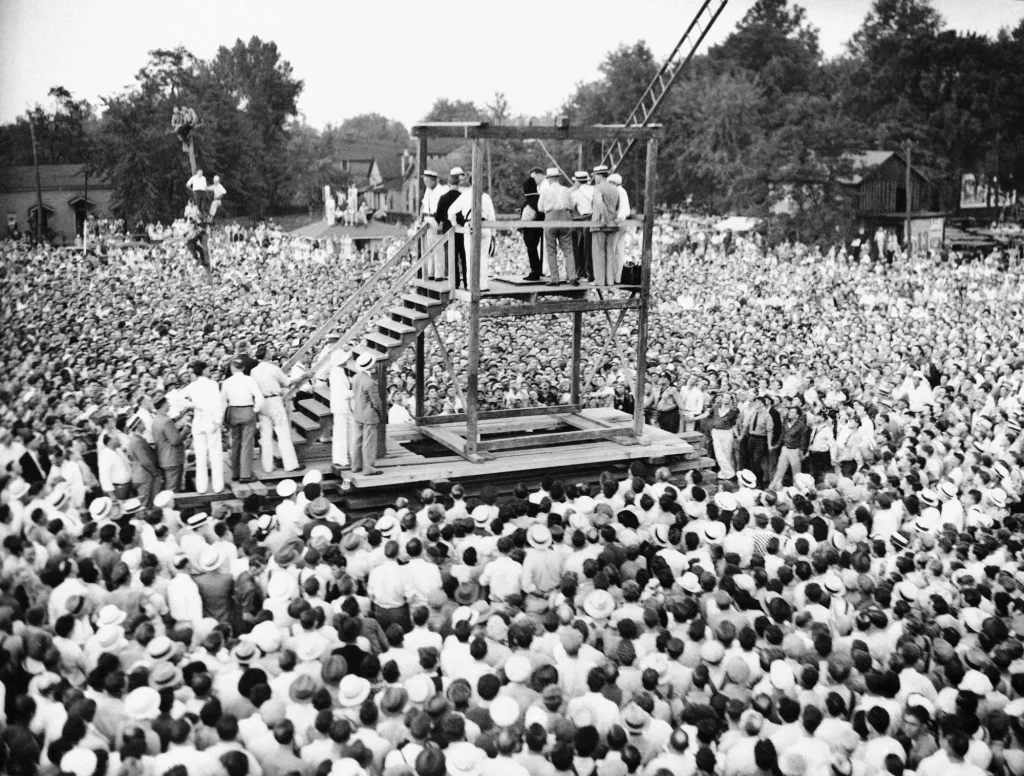
The last legal public execution in the United States took place on 14 August 1936 in Owensboro, Kentucky, when Rainey Bethea, a Black man convicted of rape and murder, was hanged before a crowd that contemporary accounts put in the thousands. The press coverage and the conduct of the crowd embarrassed the state, and Kentucky moved executions indoors shortly afterwards. Public executions had by then become a settled ritual across much of the country, often with festive crowds.
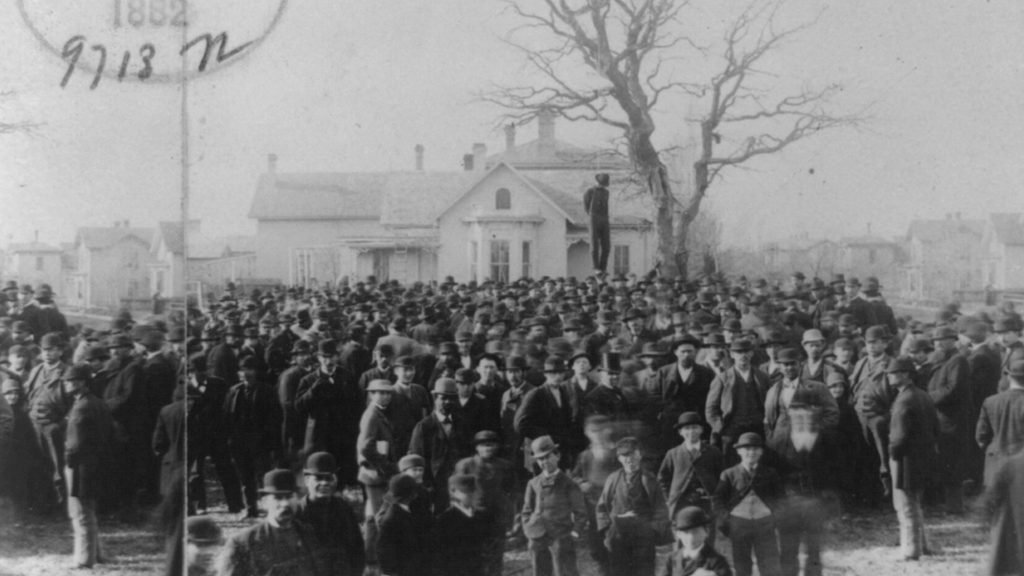
Lynching belongs to the same history of spectacle, although it was a different legal phenomenon. The Equal Justice Initiative’s Lynching in America documents more than 4,400 racial terror lynchings between Reconstruction and 1950. Many were public events attended by families, with photographs sold as postcards. The 1916 killing of Jesse Washington in Waco, watched by a crowd of thousands, is among the best documented. Congress did not make lynching a federal crime until the Emmett Till Antilynching Act of 2022.
I draw this comparison as a historian of power would, and the differences deserve equal weight. Lynching was extrajudicial violence designed to enforce racial hierarchy. Hasan was tried, convicted by a military jury, and had his sentence reviewed through every level of military appeal. The victims of the Fort Hood attack were soldiers and civilians whose deaths were real. What the two share is narrower and still important: the state or a crowd turning a death into a public event, with an audience invited to witness punishment inflicted on a person from a group the audience has been taught to fear. When the audience is global, and the camera is permanent, the effect is amplified. Other observers have reached for comparisons of their own. Senator Chris Murphy likened the plan to executions carried out by the Islamic State. Senator Thom Tillis (R-N.C.), a fierce critic of Hegseth, said, “Hasan should face the death penalty, but making his execution public and streaming it? Beyond disgusting… Public executions are what oppressive dictatorships… do. It should not be happening in America.”
International law
ICCPR Articles 6, 7 and 10
The International Covenant on Civil and Political Rights permits capital punishment under Article 6 for states that have not abolished it, limited to the most serious crimes. Article 7 prohibits torture and cruel, inhuman or degrading treatment or punishment, and Article 10(1) requires humane treatment and respect for the inherent dignity of people deprived of liberty. In General Comment No. 36 (2019), paragraph 40, the Human Rights Committee states that public executions are incompatible with human dignity and Article 7, and that an execution violating Article 7 is an arbitrary deprivation of life under Article 6.
The Committee has not decided whether a livestream is a public execution. My view is that an unrestricted government-sponsored broadcast to an indefinite audience, with the stated aim of display, falls within the reasoning of paragraph 40. The wrong identified in that paragraph lies in the exposure of the condemned person to public view as part of the punishment, and the physical presence of spectators is incidental to it. The Committee has previously held in Ng v. Canada (Communication 469/1991, 1993) that the method of execution can itself breach Article 7 even where the sentence is lawful, which confirms that implementation is reviewable separately from the verdict.
Safeguards, torture law and non-discrimination
The UN’s Safeguards Guaranteeing Protection of the Rights of Those Facing the Death Penalty (ECOSOC Resolution 1984/50) require that any execution inflict the minimum possible suffering, and the public humiliation of the condemned is difficult to reconcile with that. The Convention against Torture, which the United States ratified in 1994, requires states to prevent cruel, inhuman or degrading treatment in Article 16, subject to US reservations.
The International Convention on the Elimination of All Forms of Racial Discrimination, ratified by the United States in 1994, guarantees equal treatment before tribunals and organs administering justice in Article 5(a). The CERD Committee has repeatedly raised racial and ethnic disparities in US capital sentencing in its periodic reviews. That does not prove discrimination in this case. It does mean that a broadcast designed to be read as a message about a particular group invites scrutiny under Articles 2 and 5, as well as under ICCPR Article 26.
US reservations and domestic enforceability
The United States ratified the ICCPR in 1992 with a reservation limiting its Article 7 obligation to the cruel and unusual punishment prohibited by the Fifth, Eighth and Fourteenth Amendments, and with a declaration that Articles 1 to 27 are not self-executing. These are recorded in the UN Treaty Collection, along with objections from several states parties, including Finland, Spain and Sweden. In Sosa v. Alvarez-Machain, 542 U.S. 692 (2004) the Supreme Court held that the Covenant does not create obligations enforceable in federal court. The United States is also not a party to the First Optional Protocol, so Hasan has no individual complaint to the Human Rights Committee.
The practical result is a gap between obligation and remedy. Under the ILC Articles on State Responsibility (2001), conduct of US officials is attributable to the United States, and a breach would engage its international responsibility, including duties of cessation and non-repetition. That is a diplomatic and political consequence rather than a court order. Washington’s own Country Reports on Human Rights Practices routinely criticise public executions in other states, which gives critics a ready comparison.
US constitutional law
The Supreme Court upheld the firing squad in Wilkerson v. Utah, 99 U.S. 130 (1878), while noting that punishments of torture and unnecessary cruelty are forbidden, and in In re Kemmler, 136 U.S. 436 (1890) it accepted new methods that avoided lingering death. The method is therefore unlikely to fail on its own. The challenge is to the display.
The Eighth Amendment draws its meaning from evolving standards of decency. Trop v. Dulles, 356 U.S. 86 (1958) states that the amendment’s basic concept is the dignity of a person, and Furman v. Georgia, 408 U.S. 238 (1972) contains opinions arguing that a punishment must not degrade human dignity. Gregg v. Georgia, 428 U.S. 153 (1976) accepted retribution and deterrence as legitimate aims while barring the unnecessary and wanton infliction of pain, and Hope v. Pelzer, 536 U.S. 730 (2002) treated gratuitous humiliation of a prisoner as a constitutional wrong. Against that, Baze v. Rees, 553 U.S. 35 (2008), Glossip v. Gross, 576 U.S. 863 (2015) and Bucklew v. Precythe, 587 U.S. 119 (2019) make method-of-execution challenges hard, requiring a prisoner to identify a feasible alternative. A claim aimed at the broadcast, which concerns exposure and not the means of death, falls outside that line, and no court has decided it.
Access, minors and speech
The cases on press access point both ways. In Garrett v. Estelle, 556 F.2d 1274 (5th Cir. 1977), the court rejected a broadcaster’s claim to film an execution, and Texas had argued that televising it would make it public. In California First Amendment Coalition v. Woodford, 299 F.3d 868 (9th Cir. 2002), the Ninth Circuit recognised a First Amendment interest in viewing the whole execution process. Neither case holds that the government may itself broadcast an execution.
Army Regulation 190-55 limits attendance at executions to listed categories and excludes anyone under 18, as the regulation itself shows. A public stream cannot enforce that rule. The broader law offers little help. FCC v. Pacifica, 438 U.S. 726 (1978) concerns broadcast indecency, Reno v. ACLU, 521 U.S. 844 (1997) gives internet speech full First Amendment protection, and Brown v. Entertainment Merchants Association, 564 U.S. 786 (2011) refused to treat violent content as a category of unprotected speech for minors. Stafford Smith’s argument that US law restricts the transmission of graphic material to children is therefore much weaker than it sounds, and the best protection for minors is the Army’s own regulation.
Military law
A military death sentence requires presidential approval under Article 57(a)(3) of the Uniform Code of Military Justice, 10 U.S.C. § 857, formerly Article 71, which remains relevant to Hasan’s pre-2019 case through Executive Order 13825. Article 55, 10 U.S.C. § 855, prohibits cruel or unusual punishment inflicted on persons subject to military law. Whether a broadcast is a punishment within that article is a fresh question. Army Regulation 190-55 governs execution procedure, and Army Regulation 190-47 restricts the display of prisoners as objects of public curiosity in correctional settings. As Santos observes, neither expressly authorises an unrestricted livestream, and that silence is relevant but does not settle the matter.
If Hasan or a third party challenges the plan, the route is likely a civilian habeas petition. Burns v. Wilson, 346 U.S. 137 (1953) shows the deference federal courts have given to courts-martial, but a claim aimed at a post-appeal executive decision to broadcast is distinct from relitigating guilt. The earlier precedent from the Department of Justice is also instructive: in 2001 it allowed closed-circuit viewing of the Timothy McVeigh execution for victims and survivors only, and banned recording, as its press release records. That is the model of controlled access, and it is the opposite of an open stream.
The disability dimension
Hasan’s paralysis raises questions the Pentagon has not addressed. The UN Convention on the Rights of Persons with Disabilities requires respect for inherent dignity, and the United States has signed it but not ratified it, so it is not binding on this plan. It still gives a standard against which a global audience will judge how a man who cannot stand is restrained, positioned and shown in the final minutes of his life. The Eighth Amendment analysis in Bucklew turned on a prisoner’s particular medical condition, and while it does not decide this question, it confirms that individual physical circumstances are legally relevant. The Pentagon should say in advance what protocols apply, because a broadcast removes any possibility of dignity being preserved by privacy.
Objections, and my answers
“The victims deserve justice, and the public deserves to see it done.” Justice for the victims is served by the sentence and its lawful execution. Transparency has legitimate forms: accredited witnesses, victims’ families in attendance, official records and independent oversight. The McVeigh arrangement shows how to extend viewing to those most affected without opening it to everyone.
“He was lawfully sentenced, so the method is the government’s call.” The authority to carry out a sentence is separate from authority over how it is presented. General Comment 36 and the Eighth Amendment dignity cases both treat implementation as reviewable, and the military’s own regulations exclude minors for a reason.
“Public viewing deters.” The best evidence available does not support that, as I set out above. If officials want to defend the livestream, they should publish the evidence on which they rely.
“The lynching comparison is inflammatory.” It would be if it claimed equivalence, and I do not claim that. The comparison concerns how spectacle works, and the history of Owensboro and Waco shows what can follow when a state or crowd treats a death as entertainment or instruction. Readers may weigh that for themselves, and I have set out the differences.
Why this matters for international relations and AI governance
A livestreamed execution is a communications operation with legal consequences. It will be recorded, clipped, reposted and algorithmically amplified within minutes, in a media environment where authenticity is already contested. Governments that criticise public executions in Iran or Saudi Arabia lose credibility when they stage one, and adversaries will use the footage as propaganda, as will those who see Hasan as a martyr. Platforms will face moderation decisions with no clear legal guidance.
The deeper link to my own field is human dignity. Debates over lethal autonomous weapons turn on whether decisions to take life should be made without human judgement and accountability, and dignity is central to the argument that they should not. A state that treats a condemned person’s death as content has weakened its own claim to defend dignity in those forums. I develop these themes in my work on AI safety, set out my wider position on the stance page, and collect related commentary in my articles archive.
What should happen
- The Pentagon should publish the legal basis for the broadcast, the platform, the audience controls, the recording policy and the protocol for a prisoner with paraplegia.
- If viewing is extended beyond in-person witnesses, it should follow the McVeigh model: closed-circuit viewing for victims, survivors and accredited witnesses, with no public stream and no recording.
- Congress should use its oversight and appropriations powers to require a decision on whether the livestream proceeds, and should consider legislation on the public broadcast of executions.
- The US government should explain why the method departs from its regulations and whether the Army’s rule excluding minors can be enforced.
- Courts, if asked, should treat the broadcast as a separate question from the sentence, as the Human Rights Committee does.
Conclusion
Hasan’s guilt is settled, and the law allows the United States to carry out his sentence. The livestream raises separate questions: whether and why a state may turn a lawful execution into a global public event. International law, as interpreted by the Human Rights Committee, says that public executions violate human dignity. US constitutional law leaves the question open, military regulation points toward controlled attendance, and the evidence for deterrence is thin. On my reading, the broadcast serves a political message more than any measurable public safety goal, and it echoes a history of American spectacle that the country has spent decades trying to leave behind. The decision has been reversed, and it should always remain that way.
Frequently asked questions
Is livestreaming an execution legal in the United States?
No court has decided it. The Eighth Amendment and the Army’s witness rules supply arguments against, but the federal courts have not held that a government broadcast of an execution is unconstitutional.
Does international law prohibit public executions?
The UN Human Rights Committee treats public executions as incompatible with ICCPR Article 7 in General Comment No. 36. It has not ruled on internet livestreams, and the United States entered a reservation to Article 7.
When is the Nidal Hasan execution scheduled?
The Army set it for 3 December 2026 at 1 p.m. local time at Fort Hood, Texas, by firing squad. The livestream has been announced, although Vice President Vance has questioned whether it will proceed.
When was the last public execution in the United States?
Rainey Bethea was hanged in Owensboro, Kentucky, on 14 August 1936.
Does the death penalty deter crime?
The National Research Council concluded in 2012 that existing research cannot be used to support the claim that it does.
Sources and further reading
- Santos, E. A., “Nidal Hasan Execution Livestream: Is It Legal Under International Law?”, Diplomacy and Law (2026).
- Lawal, S., “US to livestream Fort Hood shooter’s execution: Is that legal?”, Al Jazeera, 9 October 2026.
- Donohue, J., commentary on the proposed livestreamed execution, Stanford Law School, 14 October 2026.
- Human Rights Committee, General Comment No. 36 (2019), CCPR/C/GC/36.
- National Research Council, Deterrence and the Death Penalty (National Academies Press, 2012).
- Radelet, M. and Lacock, T., “Do Executions Lower Homicide Rates? The Views of Leading Criminologists,” Journal of Criminal Law and Criminology 99 (2009).
- Equal Justice Initiative, Lynching in America: Confronting the Legacy of Racial Terror (3rd ed., 2017).
- International Law Commission, Articles on Responsibility of States for Internationally Wrongful Acts (2001).
- Lynching in America: Report

Avi is a researcher educated at the University of Cambridge, specialising in the intersection of AI Ethics and International Law. Recognised by the United Nations for his work on autonomous systems, he translates technical complexity into actionable global policy. His research provides a strategic bridge between machine learning architecture and international governance.