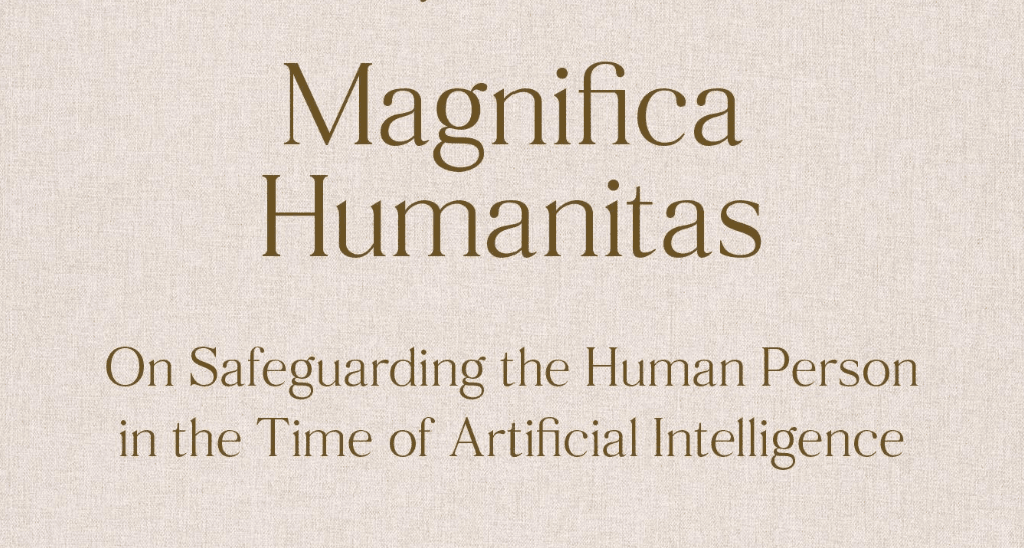
Magnifica Humanitas: Reading Pope Leo XIV’s AI Encyclical
Executive Summary
An AI governance researcher and international lawyer reads Pope Leo XIV's first encyclical, Magnifica Humanitas, on AI, autonomous weapons and truth.
On 15 May 2026, Pope Leo XIV signed the first encyclical of his pontificate in his own hand. Ten days later, on 25 May, the Holy See released it to the public: Magnifica Humanitas, subtitled, plainly, On Safeguarding the Human Person in the Time of Artificial Intelligence. Unlike most recent popes, who have generally left the public presentation of a new encyclical to a cardinal or two, Leo XIV presented this one himself, in a room that reportedly included Anthropic co-founder Chris Olah among the researchers in attendance. That detail alone tells you something about who the Vatican now thinks it is addressing.
I read papal documents the way I read most primary sources that cross my desk: closely, with an eye for what the text is actually doing rather than what it claims to be doing, and with the professional habit of asking whether its conclusions would survive contact with an actual treaty negotiation. Magnifica Humanitas runs to forty-seven pages, five chapters and two hundred and forty-five numbered paragraphs, and covers ground from Trinitarian theology to the political economy of compute. Most of it is not written for me. I am not Catholic. If pressed, I would describe myself as closer to Buddhist than anything else, and closer still to agnostic. But a fair amount of this document is written, whether its drafters intended it or not, for people who do exactly what I do for a living: try to translate moral claims about AI into legal ones that states can actually be held to.
The Document, Briefly
The Vatican timed this deliberately. 15 May 2026 marked the 135th anniversary of Rerum Novarum, Leo XIII’s 1891 letter on the rights of industrial labour, from which the current pope has taken both his regnal name and, evidently, his sense of occasion. Magnifica Humanitas is explicitly positioned as a continuation of that lineage, running through Pius XI, John Paul II’s Centesimus Annus, and Francis’s Laudato Si’ and Fratelli Tutti, updated for an era in which the “new things” (res novae) are large language models rather than steam engines.
The structure is conventional for the genre: an introduction built around two biblical images, the Tower of Babel and the rebuilding of Jerusalem’s walls under Nehemiah, two chapters of doctrinal groundwork, and three chapters that do the actual argumentative work, on AI and technological power, on truth, work and freedom, and on war and what the text calls “the culture of power.” I will spend most of this piece on that last third, because it is where the document says something a governance researcher can actually use. Citations below follow the encyclical’s own paragraph numbering, marked with a section sign (§), which is the standard convention for citing these documents.
A few things worth knowing before you read further:
- It deliberately refuses a comprehensive technical definition of AI, on the grounds that any such definition would be outdated before the ink dried (§98).
- It states outright that AI cannot be treated as morally neutral (§104), a stronger position than most secular AI ethics frameworks commit to in writing.
- It gives an entire subsection, “Weapons and artificial intelligence,” to lethal autonomous weapons, and its conclusions land close to the position held by the international arms-control community I work in (§197-200).
- It coins a striking piece of vocabulary, “to disarm AI,” meaning to free the technology from the logic of competitive escalation, whether military, economic or cognitive (§110).
- It does not name the CCW, the Group of Governmental Experts on lethal autonomous weapons, or any specific treaty body. That omission matters, and I will come back to it.
The Diagnosis: Power, Not Just Technology
The most useful move Magnifica Humanitas makes, and it makes it early, is refusing to treat AI as a primarily technical problem in search of a primarily technical fix. Leo XIV inherits Francis’s critique of the “technocratic paradigm” from Laudato Si’, the tendency to let efficiency, control and profit alone dictate what counts as progress (§92), and extends it directly to large-scale AI systems. His observation that current models are “cultivated” rather than “built” (§98), grown within a framework rather than designed component by component, is not a throwaway technical aside. It does real argumentative work: if even the people training these systems do not fully understand their internal representations, appeals to “responsible development” by the labs themselves cannot be where accountability ends.
More striking, for a document from an institution not known for economic radicalism, is the paragraph noting that the state is no longer the primary driver of technological development. Control now sits with “private, often transnational” actors whose resources and reach exceed those of most governments (§5), a concentration of power the encyclical says tends toward opacity and evades public oversight almost by structural default (§95).
I have made a version of this argument for years, from a different starting point and in considerably duller prose. On my own AI stance page I have written that the failure to govern AI effectively is not a technical problem waiting for a technical solution, but a political will deficit, sustained by the actors who benefit from the resulting vacuum. Watching a pope arrive at something close to the same diagnosis, by way of Guardini and Paul VI rather than political economy, was not what I expected when I opened this file. It happens to be the correct diagnosis, and it carries more weight now that it has the institutional authority of the Holy See behind it.
“No Algorithm Can Make War Morally Acceptable”: Autonomous Weapons and the Limits of Delegation
This is the section I read first, and the one I expect will be cited most by people who do not otherwise read encyclicals.
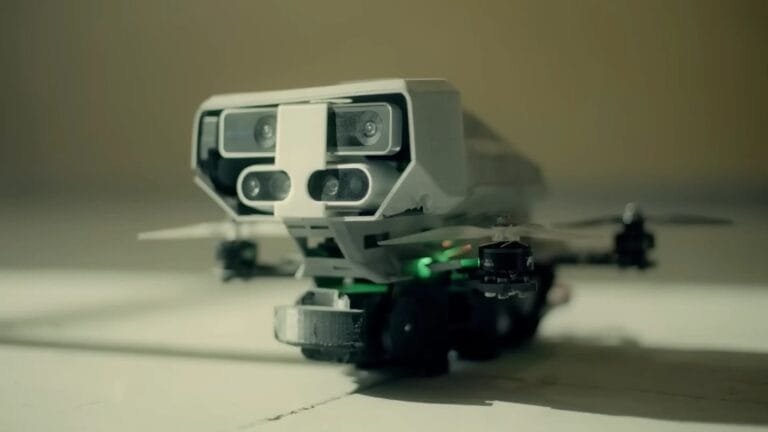
Chapter Five, under the heading “Weapons and artificial intelligence,” takes direct aim at the claim, increasingly common in defence-industry marketing material, that autonomous targeting systems can eventually exercise something resembling moral judgment (§198). Leo XIV’s response to the idea of “artificial moral agents” is unambiguous: moral judgment cannot be reduced to calculation, because it requires conscience, personal responsibility and the recognition of another person as a person rather than a data point. From there the encyclical draws a line I have spent a fair amount of my professional life trying to get states to draw in treaty language: it is not permissible to hand lethal or otherwise irreversible decisions to artificial systems. The sentence that follows is the one line from this document I expect to hear quoted in Geneva conference rooms for the next decade: no algorithm can make war morally acceptable (§198).
What follows is, structurally, close to the exact architecture I have spent years arguing for under the label “meaningful human control.” The encyclical sets out three criteria for discernment (§199): personal responsibility, meaning the chain of design, training, authorisation and use must stay identifiable and accountable; moral timeframe, meaning speed and efficiency must never become the governing logic of irreversible wartime decisions; and civilian protection, meaning any system that removes a human’s ability to see the face of the person it targets lowers the threshold for violence. It then converts these into non-negotiable requirements (§200): decisions must be traceable and reconstructable, so blame cannot dissolve into “the machine”; the decision to use lethal force must remain under effective, self-aware, responsible human control; and a shared international framework is needed to curb the arms race and protect civilians.
Substitute “cognitive understanding, intervention capacity and traceable responsibility” for the encyclical’s own three criteria and you have, almost point for point, the structure I have proposed for operationalising meaningful human control in international law. I did not arrive at this position through Trinitarian theology or Augustine’s two cities. I arrived at it through the International Humanitarian Law principles of distinction and proportionality, and the observation that no coherent doctrine of criminal responsibility currently exists for a war crime committed by a system with no capacity for intent. It is worth sitting with the fact that two entirely different intellectual traditions, one grounded in the dignity of the human person as made in the image of God, the other in the black-letter requirements of the Geneva Conventions, arrive at the same operational floor: a human being must remain genuinely, not nominally, in control of the decision to kill.
Where the encyclical stops short, and where the actual work of my field begins, is translation. “A shared framework, also at the international level” (§200) is a sentence a drafting committee can produce in an afternoon. It is not a treaty. The document does not mention the Convention on Certain Conventional Weapons, does not acknowledge the twelve years the Group of Governmental Experts on lethal autonomous weapons has spent failing to produce a binding instrument, and offers no view on what happens when “human in the loop,” as is already common practice, is invoked by states as legal cover for systems no human genuinely understands or can meaningfully override in the time available. Naming the moral floor is necessary and, coming from an institution with the Holy See’s diplomatic reach, genuinely useful. It is not sufficient. The distance between “must remain under human control” and an enforceable legal standard with verification attached is exactly the distance the CCW process has failed to close for over a decade, and exactly the distance I spend most of my working life trying to close from the other direction.
One mechanism I have proposed for closing part of that gap, an Anticipatory Objection Registry through which states could lodge advance legal objections to specific autonomous weapons configurations ahead of deployment, is the kind of instrument that could give the encyclical’s non-negotiable requirements actual teeth without waiting for the CCW’s stalled consensus process to move on its own timeline. Magnifica Humanitas will not decide whether mechanisms like it are adopted. But it has made the moral cost of further delay considerably harder for state parties to wave away.
Truth as a Common Good: Disinformation and Democratic Erosion
Chapter Four opens with a claim that will strike anyone who has spent time in AI safety circles as unusually blunt for a document of this kind: that the erosion of a shared factual basis for public life is not a side effect of AI, but a threat to democracy in its own right (§132-134). The encyclical draws on Hannah Arendt’s observation that totalitarian regimes require, not so much ideological conviction, as an audience for whom the line between fact and fiction has simply stopped mattering (§134), and argues that synthetic media, produced cheaply and distributed at scale, is accelerating exactly that condition.
This maps closely onto ground I have covered elsewhere. I regard the degradation of the epistemic foundations of democratic discourse by synthetic media as an ongoing, compounding harm rather than a speculative future one, and one that is currently outrunning the pace of any regulatory response. Where the encyclical and I part company slightly is on remedy. Leo XIV’s proposed response is what he calls an “ecology of communication” (§137): transparency norms for content-selection algorithms, stronger intermediary institutions and serious journalism, and renewed formation in critical digital literacy for families and schools. None of that is wrong. It is also not enough on its own. An ecology can be cultivated through norms and habits; a market failure of this scale, where platforms profit directly from the erosion of the very thing they are being asked to protect, generally also needs enforceable rules with consequences attached, of the kind the encyclical reaches for far more readily when the stakes are a battlefield than when the stakes are an election. That asymmetry is worth noticing. Both are existential to the people affected by them.
The Global South Divide: Automation Without Convergence
The encyclical’s treatment of labour and automation (§148-154) is more geopolitically literate than I expected going in. Rather than the generic “AI will change the future of work” framing common to most corporate and governmental white papers, Leo XIV names a specific and uneven pattern: wealthy societies automating quickly and often chaotically, shedding labour demand as they go, while what the text calls “hybrid economies” remain caught between underpaid human labour and partial technological adoption, achieving neither the productivity gains of full automation nor the stability of the labour-intensive systems they are replacing. The consequence, stated without much softening, is that these regions become sites of precarious labour, institutional instability and forced migration (§153).
That is a genuine departure from how the AI-and-jobs conversation is usually conducted in Geneva and Davos alike, where the framing tends to default to aggregate employment statistics in wealthy economies. It aligns with a point I make regularly in advisory conversations: AI-enabled tools in agriculture, energy and low-resource language processing have real potential to shorten development trajectories in lower-income economies, but only if access to the technology is not proprietary and fenced off behind the same intellectual property regimes that have historically replicated existing global inequalities at greater scale. The encyclical does not use the language of IP regimes or technology transfer, but by way of the principle of the universal destination of goods it reaches roughly the same conclusion: automation without a corresponding commitment to distributive access will widen exactly the gap it claims to want to close.
Transhumanism and the Question of Limits
Chapter Three’s treatment of transhumanism and posthumanism (§115-121) is, on its own terms, the most philosophically ambitious part of the document, and the part where my own frame of reference departs furthest from the Pope’s. Leo XIV’s core argument is that treating human limitation, illness, ageing, grief, cognitive constraint, as a defect to be engineered away rather than a condition through which relationship and meaning become possible, quietly licenses the idea that some lives are less worth preserving than others. His answer is explicitly Christological: an authentic “more than human” is found not in technological enhancement but in grace received through Christ (§126-127).
I do not share the theological premise, and I would rather say so plainly than paper over it for the sake of a tidier commentary. I was raised without much religion, and to the extent I hold anything resembling a spiritual position, it sits closer to a Buddhist orientation than a Christian one. But the underlying anthropological diagnosis, that a civilisation organised around optimising away every form of limitation risks losing the very capacities, patience, humility, the ability to sit with what cannot be fixed, that make ethical life possible in the first place, does not need a Trinitarian answer to be worth taking seriously. A Buddhist reading of the same problem would name it differently: the technocratic promise of frictionless self-improvement looks, from that angle, like an unusually well-funded form of clinging, a refusal to accept impermanence and constraint as basic features of existence rather than defects awaiting a technical patch. Different vocabulary, the same warning. Where the encyclical and I converge again is on the practical stakes: an industry culture that treats “having more,” more capability, more scale, more control, as self-evidently equivalent to “being more” (§94) is poorly positioned to notice when it has started treating people as inputs rather than ends.
How the World Read It
Press reception in the weeks following the 25 May release was instructive mainly for how little consensus it produced. Forbes covered it in near-apocalyptic terms, foregrounding the Tower of Babel imagery and warning of social and moral collapse if AI development continues without human control. The Guardian took the opposite tack, framing the document as a message secular readers could embrace on its own terms, emphasising its arguments about democratic accountability over its theological scaffolding. Le Monde read it through a distinctly continental, communitarian lens, treating it less as a warning than as a constructive call to build an alternative to the current trajectory of digital power.
None of these readings is exactly wrong, which is itself the more interesting observation. A document capable of being read simultaneously as an alarm bell, a secular humanist manifesto and a communitarian blueprint has either failed to say anything precise, or has said something precise enough that different audiences are each recognising their own existing concerns inside it. Having now read all two hundred and forty-five paragraphs rather than the pull-quotes doing the rounds on social media, I think it is closer to the latter. The document is more specific, and considerably more legally literate, than its reception suggests.
What Magnifica Humanitas Gets Right, and What It Leaves for Others to Finish
Three things, in my assessment, are genuine contributions, not restatements of existing concern dressed in ecclesiastical language.
First, the flat rejection of AI as a morally neutral tool (§104) is a stronger position than most secular governance frameworks have been willing to commit to in writing, most of which still default to some version of “it depends how it’s used.” Second, the unambiguous statement that lethal force cannot be delegated to automated or opaque decision-making (§200) now carries the institutional authority of an organisation with genuine diplomatic reach across the Global South, the Americas and parts of Asia where CCW negotiations have historically struggled to build consensus. That is not a small thing for the arms-control process, whatever one’s own view of the Church. Third, the insistence that “aligning” AI with human values is inadequate unless the underlying ethical frameworks are themselves open to public contestation, rather than set unilaterally by whoever controls the model (§107), names a problem the AI safety field discusses constantly in private and rarely states this plainly in public.
What the document does not do, and I do not think it set out to, is specify institutions. It names no treaty body, proposes no verification mechanism, and takes no position on jurisdiction, liability, or what happens the first time an autonomous system commits what would otherwise constitute a war crime and no state is willing to claim responsibility for it. The “disarm AI” language in §110 is the most evocative phrase in the entire document and the least operational: freeing technology from the mentality of armed competition describes a desired end state, not a mechanism for reaching it. That is not a criticism of the encyclical so much as a description of its genre. Moral theology sets the floor. Someone else has to build that floor into something a court, a treaty body or a procurement officer can actually stand on.
Why This Matters Beyond the Church
Most of what I do, at Cambridge, through UNIDIR, with the Campaign to Stop Killer Robots, and through SovDash, involves trying to close exactly the gap this encyclical leaves open: the distance between a moral claim everyone can nod along to and a legal instrument states are actually bound by. Documents like Magnifica Humanitas do not close that gap themselves. What they do, when they land with this much institutional weight, is shift the burden of justification. It becomes measurably harder for a state or a defence contractor to argue, in a CCW side event, that meaningful human control is an unrealistic or ideologically loaded demand, when the position is now held, in almost identical structural form, by an institution with no discernible stake in either the AI industry or Western liberal orthodoxy. Moral consensus is not a substitute for a binding instrument. But it is useful ammunition for the people trying to negotiate one, and after twelve years of the Group of Governmental Experts producing recommendations rather than obligations, useful ammunition is not nothing.
I do not know whether this encyclical will be cited in a future protocol to the CCW. Church documents rarely are, at least not by name. But I would be surprised if I am the only person working in this field who reads paragraph 198 and recognises, finally, an institution with genuinely global reach willing to state the non-delegation principle without hedging it.
Frequently Asked Questions
What is Magnifica Humanitas about? Magnifica Humanitas is Pope Leo XIV’s first encyclical, signed 15 May 2026 and released 25 May 2026. It addresses how to safeguard human dignity in the age of artificial intelligence, covering AI governance, autonomous weapons, disinformation, the future of work, and the philosophical challenge posed by transhumanism.
Does the encyclical take a position on autonomous weapons? Yes. Chapter Five states plainly that lethal or otherwise irreversible decisions cannot be delegated to artificial systems, and that the decision to use lethal force must remain under effective human control at all times (§197-200).
Is Magnifica Humanitas legally binding? No. It is a statement of Catholic moral and social teaching, not a treaty or legal instrument, and it does not name any specific international body such as the Convention on Certain Conventional Weapons. Its influence, if any, will be diplomatic and moral rather than directly enforceable.
Where can I read the full text? The full text of Magnifica Humanitas is published on the Vatican’s official website.

Avi is a researcher educated at the University of Cambridge, specialising in the intersection of AI Ethics and International Law. Recognised by the United Nations for his work on autonomous systems, he translates technical complexity into actionable global policy. His research provides a strategic bridge between machine learning architecture and international governance.