Switchblade 300 and 600 Loitering Munitions
US Supplied Switchblade Series (Switchblade 300 and 600): Technical Dossier and Legal Analysis
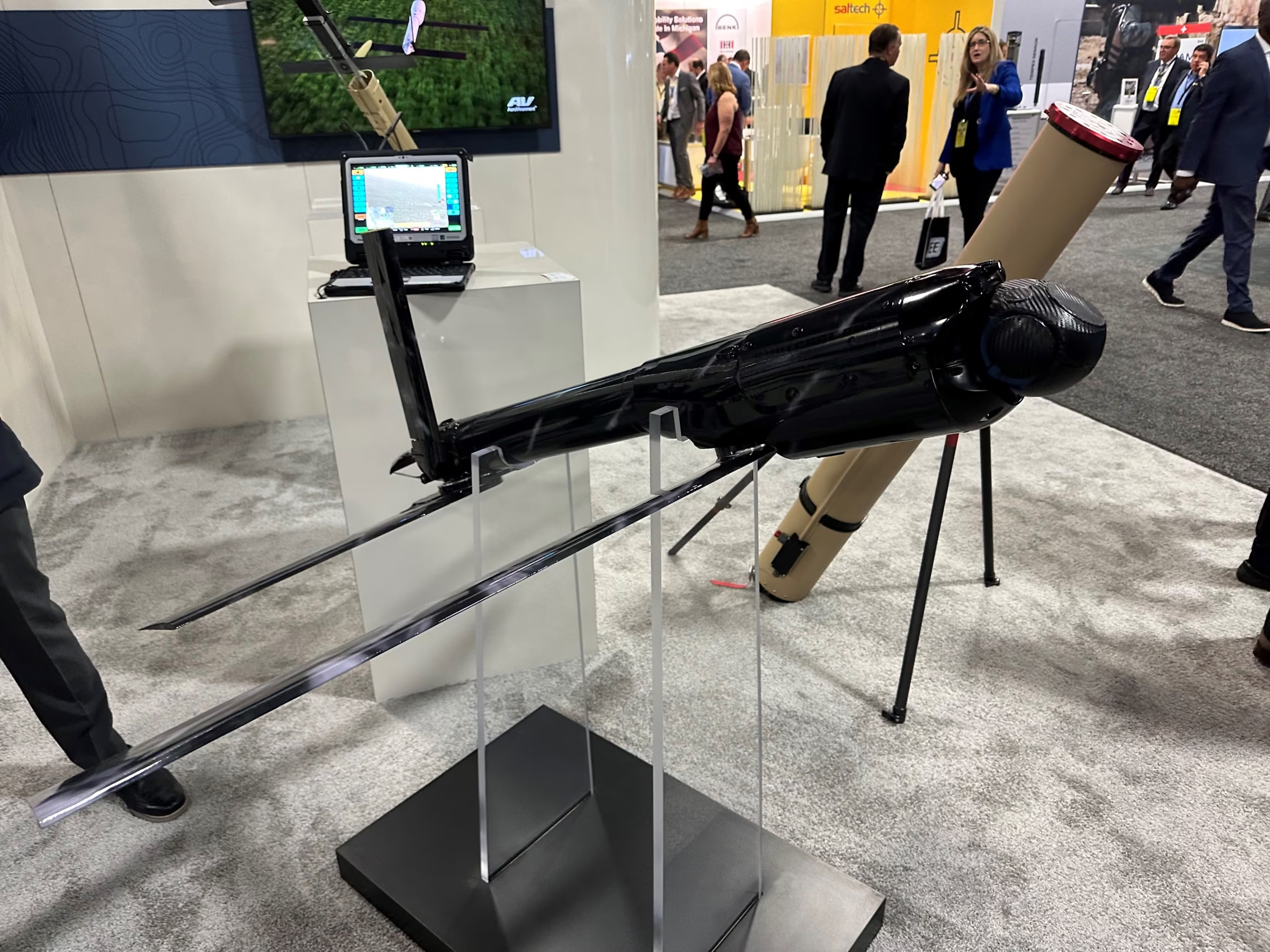
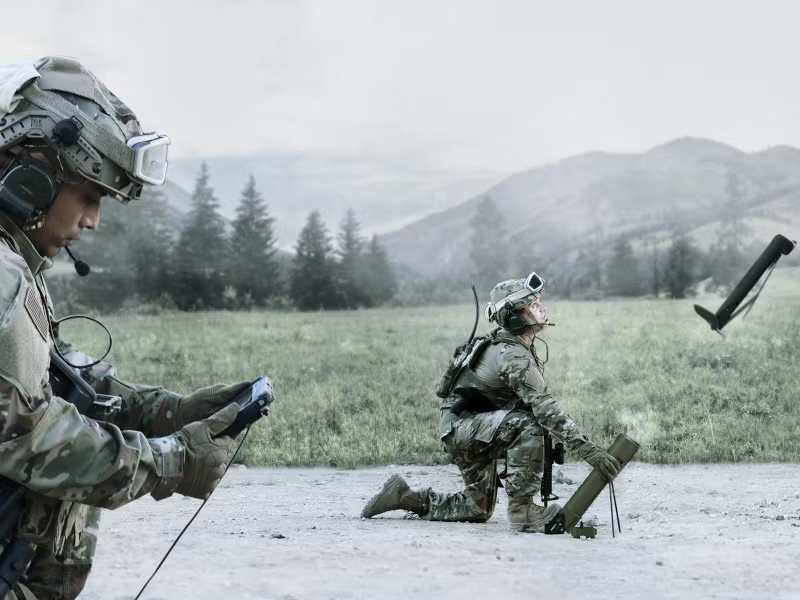
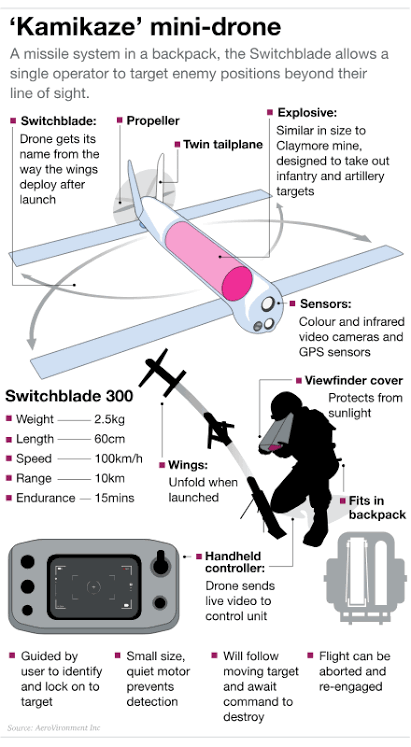
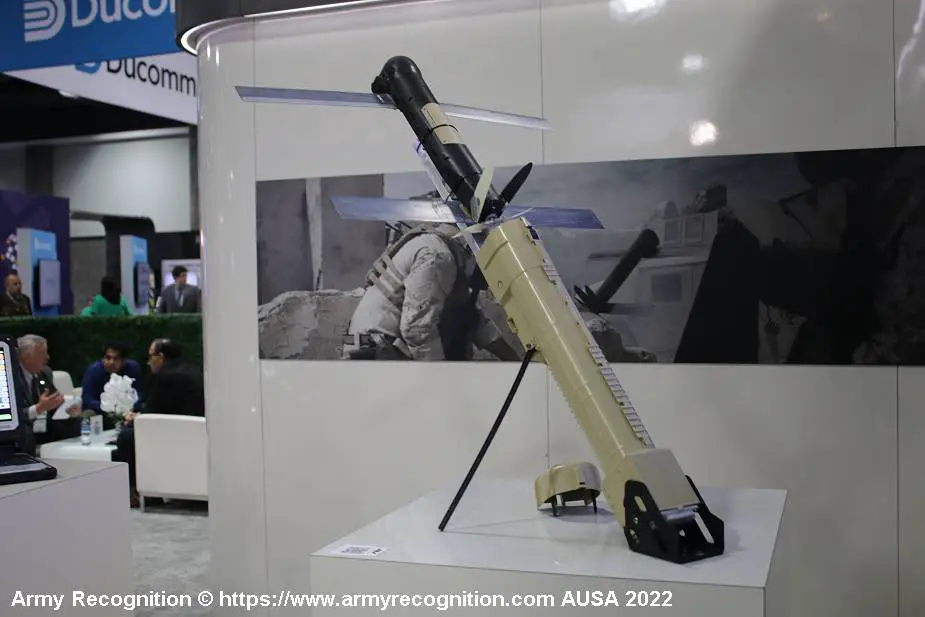
The Switchblade is a family of tube-launched, electrically powered loitering munitions made by AeroVironment (AV) of the United States. It launches from a tube, flies to the target area and crashes into its target while detonating its explosive warhead. The family has two principal members. The Switchblade 300, introduced in 2011, is small enough to fit in a backpack, and the far larger Switchblade 600, unveiled in 2020, is an anti-armour variant. I include the series because it is the best documented example of a loitering munition built around a human decision to strike, and because its record in Ukraine and its sale to Taiwan show how a human-in-the-loop weapon behaves under electronic warfare and under diplomatic pressure. It is not, on the public record, a lethal autonomous weapon system. Its significance lies in how close the line is. Wikipedia, Wikipedia
Key takeaways
- The Switchblade is operator-controlled. An attack can be cancelled until a few seconds before impact. What the munition does if its data link is lost after the operator commits to a target is Unknown. designation-systems
- Reporting on Ukrainian use is mixed. The Economist reported in October 2025 that the Switchblade 300 struggled against Russian electronic warfare and caused minimal damage on impact, while AV says Switchblade 300 systems provide real-time ISR and precision strike support in Ukraine. southfront, avinc
- In 2026 the US Army issued a $186 million delivery order for the Switchblade 600 Block 2 and the Switchblade 300 Block 20, including its first explosively formed penetrator payload in the 300 series. armyrecognition
- The US approved the sale of 720 Switchblade 300 rounds and 101 fire control systems to Taiwan for an estimated $60.2 million. army-technology
- The CCW Seventh Review Conference meets in Geneva from 16 to 20 November 2026.
Basic Weapon Facts
I. Background
| Field | Detail |
|---|---|
| Manufacturer | AeroVironment, Inc. (AV), headquartered in Arlington, Virginia, USA |
| Suppliers | Unknown. The Switchblade 600 warhead is based on the FGM-148 Javelin warhead. Subcontractors: Unknown |
| Country of origin | United States |
| Developmental stage | Operational and in production. AV says it accelerated Switchblade 600 production from 40 to 240 systems per month. |
| System version | Switchblade 300 (Block 10C, Block 20, Block 20 with EFP warhead option). Switchblade 600 (Block 1, Block 2). A Switchblade 400 appears in one reference table. Blackwing is an unarmed variant of the 300. |
| System type | Man portable, tube-launched, electric loitering munition (loitering missile) with operator in the loop AeroVironment Switchblade 600: Drone Specs, Top Speed & Range +3 |
II. General Specifications
| Parameter | Switchblade 300 | Switchblade 600 |
|---|---|---|
| System dimensions | About 49.5 cm long and 76 mm in diameter (Block 10C sources give 61 cm) | About 130 cm long and 150 mm in diameter |
| Weight | 2.7 kg for Block 10C including case and launcher, and 3.6 kg for Block 20. AV gives the Block 20 round as 7.2 lb. | About 15 kg (33 lb) |
| Max payload (warhead) | Unknown officially. One database lists a warhead equivalent to a 40 mm grenade. Another source gives 1.8 kg. Block 20 offers an EFP option | Anti-armour warhead based on the Javelin warhead |
| Max operating time | About 10 minutes (Block 10C) and 20 minutes (Block 20) | About 40 minutes. Block 2: more than 50 minutes |
| Max operating distance/reach | 10 km standard. An optional antenna extends Block 20 to 30 km. | 40 km standard. Up to about 80 km with operator handoff. Block 2: more than 100 km handoff and relay range |
| Max speed | About 101 km/h cruise and 160 km/h dash | About 113 km/h cruise and 185 km/h dash |
| Unit cost | Reported at $60,000 to $80,000. Another source gives about $53,000. | Reported at $100,000 to $175,000 AeroVironment Switchblade +20 |
Public specifications for this family come mainly from reference compilations, trade sites and industry press releases, and they disagree. The warhead size of the 300 is the largest conflict. AV does not publish it, and a 1.8 kg warhead looks hard to reconcile with a round of 2.5 to 3.6 kg, so I treat that figure with caution. Please check against current AV datasheets before publication.
History and operational record
Origins and Afghanistan. The original Switchblade was introduced in 2011 and rebranded the Switchblade 300 when the Switchblade 600 appeared in 2020. The Economist described it as essential kit for US forces in Afghanistan and Iraq. There is no systematic public data on how many strikes were made or on civilian harm from them, and I would treat that as a gap in the public record and not as evidence in either direction. Wikipediasouthfront
Ukraine. On 16 March 2022, the US announced the provision of 100 Switchblades as part of an $800 million military aid package, and later sources say about 700 Switchblade 300 units were supplied. Early combat use showed strengths in precision, portability and the abort capability, and a significant weakness against Russian electronic warfare that spread along the front in 2022 and 2023. A Ukrainian drone developer said Switchblades glitched under Russian jamming and delivered minimal damage. In 2023, the US Army announced that it would not buy more Switchblade 300 rounds and ordered more than 100 Switchblade 600 under its LASSO programme instead. I note that some of the strongest negative accounts come from secondary and aggregator outlets repeating The Economist’s reporting. The core finding, that the 300 struggled against jamming, appears in several independent places. Switchblade 300 Loitering Munition +4
Taiwan. The 2024 Taiwan notification covered 720 Switchblade 300 rounds, including 35 fly-to-buy units, and 101 fire control systems, for an estimated $60.2 million. AV says the systems were previously approved for use by Ukraine, France, the United Kingdom and additional allies. One database lists Lithuania and New Zealand as operators and Australia, Canada, France, Greece, Romania and Sweden among announced buyers, which I treat as indicative and not authoritative. US approves Switchblade loitering munition sales to Taiwan – Army Technology +2
The response to the Ukraine experience. AV’s new range includes the Switchblade 600 Block 2 with 20 percent longer endurance, IP67 rating for maritime use and a secondary payload bay, and a Switchblade 300 Block 20 with a modular payload bay, an EFP warhead, an enhanced sensor suite, a touchscreen tap-to-target interface and a user selectable point of detonation with continuous positive identification. The Army’s 2026 order describes the Block 2 as built to strike armoured targets beyond line of sight in contested electronic warfare conditions. aeromagasiaarmyrecognition
The cost problem. Cheaper systems have changed the economics. One comparison puts Ukrainian designs at a fraction of the price: a Ukrainian loitering munition at roughly $6,000 to $10,000 against about $53,000 for the Switchblade 300. A Medium essay widely recirculated in the sector puts the contrast at $400 against $100,000, and I treat that as rhetorical. The point stands that a precision munition built for low-volume use now competes with mass-produced drones in a war of attrition. thedroneoffice
Autonomy: a forensic analysis
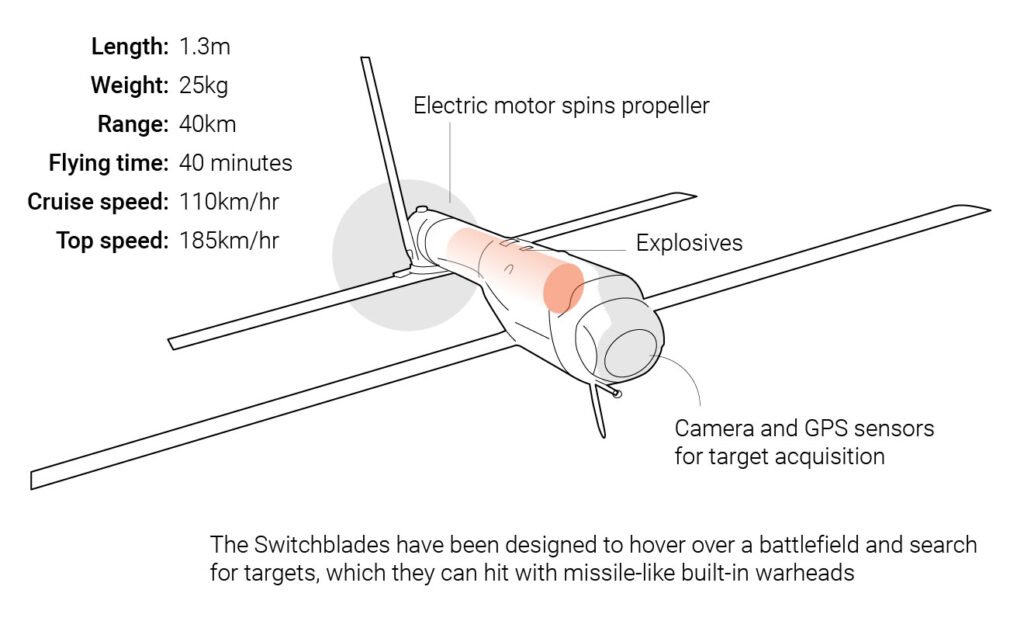
Sensors. The Block 20 has an enhanced sensor and panning camera suite. AV describes an electro-optical and infrared capability with reduced collateral damage risk. The Switchblade is an operator’s eye as much as a warhead, and AV advertises its ISR role. aeromagasiaarmyrecognition
Algorithms. The operator interface uses a touchscreen with tap to target, multiple commit angles and a user-selectable point of detonation, with continuous positive identification. After commitment the munition flies itself to the selected point. One industry report describes autonomous homing in the terminal phase, which is consistent with how such systems work, though the source is of low quality. The Block 10C added a Digital Data Link for secure communications and concurrent operation of multiple units. Whether any version carries onboard automatic target recognition is Unknown. The sources I could verify do not claim it. AeroVironment Unveils Three New Switchblades +2
Human intervention in the kill chain. A human selects the target, commits the strike and can cancel it. An attack can be cancelled until a few seconds before impact. The munition can be remotely aborted if necessary. On its face this is the strongest form of human control available for a munition, because the operator watches the target through the final approach. Three qualifications matter. designation-systemsarmyrecognition
- Link loss. The terminal question is what happens when a jammer cuts the link after the operator has committed. The options are to abort, to crash harmlessly, to continue to the last selected point or to home on the last tracked target. Each has different humanitarian consequences, and AV’s public materials I could find do not say which applies to which block. AV added resistance to jamming in the Block 20, and the Block 2 is described for contested electronic warfare conditions. A weapon designed to keep working when the link fails is a weapon designed to act without its operator, at least for a few seconds. I consider this the most important unanswered question about the system. armyrecognition
- Interface and time pressure. Tap to target and multiple commit angles describe a fast, simple interface. A touchscreen that makes lethal commitment as easy as selecting an icon raises the automation bias problem I discuss in my meaningful human control article. The interface can make a decision feel simple that is not.
- Positive identification as judgment. Continuous positive identification is a human task assisted by a camera. What the operator can see, and how long, depends on the sensor, the weather and the link, as my entries on remote warfare note.
Classification. Under the US Defense Department’s policy framework, which I cite from memory, a weapon that engages only targets selected by a human operator is semi-autonomous, and the Switchblade fits that description in its documented use. The CCW chair’s March 2026 text characterised a lethal autonomous weapon system as one that can identify, select and engage a target without intervention by a human operator, which excludes the Switchblade as described. Its relevance to this database lies in what surrounds it. The UN Panel of Experts on Libya reported in 2021 that a Kargu-2 loitering munition may have attacked retreating forces without requiring a data link between operator and munition, a report I cite from memory and recommend checking. The line between the Switchblade’s mode and that mode is software and policy. For the aerial carrier and the link loss logic see my MQ-9 Reaper entry, where an industry report I could not verify describes launching Switchblade 600 from a Reaper as a mothership. Wikipedia
Legal analysis
Lawfulness of the weapon
A loitering munition is lawful as a type. The questions arise in use. Article 36 of Additional Protocol I requires states parties to review new weapons, and the United States, which is not a party, applies its own legal review as policy. I know of no public review of any Switchblade block. The Block 20 EFP warhead and the Switchblade 600’s Javelin-derived charge raise ordinary questions about effects, and the Block 20 EFP’s anti-armour purpose suggests lower anti-personnel use than the 300’s earlier blasts.
Precautions in attack and the abort function
Article 57 of Additional Protocol I requires those who plan or decide on an attack to do everything feasible to verify targets, to choose means that minimise civilian harm and to cancel or suspend an attack if it becomes apparent that the target is not a military objective. The abort capability is a design feature that serves Article 57(2)(b) directly. That is a real advantage over a munition that cannot be recalled, and I want to give AV credit for it. The advantage depends on the link. A jammed abort is a weapon with no brake.
Judging the operator
In Prosecutor v. Galić, IT-98-29-T (ICTY, 2003), the Trial Chamber said that proportionality is judged by what a reasonably well-informed person in the position of the person carrying out the attack could have expected, making reasonable use of the information available. I cite the case from memory and recommend checking the paragraph. The Switchblade gives the operator a continuous video feed until impact, which improves the information position, although it is still a narrow view through a gimballed camera. The test would apply to what the operator could see and when.
Arms transfers: Ukraine
The supply of Switchblades to Ukraine is lawful on the prevailing view because Ukraine is exercising the right of self-defence under Article 51 of the UN Charter after an act of aggression, which the UN General Assembly condemned in resolution ES-11/1 of March 2022. Article 7 of the 1907 Hague Convention V states that a neutral power is not bound to prevent the export of arms on behalf of a belligerent, and the question of qualified neutrality remains debated. The ICJ’s Nicaragua v. United States (1986) treated arms supply to armed opposition groups as a possible form of unlawful intervention, but the context differs because Ukraine is a state acting with its own consent. I cite these from memory, so please verify them. Russia describes such supplies as making the United States a party to the conflict. The legal view is that supplying arms does not by itself amount to direct participation.
Arms transfers: Taiwan
The Taiwan sales rest on domestic law. The Taiwan Relations Act of 1979 (22 U.S.C. § 3301 and following) commits the United States to make available defensive arms, and the Arms Export Control Act requires notification to Congress of major sales. The PRC objects, citing the 1982 communiqué. Neither Taiwan nor the United States is a party to the Arms Trade Treaty, which the US signed but did not ratify, so the treaty’s risk assessment criteria do not bind these transfers. I cite the statutes and the 1982 communiqué from memory.
Accountability
The accountability analysis I gave in the Phantom entry applies, including the US contractor defences in Boyle v. United Technologies Corp., 487 U.S. 500 (1988), and Saleh v. Titan Corp., 580 F.3d 1 (D.C. Cir. 2009), which I flag for verification. A Switchblade operator is a soldier, so responsibility for the decision to commit rests with identifiable people. The diffusion arises with link loss, interface design and the choices made by the manufacturer about what happens when contact is lost.
International relations implications
A weapon shaped by electronic warfare. The Switchblade’s design history is a response to jamming. The Block 2 is built to operate in contested electronic warfare conditions. The same logic drove my MQ-9 entry, where link loss pushed the Reaper’s successors toward autonomy, and it applies to the humanoids I have covered. Wherever a human link is the weak point, pressure builds to let the machine finish the job without it. The Switchblade is the clearest place to watch that pressure, because it already ends in a terminal strike. armyrecognition
Taiwan and the porcupine. The 720 rounds for Taiwan are part of a strategy of making invasion costly through many small precision weapons. The Ukrainian experience is a warning about what a strong adversary can do to them. The PRC has a more capable electronic warfare force than Russia is believed to have, which I state as my assessment and not as a sourced finding. A munition that struggled against jamming in Ukraine will face a harder test in the Taiwan Strait, and that increases the incentive to reduce its dependence on a link.
Cost and mass. The comparison with cheap Ukrainian drones matters for strategy. The Army’s 2023 decision not to buy more Switchblade 300 rounds, followed by the 2026 order for upgraded models, shows a service adjusting. The lesson I take is that precision and mass are both needed, and that the market is moving toward cheaper, more expendable and more autonomous systems. That pressure will not stay within any one country’s choices. designation-systems
The US as norm setter. The United States is the largest exporter of this class of weapon to its allies, and its practice sets expectations. Its framing, human selection, human commitment and a right to abort, is a defensible one. As Reuters reported on 4 September 2026, the US position has hardened over six months, favouring something closer to guidelines than a binding treaty, with support from Russia, India and Turkey. A state that argues that existing law is sufficient has an interest in showing that its own weapons keep humans meaningfully in control, and I would welcome publication of what the Switchblade does on link loss as a test of that claim.
The treaty moment. On 5 September 2026 the CCW Group of Governmental Experts reached consensus among 128 states on a document addressing lethal autonomous weapons systems, though critics argue major military powers weakened it. France says the text clarifies human control and judgment and that the Review Conference must decide next steps. The UN Secretary General and the ICRC jointly called on 25 August for the November conference to begin binding negotiations, and the ICRC urges states to launch negotiations on a new protocol. The Reaching Critical Will report and the UNODA briefing follow the process. The Switchblade is the kind of system a definition tied to autonomy in target selection would exclude today. The question for delegates is what the definition should say about weapons that keep a human in the loop until the link breaks.
My assessment
I want to say something unusual for this series. The Switchblade is the system I find hardest to criticise on the principles I argue for. A human chooses the target, a human commits, a human can cancel until the last seconds, and the operator watches the approach on a screen. Lawyers and ethicists who talk about meaningful human control are, in effect, asking for something like this. If every autonomous weapon behaved this way, my job would be easier.
My concern lies at the edges of the design. A weapon that can be jammed has a human who can lose contact with it. The industry’s answer to jamming is to make the munition cope without the link, and each improvement in coping is a step toward a munition that can finish the attack alone. I do not accuse AV of anything. I say that the market and the battlefield are pushing the same way, and that the public record does not tell us where the Switchblade stops. I would ask AV and the US Army to say, in plain terms, what each block does if the link is lost after commitment, and to say it before the next conflict tests it.
I also find the interface worth reflecting on. A tap on a touchscreen decides a life. Training, procedures and the culture around the weapon matter more than the engineering of the button. The abort function is only as good as the operator’s readiness to use it, and that depends on how often operators are asked to override a screen that is confident. My position is the one on my stance page. Meaningful human control has to be specified, attached to identifiable people and written into law that binds every state. I explain how I came to this work in my story, the wider risks are on my AI safety page, and I track the response in my research and the AI Policy Tracker.
Frequently asked questions
What is the Switchblade?
A family of tube-launched, electric loitering munitions made by AeroVironment. The Switchblade 300 is backpackable and aimed at personnel and light vehicles, and the Switchblade 600 is larger with an anti-armour warhead.
Is the Switchblade autonomous?
No, in its documented use. A human operator selects the target, commits the strike and can cancel until seconds before impact. What the munition does if the data link is lost after commitment is not public.
Has the Switchblade been used in Ukraine?
Yes. The US supplied hundreds of Switchblade 300 rounds from 2022. Reports say they struggled against Russian electronic warfare and caused limited damage, while AV says they provide ISR and precision strike support.
Why is the US selling Switchblades to Taiwan?
The State Department approved a sale of 720 Switchblade 300 rounds and 101 fire control systems for an estimated $60.2 million under the Taiwan Relations Act’s commitment to provide defensive arms.
What is the range of the Switchblade 600?
About 40 km as standard and up to about 80 km with operator handoff. AV says the Block 2 offers a handoff and relay range of more than 100 km.
Sources
Manufacturer website: AeroVironment, Switchblade and press release, Taiwan to Receive AV’s Switchblade 300
News reports and analysis
- Army Recognition, US Army Approves $186M Switchblade 600 Block 2 and 300 EFP Anti Armor Loitering Munitions (2026)
- Aero Mag Asia, AeroVironment Unveils Three New Switchblades
- Army Technology, US approves Switchblade loitering munition sales to Taiwan
- Army Recognition, New US Switchblade 300 Block 20 Now Operates in Electronic Warfare Environments
- The Economist, report on Switchblade performance in Ukraine (23 October 2025) as relayed by SouthFront (secondary, see notes)
- The Drone Office, Ukraine vs Western drone costs: why the price gap is structural
- NBC News via AOL, White House weighs providing Ukraine killer drones called Switchblades (2022)
- Army Recognition, Switchblade 300 Loitering Munition
- Reference compilations (check against AV datasheets): Wikipedia, AeroVironment Switchblade, Designation Systems, Switchblade, Global Military, Switchblade 300 and Switchblade 600
Government, military and diplomatic documentation
- Department of Defense Directive 3000.09, Autonomy in Weapon Systems (updated January 2023)
- US Department of State, Defense Security Cooperation Agency notification on Taiwan (October 2024)
- Reuters via The Star, Opposition by US and Russia raises doubts over autonomous weapons talks outcome (4 September 2026)
- ICRC, Autonomous Weapons advocacy paper (June 2026)
- France, GGE communiqué (10 September 2026)
- UNODA, CCW GGE LAWS briefing
- Reaching Critical Will, CCW Report (January 2026)
- UN Security Council, Final report of the Panel of Experts on Libya, S/2021/229 (2021)
Treaties, statute and case law
- Additional Protocol I, Arts 36 and 57 (ICRC database)
- UN Charter, Art 51; UNGA Resolution ES-11/1 (2022); Hague Convention V (1907), Art 7
- Arms Trade Treaty, Arts 6 and 7
- Taiwan Relations Act (1979), 22 U.S.C. § 3301 and following; Arms Export Control Act
- UNGA Resolution 78/241 (2023)
- Prosecutor v. Galić, IT-98-29-T (ICTY, 2003)
- Military and Paramilitary Activities in and against Nicaragua (Nicaragua v. United States), ICJ (1986)
- Boyle v. United Technologies Corp., 487 U.S. 500 (1988)
- Saleh v. Titan Corp., 580 F.3d 1 (D.C. Cir. 2009)

Avi is a researcher educated at the University of Cambridge, specialising in the intersection of AI Ethics and International Law. Recognised by the United Nations for his work on autonomous systems, he translates technical complexity into actionable global policy. His research provides a strategic bridge between machine learning architecture and international governance.