
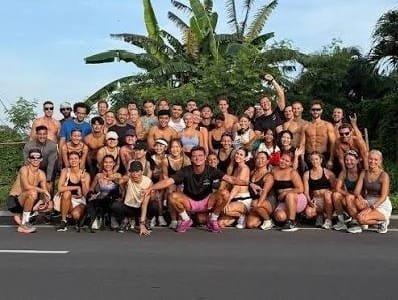
The New Colonisers: How the Digital Nomad Economy Is Recolonising the Global South
Usually I don’t watch much YouTube these days, and I’m highly cautious and skeptical of what I do watch online. However this video by Moon called “Bali: Everything Wrong With Society” came into my recommended and after watching it, combined with my knowledge of living in South East Asia for some years, leads me to agree very much with many of the points he is making.
I highly recommend for everyone to watch this video, as it will give you a strong and accurate insight on what is the reality of the situation regarding “influencers” and digital nomad colonisers in the Global South.
For the rest of this article, I will highlight and expand on many of the points made here. I wil also include a list of sources at the end.
Bali, Tulum, and the extraction economy hiding behind a ring light
For most of its history, Bali was a footnote in the story of the colonial European empire — overlooked by the Dutch until the late 1800s, worked by fishermen and rice farmers who answered to local royal houses rather than colonial administrators. It became, briefly, one of the least colonised corners of Southeast Asia. That window is closing. Not through gunboats or chartered companies this time, but through a laptop economy that arrived with a much friendlier face: the remote worker, the wellness entrepreneur, the “location-independent” founder, the influencer chasing a T-Rex-shaped cliff for a thumbnail.
The vocabulary is new. The mechanism is not. A wealthier population arrives in a poorer one, prices the locals out of their own land, strips their spiritual and cultural practices for content, and leaves behind an economy structurally rebuilt around servicing the newcomers rather than the people who were there first. Development economists and tourism scholars increasingly have a name for this, and it isn’t a metaphor: neocolonialism, or in the specific academic literature on remote work, “digital nomad colonialism.”
This piece lays out the evidence — economic, environmental, criminological, and cultural — using Bali and Tulum as the two clearest case studies, and situates both within a wider pattern now visible from Lisbon to Mexico City to Chiang Mai.

1. The scale of the thing
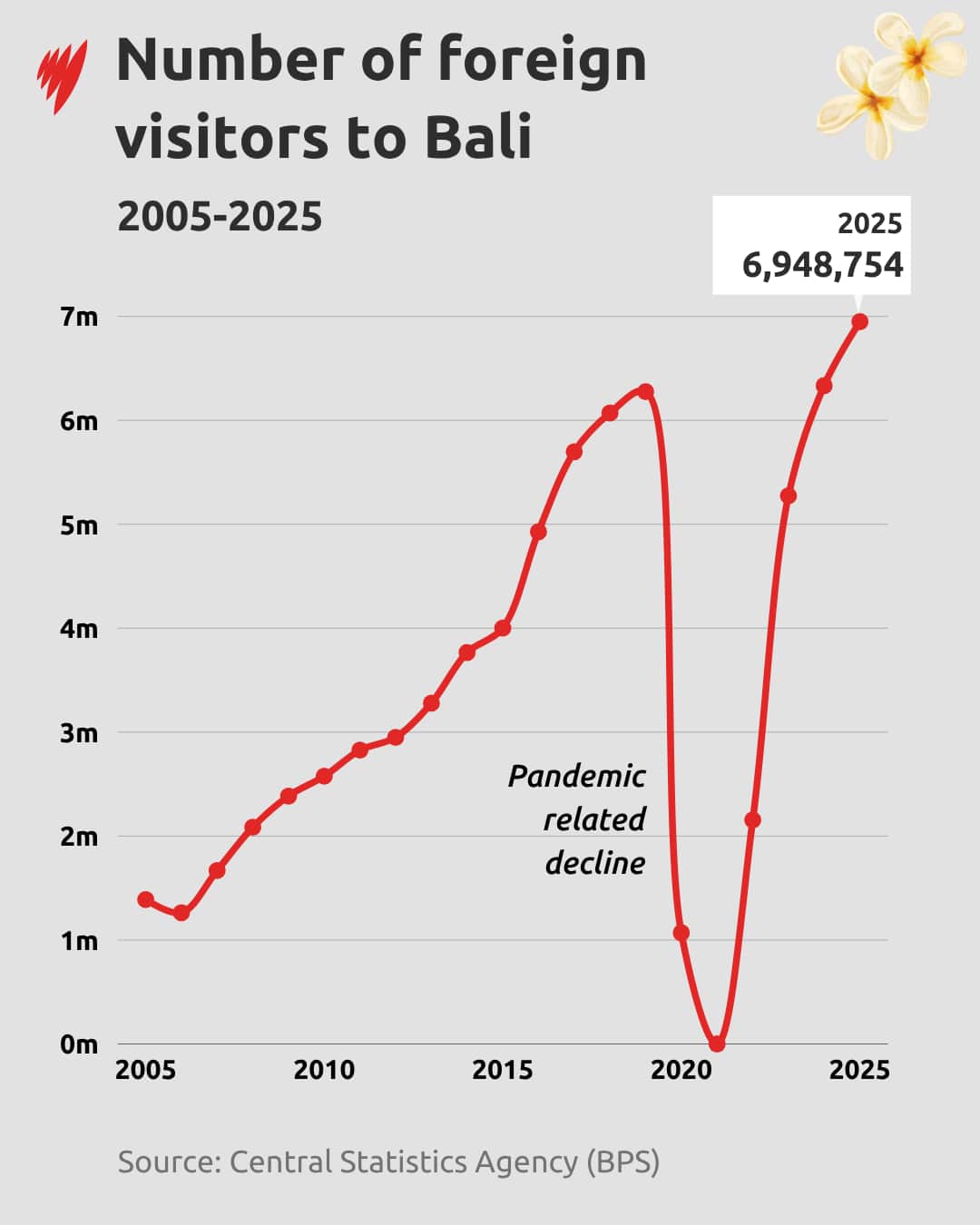
Bali received roughly 7 million foreign visitors in 2025, a nearly ten-fold increase on the roughly 1 million annual visitors it saw in the early 2000s.¹ Digital nomads — as distinct from short-stay tourists — now make up an estimated 20% of Bali’s long-term rental market, concentrated almost entirely in a handful of micro-markets: Canggu, Ubud, Uluwatu, Pererenan.² Indonesia’s central statistics agency recorded that Bali’s average household expenditure rose 20.72% year-on-year in March 2023 — the highest increase of any province in the country, explicitly attributed to the post-pandemic tourism surge.³
This is not incidental economic activity. It is a structural reweighting of an entire regional economy around a foreign consumer base, and it has happened with extraordinary speed — inside a single decade in Bali’s case, inside a handful of years in Tulum’s.
2. “Is this colonialism?” — what the researchers actually say
It would be intellectually lazy to simply assert the colonialism framing without acknowledging that it’s contested. It is. Some tourism economists, such as researcher Vipin Tiwari, have pushed back directly, arguing that digital nomads are not “directly involved with the productive mechanisms” of host economies in the way colonial administrations were, and that some host nations are using nomad inflows to accelerate into middle-income status.⁴
But a growing and increasingly specific body of peer-reviewed scholarship disagrees, and it doesn’t disagree loosely. Researchers including McElroy (2020), Thompson (2021), and Wang et al. (2024) have directly tied digital nomadism to “the legacies of colonialism and neo-colonialism.”⁵ A 2026 study of Denpasar youth — titled, pointedly, “White Skin, Tanned Masks, Sawo Mateng Exploitation? Digital Nomads in Bali” — investigated what the authors call “the coloniality of contemporary digital nomadism,” an identity structure in which Western tech workers maintain Silicon Valley salaries while adopting the aesthetics of location independence, found split local sentiment (49% defending Western digital-nomad advocacy, 51% opposed) and concluded that gentrification was actively occurring as a result of the wealth and cultural gap between nomads and locals.⁶ The University of Melbourne’s Pursuit journal reports fieldwork in which local–nomad interactions were found to be “primarily transactional,” occurring across a counter rather than in genuine community space, in cafés that are frequently priced beyond what local Balinese can afford.⁷ Locals themselves, per research published by The Conversation, use the term “bules” for the newcomers — one of a family of terms (alongside things like New Jersey’s “shoobies”) used globally by residents to mark out extractive, unrooted visitors who occupy space without belonging to it.⁸
The honest position (and the one Bali’s own residents hold in something close to a 51/49 split) is that this is a genuinely contested question with real scholarship on both sides. But the weight of the specific, granular evidence — displacement, price arbitrage, cultural commodification, demographic replacement in spiritual centres — points overwhelmingly toward the extractive reading. The rest of this piece is that evidence.
3. The economics of arbitrage
The core mechanism is simple and well documented: a nomad earning a wealthy-nation salary spends a wealthy-nation budget in a low-cost economy, and local rents, land prices, and even café menus reprice around that spending power rather than around local wages.
- Bali’s official minimum wage for 2026 is IDR 3.2–3.5 million per month — roughly $196–232, even in the highest-tourism regencies like Badung, which covers Canggu, Seminyak, and Uluwatu.⁹
- Rents in Canggu climbed 18% year-on-year in 2026 alone, on top of years of prior increases; one long-term digital nomad housing guide notes a basic Canggu villa that cost $400/month in 2019 now runs $700–900+, more than double in seven years.¹⁰
- Long-term residents describe land prices in Canggu rising roughly tenfold since 2017 as the area was “discovered” by the nomad and influencer economy.¹¹
- Denpasar rental prices alone rose over 15% in a single year even outside the popular nomad enclaves.¹²
This is precisely the mechanism documented in Mexico City, where McGill University gentrification researcher David Wachsmuth has noted that unlike conventional tourists, nomads settle in residential neighbourhoods and create sustained demand that restructures local retail — “grocery stores turn into restaurants” — with little benefit flowing back to long-term residents.¹³ In Lisbon, rental prices rose 37% in a single year, forcing Portuguese families out of neighbourhoods their own grandparents built, according to reporting compiled from The Independent and The New York Times.¹⁴ Mexico City saw mass protests in July 2025 explicitly targeting the digital-nomad-driven rent surge, with banners reading “Gringo: Stop stealing our home” — protests serious enough that then-Mexico City Mayor Claudia Sheinbaum, by then Mexico’s president, felt compelled to publicly condemn xenophobic elements of the demonstrations while still acknowledging gentrification as “a legitimate problem.”¹⁵ That distinction matters, and it is worth holding onto throughout this piece: the economic critique of the nomad economy is evidence-based and defensible; conflating it with blanket hostility toward foreigners is not, and serious critics on the ground — including the very officials managing the fallout — have said so explicitly.

4. Spiritual extraction: when a religion becomes a wellness SKU
Nowhere is the colonial pattern more visible than in the commodification of Balinese Hindu spiritual practice. A 2025 peer-reviewed study, “Wellness for Tourists? Well…mess for Locals,” documents Ubud residents directly reporting demographic displacement inside their own spiritual capital: one local source told researchers “the Hindu population is now less than 60% of the original Balinese people” in areas of Ubud that were, within living memory, close to entirely Hindu Balinese.¹⁶ The same research traces how yoga — a practice with specific metaphysical and devotional content — has been systematically stripped of that content and “rebranded as a lifestyle product,” with the added irony that Western-issued yoga certifications now function as the credentialing standard even for local Balinese teachers, effectively requiring the colonised to seek Western validation to teach their own tradition.¹⁷
Investigative reporting from The Lead on what it terms Bali’s “spiritual-industrial complex” documents Balinese healers voicing direct discomfort at the marketisation of practices that were never meant to be sold, alongside a wellness-influencer ecosystem in which, as one long-term Ubud resident and healing practitioner put it to journalists, visitors arrive with essentially no grounding in either genuine Balinese healing tradition or the New Age industry that has grown up around it — leaving them vulnerable to predatory operators who dress extraction up as enlightenment.¹⁸
This is the “spirituality loser” phenomenon in its most literal, sourced form: an entire subculture of Western-run retreat centres, energy healers, and “shamanic” facilitators operating with zero accountability to the tradition they are profiting from, in a country where that tradition constitutes an actual, living, minority religion under active demographic pressure.

5. Environmental extraction
Two Bali stories from 2025–2026 make the environmental cost concrete.
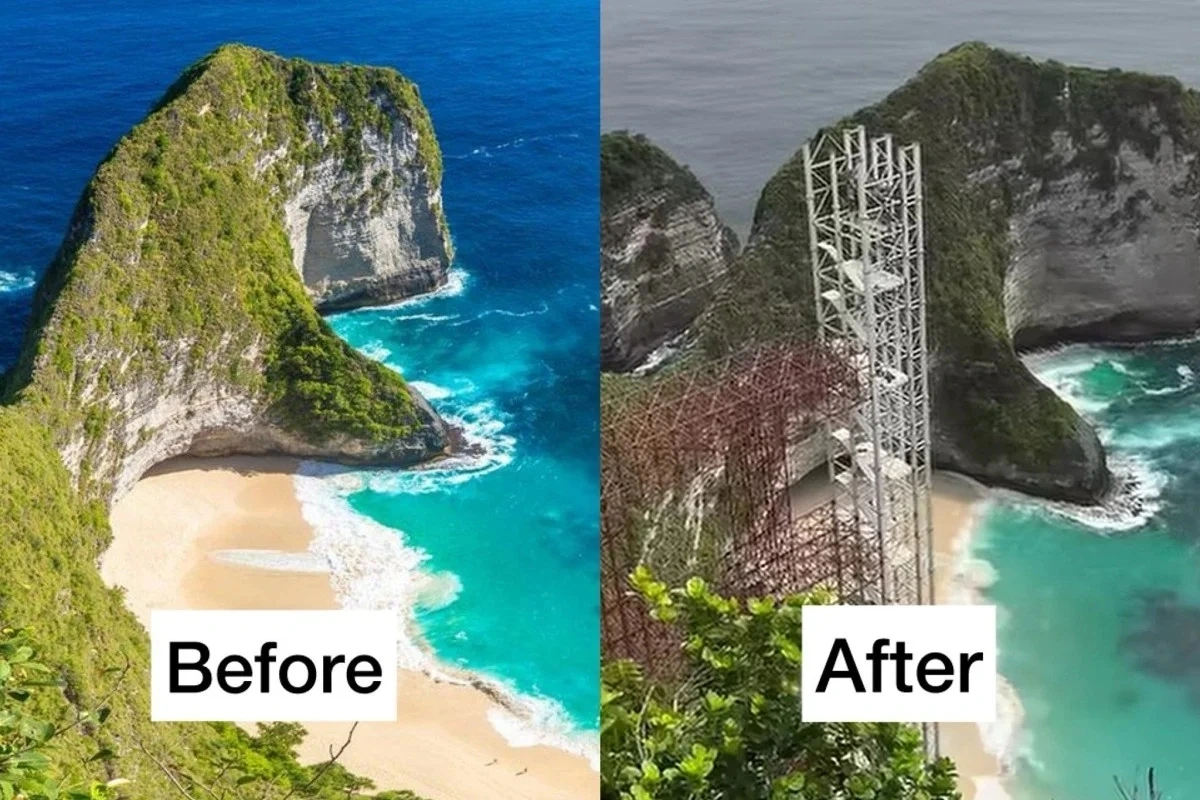
The Kelingking Beach glass lift. Kelingking Beach, on Nusa Penida, is one of the most photographed cliffs on earth — a limestone formation curved into the shape of a dinosaur’s head, a favourite backdrop for influencer content. In 2023, Chinese developer China Kaishi Group (operating locally as PT Indonesia Kaishi Tourism Property Investment Development Group) began building a 182-metre glass elevator directly through the cliff face, at a cost of roughly 200 billion rupiah (US$12 million), explicitly to speed tourist access for photography.¹⁹ Bali’s provincial legislature found the project violated national coastal zoning law, sat inside a legally protected disaster-mitigation zone, and lacked proper permits; Governor I Wayan Koster ordered construction halted in early November 2025 after viral photos of the lift shaft cutting through the cliff triggered national outrage.²⁰ A court ordered the structure demolished by 23 May 2026 — a deadline that has now passed with no demolition carried out, as the developer pursues an appeal through Indonesia’s State Administrative Court while the unfinished steel shaft continues to dominate one of the country’s most sacred natural landmarks.²¹
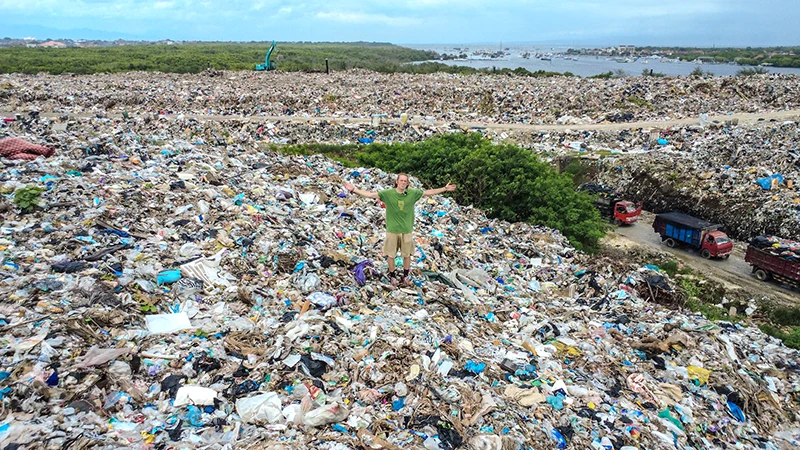
The waste crisis. Bali’s principal landfill, TPA Suwung, operating since 1984, stopped accepting organic waste on 1 April 2026 as part of a national anti-open-dumping mandate — organic material accounts for 65% of everything the island throws away.²² The replacement waste-to-energy infrastructure was not ready. The result, as documented by Inside Climate News, SBS, and multiple Bali-focused outlets, has been a surge in illegal dumping and open burning across the island, with residents in Denpasar, Badung, Gianyar and Tabanan setting rubbish alight in the absence of any functioning collection alternative, producing acrid smoke that has pushed air quality readings toward AQI 150 in some of Bali’s most popular surf zones.²³ None of this is a natural disaster. It is the downstream cost of an island whose waste infrastructure was built for a population a fraction of the size of what mass tourism and long-stay foreign residency now produce.
6. Cultural desecration, one deportation at a time
Indonesia’s Ministry of Law and Human Rights has, in recent years, had to build an entire administrative process around the specific problem of foreign tourists filming themselves naked at Balinese sacred sites for social content:
- In 2022, Russian influencer Alina Fazleeva was deported after her husband photographed her nude beside a 700-year-old sacred banyan tree in a Tabanan temple complex for Instagram.²⁴
- In 2023, a Russian tourist known publicly only as “Yuri” was deported for posing semi-nude atop Mount Agung, the volcano regarded in Balinese Hinduism as the seat of the gods.²⁵
- Canadian actor Jeffrey Craigen, who described himself as a wellness guru, was deported after posting video of himself performing a Māori haka nude atop Mount Batur, another sacred peak, in 2022.²⁶
- The accumulation of these incidents was serious enough that in mid-2023 Bali’s governor imposed a permanent ban on climbing all 22 of the island’s mountains for tourists, residents, and domestic visitors alike, citing the need to protect their sanctity.²⁷
Each of these is an individual incident. Together, they describe a pattern: a subculture that treats an entire population’s active religious cosmology as a photogenic backdrop, indifferent to the fact that these are not ruins or museum pieces but living sites of ongoing devotion.

7. The criminal shadow economy that follows the money
Wherever large flows of foreign cash and weak enforcement capacity intersect, transnational organised crime follows — and Bali and Tulum both illustrate this with grim precision.
Bali. In September 2025, a Bali court sentenced Ukrainian national Roman Nazarenko to life imprisonment for operating a drug production laboratory found inside a rented villa; two Ukrainian brothers and a Russian national were separately sentenced to 20 years each for the same operation, with the alleged mastermind still at large.²⁸ More gravely, in February 2026, 28-year-old Ukrainian national Ihor Komarov was kidnapped from a motorbike in Jimbaran, a resort district. His captors demanded a $10 million ransom and released footage of him tortured and mutilated; his dismembered remains were later identified via DNA testing on a Gianyar beach. Bali police named six foreign suspects, several allegedly holding multiple passports. Indonesian investigators believe the couple’s location may have been exposed through a Valentine’s Day Instagram post shared by Komarov’s girlfriend, a lifestyle influencer with over 146,000 followers.²⁹ It is a genuinely difficult case to sit with: an economy built on visibility — post your location, post your face, post your wealth — intersecting directly with a criminal underworld that reads those same posts as targeting data.
Tulum. The pattern is sharper still in Mexico. Tulum’s population was roughly 20,000 in the 2020 census; it is now projected to reach 250,000 within a decade, driven almost entirely by tourism and remote-work migration.³⁰ Violent crime in Tulum has risen 783% since 2019, according to Mexican outlet La Reforma, with at least five cartels now operating in the Riviera Maya.³¹ In October 2024, a shooting at a popular restaurant killed two foreign tourists; a note left by the group Los Pelones — allied with the Gulf Cartel — was found in the local market the following day, warning local business owners that “la plaza has an owner” and threatening further violence against anyone who didn’t comply.³² Quintana Roo’s state attorney general has separately confirmed the existence of a so-called “Cartel del Despojo” — a “Dispossession Cartel” of corrupt public officials using fraudulent civil and labour lawsuits to seize land from at least a dozen Tulum business owners since mid-2024.³³ Former DEA chief of international operations Mike Vigil has explicitly framed this trajectory as following the same arc as Acapulco: a beloved resort town whose criminal infrastructure grew in direct proportion to its tourist economy, until the tourists themselves became targets.³⁴

None of this is the fault of any individual traveller having a nice holiday. It is the fault of an extraction economy that grows faster than the governance capacity needed to contain what it attracts.
8. The grift layer: manosphere hustle culture goes tropical
A specific subculture has attached itself to the digital nomad economy, and it deserves to be named precisely rather than gestured at: the online fake “business coach” scam ecosystem — self-development gurus, supplement-brand founders, real-estate “education” sellers, dating-app optimisation consultants — relocating to low-cost countries specifically because the cost arbitrage lets a thin income look, on camera, like wealth.
This is not a fringe phenomenon. A 2026 investigation by digital-safety group Reset Tech and gender-equality nonprofit Equimundo, titled “The Grift Economy: How Young Men Are Being Sold Fake Belonging and Fake Wealth Online,” spent eighteen months examining the commercial architecture of the online “manosphere” and concluded it functions less as an ideological movement than as a commercial pipeline: identify an anxious or isolated young man, sell him a grievance narrative, then sell him the “cure” — a subscription “academy,” a supplement stack, a course promising financial independence.³⁵ Academic research from the Australian National University reaches the same conclusion, describing “manfluencer” academies that can cost thousands of dollars and documenting how the entire economy runs on monetised insecurity rather than delivered value.³⁶
Layer that business model onto a country where $1,500 a month buys a beachfront villa, and you get exactly the pattern visible in viral creator interviews from Bali and Canggu over the past several years: men in their twenties, months into a “coaching” or “supplement brand” business, describing themselves as on track for seven-figure annual revenue while giving no verifiable evidence of it — a claim pattern local commentators and even fellow travellers have publicly mocked as simply not adding up.³⁷ The country functions, for this subculture, as a stage set: cheap enough that a thin income mimics wealth on camera, foreign enough that no one back home can verify the claims, and photogenic enough to generate the b-roll that sells the next scam course.

9. This is a global pattern, not a Bali problem
Bali and Tulum are the sharpest case studies, but the mechanism is now visible across a specific, repeating list of destinations: **Lisbon, Mexico City, Chiang Mai, Medellín, Tbilisi, Cape Town, the Canary Islands.**³⁸ Portugal has already tightened its digital nomad visa rules in direct response to the housing pressure.³⁹ Cafés in both Lisbon and Mexico City have begun banning laptop use outright to push out the remote-work crowd occupying tables for hours on minimal spend.⁴⁰ The pattern is now well enough established that even writers embedded inside the nomad community — including several publishing under their own bylines — have begun describing the correction as “healthy, not hostile,” acknowledging the arbitrage they personally benefited from while calling for it to end.⁴¹
10. Is “neocolonialism,” the new “fascism”?
It’s worth being precise about terminology here, because precision is what makes an argument like this hold up under scrutiny rather than collapsing into rhetoric. Fascism is a specific historical and political category — a form of authoritarian ultranationalism organised around a centralised state, typically featuring a cult of a leader, suppression of political opposition, and often territorial or racial expansionism enforced through state violence. The digital nomad and influencer economy has no state apparatus, no centralised ideology, and no coercive political programme. Though they are certainly engaging in territorial and racial expansionism, calling it “fascism” would be a category error that actually hands critics an easy way to dismiss the argument.
That is not to say that many of these individuals are not fascistic in their conduct, and considering fascism is louder and more organised than it has been in decades, many of them indeed are textbook fascists.
Neocolonialism, by contrast, is a well-established and precisely defined concept in postcolonial and development studies: the exercise of effective economic and cultural control over a formerly (or never-formally) colonised territory through market mechanisms rather than direct political rule — extraction of value, displacement of local populations, and reshaping of local economies and culture around the needs of a wealthier outside group, without the machinery of a colonial state. That is exactly the pattern documented above, and it is the term the peer-reviewed literature on this subject already uses.⁴² Using the accurate term isn’t a softening, it should be what makes the argument evidentially bulletproof rather than easy to wave away.
11. What responsible engagement actually looks like
None of this is an argument against travel, remote work, or foreign investment as such — all of which can be conducted in ways that build rather than extract. It’s an argument for naming the mechanism honestly so it can be governed. Host governments have begun to respond: Indonesia’s Remote Worker (E33G) visa was designed explicitly to formalise and tax nomad presence rather than leave it in a grey zone;⁴³ Mexico City has moved toward rent regulation tied to inflation;⁴⁴ Bali’s mountain-climbing ban and Kelingking demolition order both represent, however belatedly, a state reasserting control over sites the market had begun treating as content backdrops rather than sacred ground.
The uncomfortable truth for anyone inside this economy — nomad, researcher, or occasional traveller alike — is that individual good intentions do not neutralise structural extraction. Paying a fair local wage to a housekeeper doesn’t offset an 18% rent surge that prices out a hundred families down the street. The fix has to be structural: foreign land-ownership caps, enforced local-hire quotas, tourist taxation that funds waste and housing infrastructure rather than developer profit, and — as several of the sources above argue — a willingness among nomads themselves to treat host countries as places with their own political and economic sovereignty, rather than a discount backdrop for a life built somewhere else.
Sources
- Bali tourist arrivals: Magnum Estate, “Bali Digital Nomads 2026: Remote Work & Villa Demand” (2026) — magnumestate.com
- Digital nomad share of long-term rentals: Prestige Property Bali, “Best Areas to Invest in Bali for Maximum ROI in 2026” — prestigepropertybali.com
- Household expenditure increase: Databoks/Katadata, citing Indonesia’s Central Statistics Agency (BPS), March 2023 data — databoks.katadata.co.id
- Tiwari critique of the colonialism framing: “Digital nomads: the future of work, or colonialism 2.0?”, The Long and Short — thelongandshort.org
- McElroy/Thompson/Wang et al. on nomadism and neo-colonial legacies: ScienceDirect, “Digital nomadism from a life course perspective” (2025) — sciencedirect.com
- “White Skin, Tanned Masks” study: ResearchGate (2026) — researchgate.net
- University of Melbourne Pursuit, “Local responses to global nomads” — pursuit.unimelb.edu.au
- “Bules” terminology and neocolonial tourism framing: The Conversation, “As countries ranging from Indonesia to Mexico aim to attract digital nomads, locals say ‘not so fast'” — theconversation.com
- Bali minimum wage 2026: RemotePeople, “Minimum Wage in Bali for 2026” — remotepeople.com
- Canggu rent increases: Meridian Nomad, “Bali Digital Nomad Guide 2026” — meridiannomad.com; Yahoo Travel, “Why Digital Nomads Are Quietly Abandoning Bali” — travel.yahoo.com
- Canggu land price history: Nomads.com, “Cost of Living in Canggu, Bali” — nomads.com
- Denpasar rental increases: The Bali Sun, “Rising Cost Of Living Impacting Local Communities & Digital Nomads In Bali” — thebalisun.com
- David Wachsmuth (McGill University) on Mexico City gentrification mechanics: NBC News — nbcnews.com
- Lisbon rent increases: Medium, “Digital Nomadism Is Dismantling the Very Communities It Claims to Celebrate” — medium.com
- Mexico City protests and Sheinbaum statement: Associated Press via Fortune, July 2025 — fortune.com
- Ubud Hindu demographic decline: “Wellness for Tourists? Well…Mess for Locals”, Taylor & Francis (2025) — tandfonline.com
- Yoga commercialisation and Western certification standards: same source, 16 above
- Balinese healers and the “spiritual-industrial complex”: The Lead — thelead.uk 19–21. Kelingking Beach glass lift: South China Morning Post — scmp.com; Bali Discovery, “Faulty Tower” (2026) — balidiscovery.com; Global Construction Review — globalconstructionreview.com 22–23. TPA Suwung landfill closure and burning crisis: Inside Climate News, “Bali Is Still Choking on Plastic” (2026) — insideclimatenews.org; SBS Indonesian — sbs.com.au
- Alina Fazleeva deportation: Malay Mail (2022) — malaymail.com
- “Yuri” Mount Agung deportation: BBC — feeds.bbci.co.uk
- Jeffrey Craigen Mount Batur deportation: Gulf News — gulfnews.com
- Bali mountain-climbing ban: Time Out — timeout.com
- Bali drug lab sentencing: Al Jazeera (2025) — aljazeera.com
- Ihor Komarov kidnapping and murder: CBS News — cbsnews.com; Indonesian National Police — inp.polri.go.id
- Tulum population projection: Mexico News Daily, “The Tuluminati: Gentrification and the jungle” — mexiconewsdaily.com 31–32. Tulum cartel violence and Los Pelones: The Daily Beast — thedailybeast.com; VICE World News — vice.com
- “Dispossession Cartel” land seizures: Riviera Maya News — riviera-maya-news.com
- Former DEA official on Acapulco/Tulum trajectory: The Daily Beast, source 31 above
- “The Grift Economy” report (Reset Tech / Equimundo, August 2026): IBTimes UK — ibtimes.co.uk
- Manosphere monetisation research: Australian National University — research.anu.edu.au 38–40. Digital nomad backlash across Lisbon, Mexico City, Chiang Mai: RoughMaps — roughmaps.com; Travelbinger — travelbinger.com
- Nomad-community self-critique: EditorialGE, “Digital Nomad Backlash: Why the Correction Is Healthy, Not Hostile” — editorialge.com
- Neocolonialism framing in tourism/nomad literature: sources 4–8 above
- Indonesia Remote Worker Visa policy: ResearchGate, “Role of Digital Nomad in Supporting Tourism in Indonesia” — researchgate.net
- Mexico City rent regulation plan: Associated Press via Fortune, source 15 above
Note on sourcing: viral influencer/creator interview footage referenced anecdotally in this piece (business-coach and supplement-brand claims filmed in Bali/Canggu) is used illustratively to characterise a documented subculture and business model, not as statistically representative or independently verified financial data. All factual claims about specific incidents, legal proceedings, and figures are sourced to the news, government, and academic citations above.

Avi is a researcher educated at the University of Cambridge, specialising in the intersection of AI Ethics and International Law. Recognised by the United Nations for his work on autonomous systems, he translates technical complexity into actionable global policy. His research provides a strategic bridge between machine learning architecture and international governance.