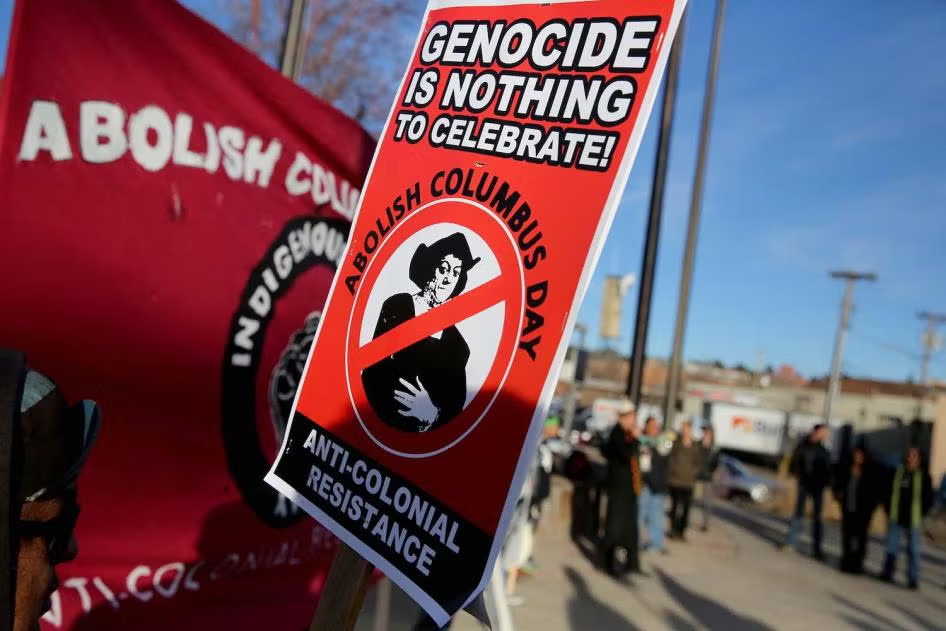
Abolish Columbus Day
A few days ago, the United States marked Columbus Day. On Friday the President hosted a celebration in the East Room and issued a proclamation praising Columbus as a hero whose voyage set in motion the forces behind 1776. I disagree, and I think the evidence, the law and the practice of international relations all point the same way. The federal holiday should be abolished, and Congress is the body that has to do it.
I write this as someone who studied international relations at Cambridge and law at Buckingham, and who spends most working days on how states use law to describe, excuse or prevent mass violence. My argument is narrow and I want to state it precisely. I am not asking anyone to forget Columbus. I am arguing that a democratic state should not hold a national day of celebration for a man whose governorship was ended by his own sovereign over abuses against the people he ruled, and whose voyages opened the door to one of the largest demographic catastrophes in recorded history.
Key takeaways
- Columbus Day is a creature of statute, set by 5 U.S.C. § 6103, and only Congress can repeal it. Presidential proclamations on either side are symbolic.
- The primary sources, including Columbus’s own logbook and the Bobadilla inquiry, document enslavement and brutality, and contemporaries condemned it.
- Whether “genocide” is the correct legal label for 1492 to 1500 is contested. Whether it is an acceptable object of national celebration is not.
- The legal doctrine that grew from “discovery” still sits inside US federal Indian law, while the Vatican, the High Court of Australia and the International Court of Justice have each rejected its foundations.
- Italian American heritage deserves honour in its own right and does not depend on Columbus.
What the holiday actually commemorates
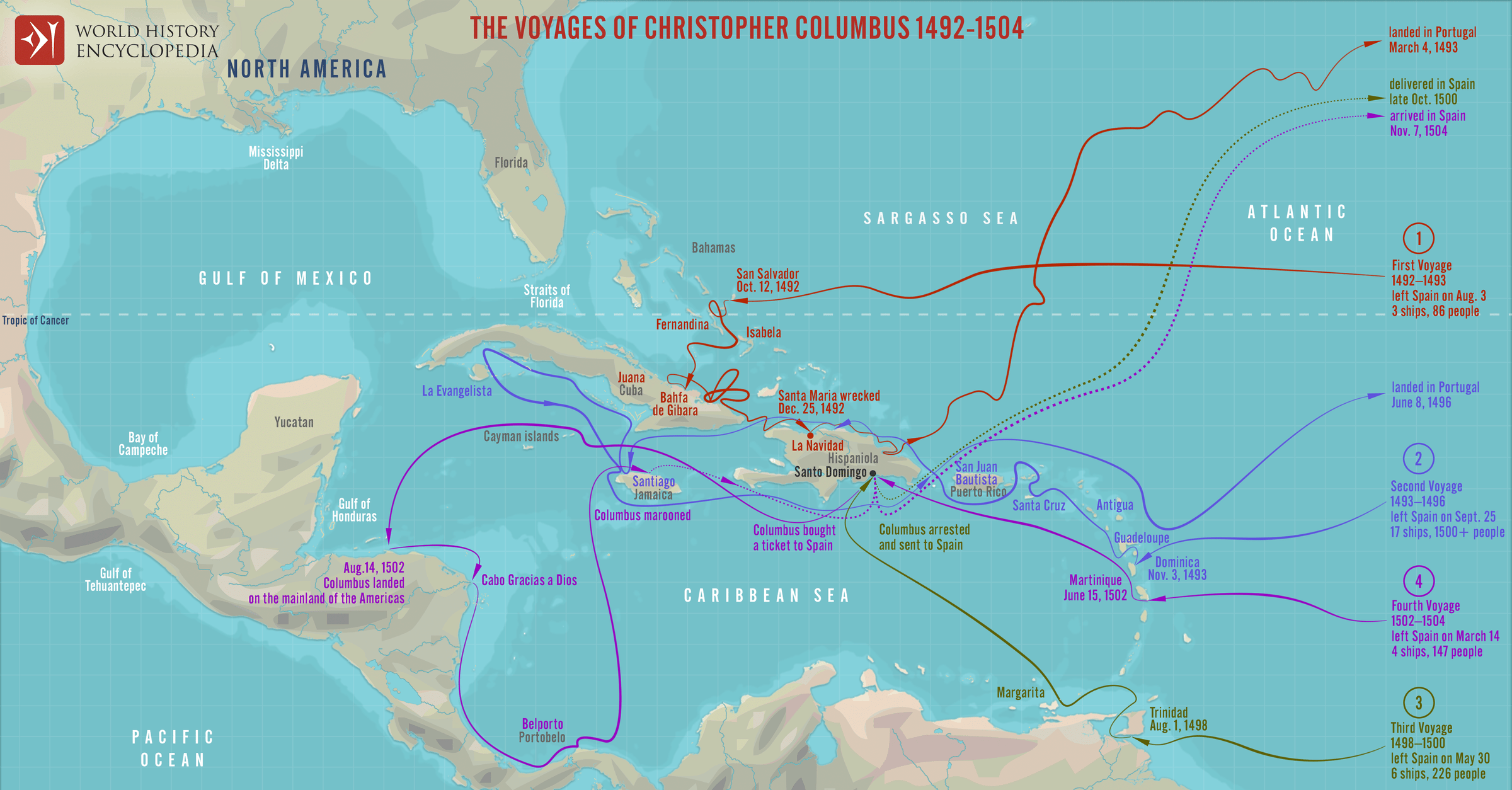
Columbus never set foot in what became the continental United States. His four voyages touched the Bahamas, Cuba, Hispaniola, Puerto Rico, Jamaica and the coasts of Central and South America. A holiday that presents him as a founding figure of the Republic rests on a myth that was built deliberately.
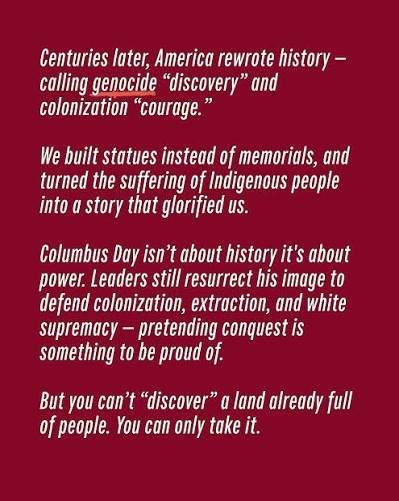
The observance began in New York in 1792, grew into a national gesture in 1892 under President Benjamin Harrison after the 1891 lynching of eleven Italian Americans in New Orleans, and became an annual federal observance when Franklin Roosevelt proclaimed it in 1937. Congress then fixed the date as the second Monday in October through the Uniform Monday Holiday Act of 1968, which took effect in 1971. Today the holiday is listed in 5 U.S.C. § 6103(a). That history matters for two reasons. It shows that the holiday was always about politics and belonging, and it shows that the remedy is legislative.
What the primary record shows
I rely on the sources rather than on slogans, so here is the record in order.
The 1492 logbook. Columbus’s journal survives mainly through Bartolomé de las Casas’s abstract. In the entry for his first landing he records that the people he met would make good servants and could be subdued with a small force. The intent to dominate appears on the first day.
Enslavement. In 1495 Columbus had hundreds of captured Taíno shipped to Spain for sale, and many died on the crossing. On Hispaniola he imposed a tribute regime built on quotas that people could not meet, which Las Casas later described in his Brevísima relación de la destrucción de las Indias (1552).
The Bobadilla inquiry. In 2006 the Spanish archivist Isabel Aguirre and the historian Consuelo Varela published the testimony gathered in 1500 by the royal investigator Francisco de Bobadilla, found in the Archivo General de Simancas. Twenty-three witnesses, including people who had supported Columbus, described a government of summary punishment and mutilation. Varela’s study, La caída de Cristóbal Colón (Marcial Pons, 2006), concluded the regime was tyrannical. Critics note that some witnesses were hostile to Columbus, and that is a fair caution about any single account. It does not explain why the Crown acted on the findings by removing him from office and sending him home in chains.
Contemporary condemnation. This answers the most common objection I hear, that we are judging a fifteenth-century man by twenty-first-century standards. In December 1511 the Dominican Antonio de Montesinos preached against the treatment of the Taíno in Santo Domingo, and Las Casas spent decades arguing that Indigenous peoples had rights. The standards were available at the time and people applied them to Columbus.
The demographic collapse. A 2019 study in Quaternary Science Reviews by Koch, Brierley, Maslin and Lewis estimates that the Indigenous population of the Americas fell by roughly 90 percent in the century after 1492, a loss of around 56 million people. Epidemic disease was the largest driver, and I do not claim otherwise. Disease did not act alone, though. Enslavement, forced labour, warfare, famine and the destruction of social systems compounded it, and those were human decisions. Even a reader who attributes most deaths to pathogens should hesitate to hold a parade for the man who inaugurated the system.
Is “genocide” the right word?
I use the word carefully because it has a legal meaning. Article II of the 1948 Genocide Convention requires specified acts committed with intent to destroy a national, ethnical, racial or religious group in whole or in part. The Convention entered into force in 1951, and in Croatia v. Serbia (2015) the International Court of Justice confirmed that it does not apply retroactively. No court could convict anyone of genocide for conduct in 1495. The United States implements the Convention domestically through 18 U.S.C. § 1091, which is likewise forward-looking.
That is the legal answer. The historical and sociological answer is different. Raphael Lemkin, who coined the term in Axis Rule in Occupied Europe (1944), defined genocide broadly as a coordinated plan to destroy the essential foundations of the life of national groups. His unpublished manuscripts, discussed in A. Dirk Moses’s edited volume Empire, Colony, Genocide, treated Spanish conquest in the Americas as an early case. Later episodes in the same continuing process, such as the killing of an estimated 9,400 to 16,000 California Indians between 1846 and 1873 documented by Benjamin Madley in An American Genocide (Yale University Press, 2016), have been analysed under the same concept.
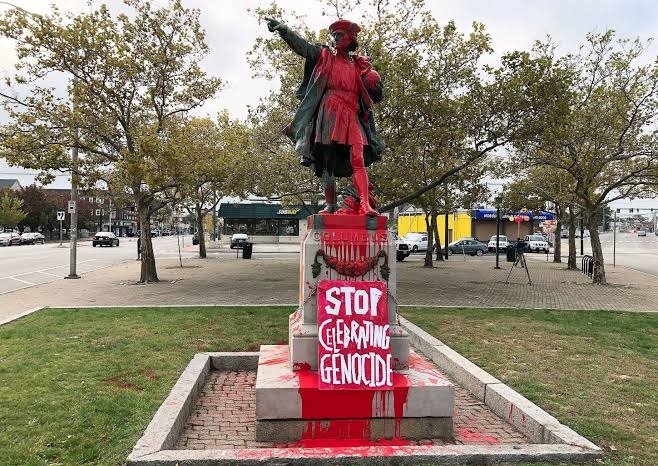
I therefore make a two-part claim. Scholars disagree about applying the legal term to the earliest period, and I respect that disagreement. The conduct recorded in the sources, namely enslavement, forced labour, mutilation and the shattering of whole societies, is something no state should celebrate under any label.
The law still lives in the doctrine of discovery
This is the part of the argument that connects past and present. In Johnson v. M’Intosh, 21 U.S. 543 (1823), Chief Justice Marshall held that discovery gave the European sovereign, and then the United States, the exclusive right to extinguish Native title, leaving Native nations with a right of occupancy that the sovereign could override. Nine years later, Worcester v. Georgia, 31 U.S. 515 (1832), recognised tribal nations as distinct political communities, and the two decisions have pulled against each other ever since.
Discovery reasoning has not disappeared. Justice Ginsburg cited it in a footnote to City of Sherrill v. Oneida Indian Nation, 544 U.S. 197 (2005), where the Court refused to let the Oneida revive sovereignty over land they had bought back. In McGirt v. Oklahoma (2020) the Court went the other way and held that Congress had never disestablished the Muscogee (Creek) Reservation, which shows that treaty promises can still bind. The result is a body of law that gives with one hand and retains the old premise with the other.
Other authorities have moved on. The International Court of Justice’s 1975 Western Sahara advisory opinion rejected the idea that inhabited land can be treated as terra nullius. In Mabo v Queensland (No 2) (1992) the High Court of Australia overturned that premise in domestic law and recognised native title. In March 2023 two Vatican departments issued a joint statement repudiating the doctrine of discovery and stating that it is not part of Catholic teaching, despite the fifteenth-century bulls, including Inter Caetera (1493), on which some scholars say it was built. When the institution that issued the documents disowns the doctrine, a national holiday honouring the voyage that put it into practice looks increasingly isolated.
Statute law and international standards
The UN Declaration on the Rights of Indigenous Peoples (2007) is not a binding treaty, and the United States, which initially voted against it, announced its support in 2010. Its standards are still instructive. Article 8 protects against forced assimilation and the destruction of culture, and calls for redress. Article 15 states that the dignity and diversity of Indigenous cultures and histories should be appropriately reflected in education and public information, and that states should combat prejudice. A federal holiday that honours the leader of the conquest while Indigenous history is compressed into a footnote sits badly with that standard.
On the domestic side, the executive can only do so much. In 2021 President Biden issued Proclamation 10283, the first presidential proclamation of Indigenous Peoples’ Day, and issued a separate Columbus Day proclamation. The current administration has reversed course. According to NPR reporting in October 2025, 17 states and the District of Columbia commemorate Indigenous people on the day. This back-and-forth is exactly what happens when a national question is left to the mercy of whoever holds the pen. Congress should amend 5 U.S.C. § 6103(a) and settle it.
The strongest objections, and my answers
“This holiday honours Italian Americans.” It does, and that history is serious. Italian immigrants faced real violence and discrimination, and the 1892 gesture was a response to it. That is an argument for a day that honours Italian American contributions directly. Linking their dignity to a man the Spanish Crown removed from office hands critics an unnecessary target and gives the community a weaker foundation than it deserves.
“You are erasing history.” Holidays are decisions about whom a state chooses to celebrate. Removing one does not remove a single page from a textbook, and it creates room to teach the whole record, including the Bobadilla papers and the work of Las Casas.
“Most deaths were from disease.” Epidemic disease accounts for much of the catastrophe, and I have said so above. The holiday does not honour epidemiology. It honours a person and a project, and the project included enslavement and forced labour.
“Other historical figures were flawed too.” Yes, and the test I apply is whether the wrongdoing was central to the role the person played and whether it was condemned at the time. For Columbus, both answers are yes.
Why this matters for international relations and AI governance
The logic that made discovery respectable was that land and resources count as available to whoever has the means to claim and exploit them. I see that pattern in current debates. Data is extracted from communities that never consented, compute and capital concentrate in a few jurisdictions, and Indigenous and Global South peoples are told that governance frameworks will be written elsewhere on their behalf. The CARE Principles for Indigenous Data Governance from the Global Indigenous Data Alliance are one attempt to reverse that, built on collective benefit, authority to control, responsibility and ethics.
The same habit of mind appears in security policy, where communities most exposed to surveillance and force are consulted least. I have written about this in my work on AI safety, set out my wider position on my stance page, and collected related commentary in my articles archive. My reasons for caring about these questions are in my story. A state that cannot tell the difference between a founding story and a justification for conquest will struggle to apply principles of consent and accountability to new technologies.
What should replace it
- Congress amends 5 U.S.C. § 6103(a) to replace Columbus Day with Indigenous Peoples’ Day, drafted in consultation with Tribal Nations.
- A separate, dedicated observance for Italian American heritage, so that recognition no longer depends on Columbus.
- Curriculum reform that teaches the primary sources, including the 1492 log, the Bobadilla inquiry and the Las Casas record, alongside the legal history from Johnson v. M’Intosh to McGirt.
Conclusion
A celebration is a statement of values made on behalf of every citizen. The evidence supports the view that the man at the centre of this one oversaw enslavement and brutality that his own contemporaries condemned, and that the system he began wrecked societies on a scale that has few parallels. A country confident in its principles can acknowledge that and still honour the communities who have a real claim to recognition. Abolishing Columbus Day is a modest correction, and it is long overdue.
Frequently asked questions
Is Columbus Day a federal holiday by law?
Yes. It is listed in 5 U.S.C. § 6103(a) as the second Monday in October, and only Congress can change that.
Did Christopher Columbus commit genocide?
No court can rule on it, because the Genocide Convention is not retroactive. Historians and legal scholars disagree about applying the concept to the early colonial period, but the documented enslavement and violence are well supported by primary sources.
Can a president abolish Columbus Day?
No. A president can issue proclamations, which are symbolic, but the holiday exists in statute.
What is the doctrine of discovery?
It is the legal idea that European discovery of land gave the discovering sovereign exclusive rights over it, subordinating Indigenous title. It entered US law in Johnson v. M’Intosh (1823) and was formally repudiated by the Vatican in 2023.
Sources and further reading
- Las Casas, B. de, Brevísima relación de la destrucción de las Indias (1552).
- Varela, C., La caída de Cristóbal Colón: el juicio de Bobadilla (Marcial Pons, 2006).
- Koch, A., Brierley, C., Maslin, M. and Lewis, S., “Earth system impacts of the European arrival and Great Dying in the Americas after 1492,” Quaternary Science Reviews 207 (2019).
- Madley, B., An American Genocide: The United States and the California Indian Catastrophe, 1846-1873 (Yale University Press, 2016).
- Moses, A. D. (ed.), Empire, Colony, Genocide (Berghahn, 2008).
- Lemkin, R., Axis Rule in Occupied Europe (1944).
- Joint Statement of the Dicasteries for Culture and Education and for Promoting Integral Human Development on the “Doctrine of Discovery” (30 March 2023).

Avi is a researcher educated at the University of Cambridge, specialising in the intersection of AI Ethics and International Law. Recognised by the United Nations for his work on autonomous systems, he translates technical complexity into actionable global policy. His research provides a strategic bridge between machine learning architecture and international governance.