Foundation Phantom MK-1 and MK-2
Foundation Phantom MK-1 / MK-2: Technical Dossier and Legal Analysis
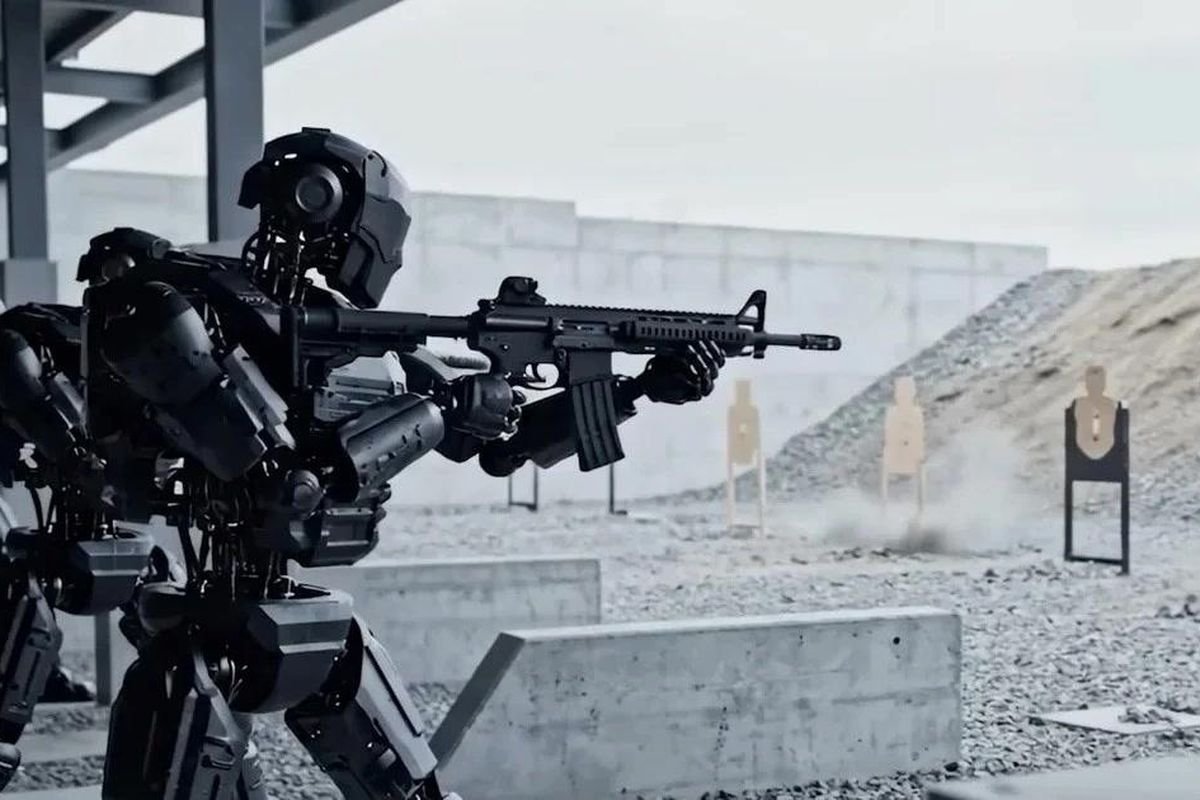
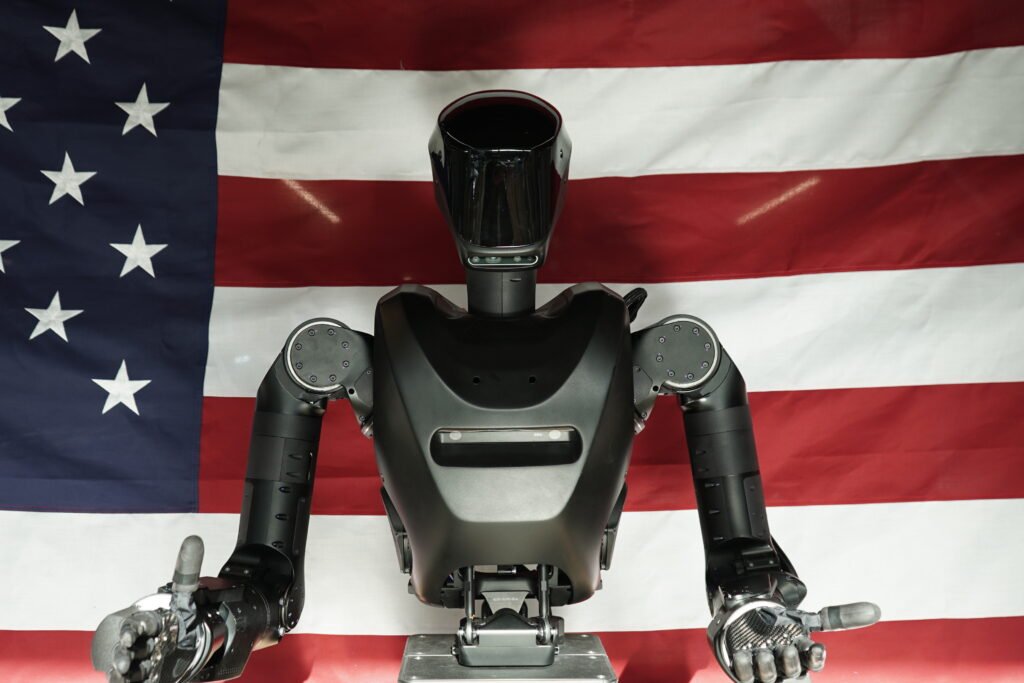
The Phantom is a general-purpose humanoid robot built by Foundation Future Industries of San Francisco, which markets it for factories and for war. Foundation unveiled the MK-1 in October 2025 as a humanoid designed for military use and sent two units to Ukraine in February 2026. Its chief executive, Sankaet Pathak, says the company is not shying away from combat, and that it has done some weapons handling and will eventually move to weapon use cases. I have catalogued the MK-1 and its successor, the MK-2, because the humanoid form changes the arms control question. It does not need a weapon bolted on, it is designed to pick up the weapons human soldiers already carry. This entry treats the system as it stands, which is a prototype with limited demonstrated capability and large declared ambitions. I mark clearly which statements are company claims and which are independently reported. Interesting Engineering, Forbes
Key takeaways
- The Phantom MK-1 is a prototype. Ukrainian trial reporting says it carries only about 20 kg, is not waterproof, and lacks battery life for large-scale use. militarnyi
- Foundation holds research contracts worth a combined $24 million with the US military. I found no confirmed armed use of a Phantom in combat. Time
- Foundation describes a human-in-the-loop model for lethal decisions. Its CEO has also said Phantoms will need to make fully autonomous decisions in certain time-critical scenarios. Those two statements cannot both govern the same system without a stated boundary, and none has been published. CNBC
- On 9 October 2026 Forbes reported that the Army is developing requirements and testing the MK-1, and that Ukraine’s former defence minister wants humanoids fighting within six months. Forbes
- The CCW Seventh Review Conference meets in Geneva from 16 to 20 November 2026. reachingcriticalwill

Basic Weapon Facts
I. Background
| Field | Detail |
|---|---|
| Manufacturer | Foundation Future Industries (also styled Foundation Robotics), San Francisco, USA. Co-founders: Sankaet Pathak (CEO) and Mike LeBlanc, a 14-year Marine Corps veteran with tours in Iraq and Afghanistan |
| Suppliers | Proprietary cycloidal actuators and an in-house AI system called Cortex. Third-party suppliers for cameras, compute, batteries and weapons: Unknown |
| Country of origin | United States |
| Developmental stage | Prototype and field trial. The MK-1 is being tested in factories and dockyards from Atlanta to Singapore, and in Ukraine. The MK-2 was announced for April 2026. Whether serial production has begun: Unknown |
| System version | MK-1 (first generation) and MK-2 (second generation). Some outlets also use the names Phantom 1, Phantom 2 and Phantom-01 |
| System type | Bipedal humanoid robot, general purpose, with declared military and security roles The Race to Build AI Humanoid Soldiers for War +3 |
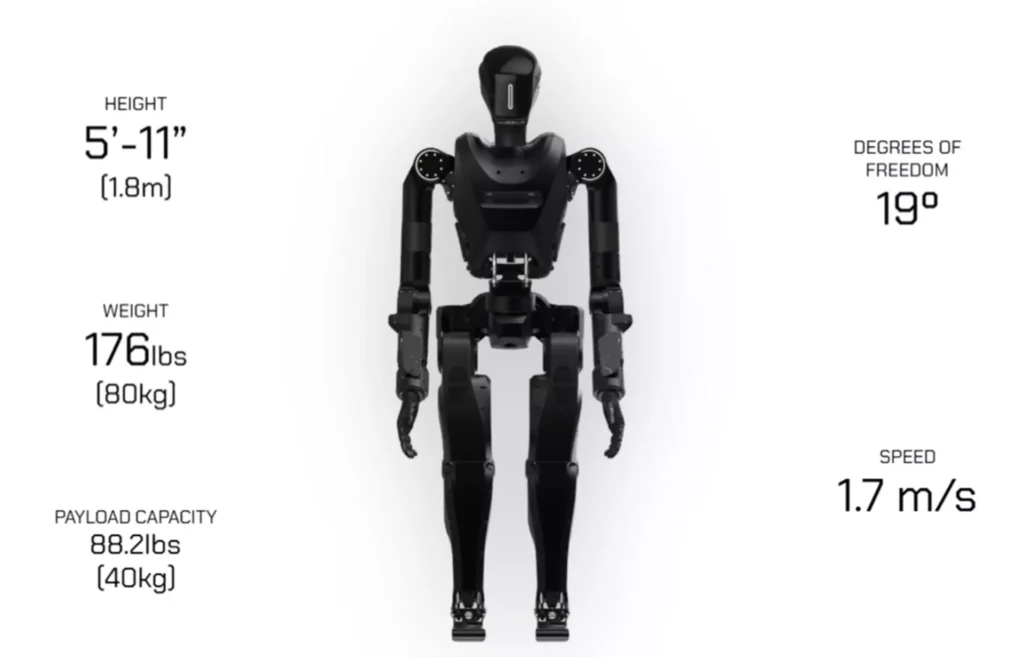
II. General Specifications
| Parameter | Specification |
|---|---|
| System dimensions | About 5 ft 9 in (about 175 cm) tall. Other dimensions: Unknown |
| Weight | Roughly 175 to 180 lb (about 80 kg) |
| Max payload | MK-1: about 44 lb (20 kg). MK-2: a claimed 175 lb (about 80 kg) |
| Max operating time | MK-1: Unknown. The unit shown to the BBC had no battery, and Ukrainian testers found battery life insufficient. MK-2: four to six hours depending on the task, with 30 to 45 minutes to recharge, as claimed by the company |
| Max operating distance/reach | Unknown |
| Max speed | Unknown (not verified in the sources I could open) |
| Actuation and sensing | Eight cameras, no LiDAR, and cycloidal actuators delivering up to 160 N·m of torque |
| Durability claims | Foundation says the MK-2 tolerates a momentary 100 g shock and keeps functioning after hits to several parts of its body. Independent verification: Unknown |
| Unit cost | About $150,000 in trial reporting. Mr Pathak puts the current cost around $50,000, with targets of $25,000 to $30,000 and, for basic units, under $10,000. The figures conflict |
| Production targets | Reported variously as up to 50,000 units by the end of 2027 and 40,000 per year by the end of 2027. Treat as aspiration US firm Foundation plans to build 50,000 humanoid robots by 2027 +12 |
The cost and production figures show how far the sources disagree, and I would not repeat any of them on a page without the word “reported”.
Development and operational record
October 2025. Foundation unveils the MK-1. Its co-founder says the company believes there is a moral imperative to put robots into war in place of soldiers, and describes a feedback loop in which combat use improves the product. Time
February 2026, Ukraine. Two MK-1 units went to Ukraine, with Foundation saying they were sent for battlefield evaluation. Reported tasks were logistics runs and reconnaissance sweeps. Mr Pathak said the trial showed the robot’s potential for supply pickups, which often expose soldiers to danger. I found no report of weapons use. Battlefield trial begins as Phantom MK-1 humanoid robots reach Ukraine +2
Independent assessment. A Ukrainian defence outlet concluded that the trial showed potential but that the MK-1 remains far from a super soldier. The same account lists a payload of about 20 kg, lack of waterproofing and insufficient battery life, and notes that the machine depends on about 20 motors that must each work reliably. TIME’s own visit saw Phantoms fall over with a crash more than once. The BBC found that the MK-1 could not recover from a fall and that its hands lacked the strength and dexterity for demanding tasks. Ukraine Testing Shows Limited Suitability of Phantom MK-1 Humanoid Robots for Battlefield Use +2
April 2026, the MK-2. The MK-2 was due in April with consolidated electronics, waterproofing, larger batteries and a 175 lb load capacity. Foundation also describes fall recovery, better force tolerance and more capable hands with wrists intended to help the robot fire weapons. Pathak says a hand matching human dexterity will follow in early 2027. Independent test data for the MK-2: Unknown. The Race to Build AI Humanoid Soldiers for War +2
Contracts and politics. The $24 million covers research contracts with the Army, Navy and Air Force. A Pentagon spokesperson said the department continues to explore militarised humanoid prototypes designed to work alongside warfighters, and LeBlanc said the company is in close contact with the Department of Homeland Security about patrol roles. CNBC describes the firm as Trump-linked, and The Next Web reports that Eric Trump is an adviser and that the company is seeking $500 million at a valuation above $3 billion. I attribute those points to the outlets. They are not findings of wrongdoing, and they are the sort of context a procurement oversight body would want on record. Humanoid Robot Soldiers Have Arrived in Ukraine—And the Battlefield May Never Be the Same +3
October 2026, the escalation. Forbes reports that Mykhailo Fedorov, Ukraine’s former defence minister, launched an Army of Robots scheme and wants humanoids fighting within six months. The target is, as Forbes itself notes, extremely ambitious, and I regard it as political signalling more than a technical forecast. Forbes
Autonomy: a forensic analysis
Sensors. The MK-1 uses eight cameras and no LiDAR. The design choice is deliberate. A camera-first approach lowers cost and weight, and it makes the robot depend on machine vision alone to understand its surroundings, which is the hardest condition for reliable recognition of people. One report notes that the robot’s thermal signature and footprint resemble those of a human soldier, which matters for how an adversary reads it. thenextwebthedefensenews
Algorithms. Phantom is controlled by Cortex, which Foundation says combines a reasoning model trained on task-specific examples with a world model trained on internet video and data gathered from the robot’s own physical interactions. Mr Pathak says transformer models let the robots learn quickly and cope with unfamiliar situations, and expects few-shot learning to suffice for structured military tasks. I regard this as the most consequential technical claim on the page, because a system built to generalise from few examples is also a system whose behaviour in a new environment is harder to predict or to test. humanoidForbes
Human intervention in the kill chain. Foundation’s public position is that robots manage movement and navigation while human operators keep control over lethal decisions, as with current military drones. The qualifier appears in the same reporting. Mr Pathak said that although most weaponised uses will retain a human confirmation step, the robots will need to make fully autonomous decisions in certain time-critical scenarios. The company has not said which scenarios, what limits apply, or who authorises the exception. That is the central gap in this entry. A system whose maker reserves the option of autonomous lethal decisions, and has not defined it, cannot be assessed as a human-in-the-loop weapon, whatever the marketing line says. interestingengineeringCNBC
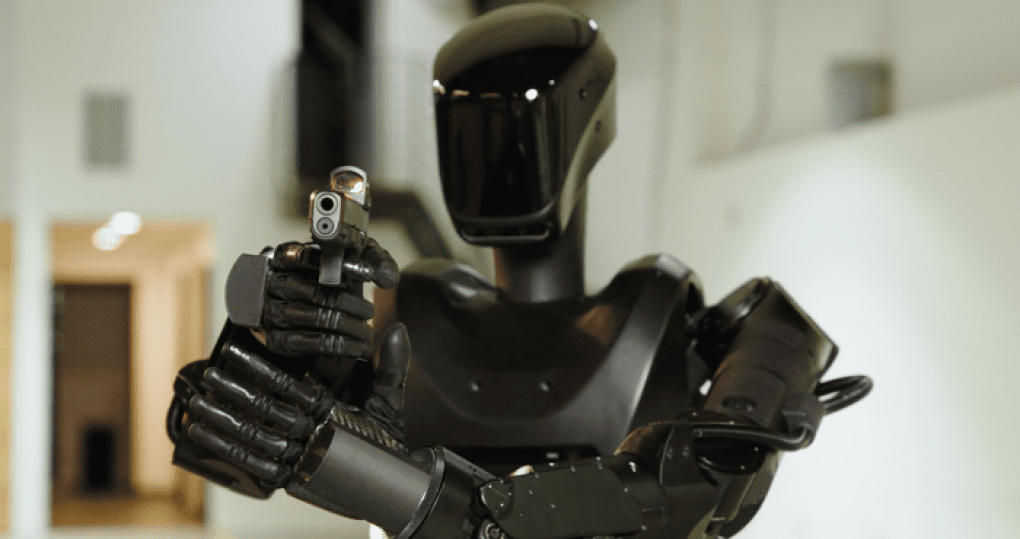
What has actually been shown. Foundation has trained the MK-1 on a 9mm pistol. Mr Pathak says it has done some weapons handling. Firing from a Phantom in a live trial or in combat: Unknown, and I have found no independent record of it. Weapons handling in a demonstration and a reliable engagement under battlefield conditions are different capabilities, and current hardware, with its weak hands and short endurance, sits far from the second. united24mediaForbes
Classification. On the public record the Phantom is a teleoperated and partly autonomous humanoid prototype with no confirmed armed use. It is not yet a lethal autonomous weapon system. I include it because the design intent is plain. A humanoid body is meant to use human weapons and human spaces, and a software update moves it from supervised to autonomous operation. For related ground systems see my entries on the Ghost Robotics Vision 60, the Unitree B2 and the ARCV MULE, and for the principle see my stance page and the meaningful human control article.
Legal analysis
Weapons review and the Pentagon directive
Article 36 of Additional Protocol I requires states parties to review new weapons, and the United States applies a comparable review as policy. Some press coverage says Department of Defense Directive 3000.09 requires a human in the loop for autonomous platforms. The Next Web makes that claim. I read the 2023 directive differently. It requires that autonomous and semi-autonomous weapon systems allow commanders and operators to exercise appropriate levels of human judgment over the use of force, and it imposes senior review for systems that select and engage targets autonomously. It does not mandate a human in the loop in every case. I flag this from my own reading, so check the text before publication. The distinction matters here because the CEO’s stated reservation for time-critical autonomy sits in the space the directive leaves open. thenextweb
Distinction, precaution and the urban setting
The Phantom’s declared uses include urban reconnaissance, door and stair negotiation and, in time, assault. Forbes reports that the Army’s interest begins with navigating urban environments. Urban combat is where Articles 48, 51 and 57 are hardest to apply, because civilians and combatants share the same buildings. A robot whose perception rests on cameras and a model trained on internet video must recognise civilians, persons who are hors de combat under Article 41, and people who surrender. Those are the judgments that depend most on context and least on pattern matching. The humanoid shape adds a further risk, because it invites people to read the machine as a soldier and trust its judgment accordingly. Forbes
A robot used as a decoy or a bullet sponge, as Foundation describes, is lawful as a ruse under Article 37(2), since a machine has no protected status. The legal weight falls on what the machine does to people and on the human accountability behind it.
The ICRC position on unpredictability and anti-personnel systems
The ICRC’s 2021 recommendations, which I cite from my knowledge and which its 2026 advocacy paper builds on, call for a prohibition on autonomous weapons whose effects cannot be predicted, and on those designed or used to apply force against persons. Both categories are engaged here. Few-shot learning in an unstructured environment is an unpredictability risk by design, and an armed humanoid used in building clearance is an anti-personnel system. If the autonomous exception described by Mr Pathak were operationalised, it would fall within the ICRC’s proposed prohibitions on both counts.
Domestic use
Foundation’s co-founder describes discussions with the Department of Homeland Security about patrol roles. Any armed domestic use would engage the Fourth Amendment’s use of force doctrine. Graham v. Connor, 490 U.S. 386 (1989), applies an objective reasonableness test to force used in seizures, and Tennessee v. Garner, 471 U.S. 1 (1985), restricts deadly force against fleeing suspects. The Posse Comitatus Act (18 U.S.C. § 1385) limits the use of the military for domestic law enforcement. I know of no case that addresses a humanoid robot, and I flag all four citations from memory. Time
Accountability and the contractor shield
If a Phantom harms civilians, whom do you sue or prosecute? Article 28 of the Rome Statute addresses command responsibility, and individual responsibility under Article 25 attaches to those who order, plan or commit the act. A robot is neither. US law then adds a shield. In Boyle v. United Technologies Corp., 487 U.S. 500 (1988), the Supreme Court recognised a government contractor defence to state law design defect claims where the contractor built to government specifications. In Saleh v. Titan Corp., 580 F.3d 1 (D.C. Cir. 2009), the court applied the combatant activities exception to bar tort claims against military contractors. Both are flagged for verification. Together they show how an armed robot could produce harm with a human chain of causation stretching through a start-up, a procurement officer, an operator and a model trained on internet video, and no party clearly answerable.
Corporate pledges
Boston Dynamics strictly prohibits arming any of its robots. I found no indication that Foundation signed the 2022 industry pledge against weaponisation, and its stated strategy is the opposite. I explained in the Vision 60 entry and the Unitree entry why such pledges bind only the signatory. Foundation’s open embrace of combat at least removes the ambiguity. Forbes
International relations implications
A humanoid arms race, openly welcomed. Foundation’s leadership says it wants China, America and everyone to have humanoid robots, and describes competition as forcing rapid innovation. Chinese developers talk of a coming ChatGPT moment for humanoid robots, and Russia has shown an experimental humanoid on a firing range. A company that cheers on its competitors’ militaries is describing an arms race as a business model. I covered the Chinese side in my Unitree B2 entry, and the mutual escalation logic is the same. The Race to Build AI Humanoid Soldiers for War
Lowering the political cost of force. The strongest argument for these robots is humane: send a machine ahead of a person. I accept that argument for reconnaissance, mine clearance and supply under fire. It carries a strategic cost. Foundation envisions expending large numbers of cheap machines like rounds of ammunition, replacing a dozen human casualties in an assault with a dozen robots. When a state’s own casualties fall, the domestic political barrier to using force falls too, and the burden shifts to the other side’s soldiers and to the civilians in between. Casualty aversion has always shaped decisions to go to war. A technology that removes it deserves to be examined as an input to those decisions. Forbes
Ukraine as a proving ground. The Army’s requirements work and the Ukrainian trials feed each other, and Foundation says it will use battlefield feedback to refine the product. That is a commercial model in which a country at war supplies the test conditions. Ukraine’s need is real, and so is the asymmetry. A company outside the conflict learns from the war, and the consequences of any failure fall on people inside it. I would want any such trial conducted under written rules on weapons, civilian protection and data. Forbes
Political economy. The reported links between a defence start-up, its political advisers and procurement decisions are worth independent scrutiny whatever party is in office. Humanoid military programmes are a young market with large valuation claims and thin evidence of capability, and that combination is where oversight tends to lag.
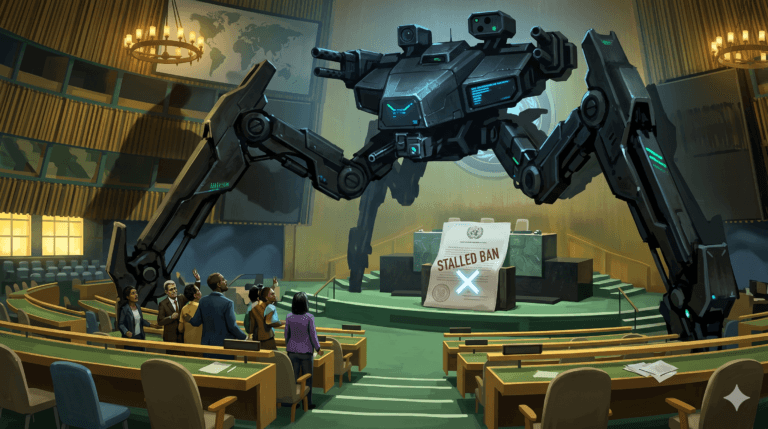
The treaty moment. On 5 September 2026 the CCW Group of Governmental Experts reached consensus among 128 states on a document addressing lethal autonomous weapons systems, though critics argue major military powers weakened it. France says the text clarifies human control and judgment and that the Review Conference must decide next steps. The UN Secretary General and the ICRC jointly called on 25 August for the November conference to begin binding negotiations. The ICRC urges states to launch negotiations on a new protocol. The Phantom is a test of whether a two-tier approach, prohibiting some systems and restricting others, can reach a humanoid general-purpose robot. A definition keyed to a specific weapon will miss a machine whose only fixed feature is a body shaped to hold other people’s weapons. States reach agreement on autonomous weapons regulations in Geneva
My assessment
I read the company’s own account of its aims twice. A founder tells a magazine that putting robots into war instead of soldiers is a moral imperative, and that his machines will make fully autonomous decisions in time-critical situations. I understand the moral instinct, and I do not think it is cynical. A former Marine who has buried friends will want to put something else in the doorway. My concern is the sentence that follows. Autonomy in time-critical situations is the exact phrase every developer reaches for when the human becomes too slow, and it describes the moment at which meaningful human control ends.
I also want to be fair about where the evidence stands. The MK-1 falls over. Its hands are weak, its battery is short, and Ukrainian testers called it far from a super soldier. The danger today is a programme that moves faster than its legal framework, funded by claims that outrun its demonstrated capability. The danger tomorrow is a robust, cheap, general-purpose body whose software is updated by a company that has already said where it wants to go. A dozen robots standing in for a dozen casualties is an attractive picture, and the people in the building next door are absent from it.
My position is the one I set out on my stance page. Meaningful human control has to be specified before the capability matures, attached to identifiable people, and written into law that binds manufacturers and states. I explain how I came to this work in my story, I set out the wider risks on my AI safety page, and I track the policy response in my research and the AI Policy Tracker.
Frequently asked questions
What is the Foundation Phantom MK-1?
A humanoid robot built by Foundation Future Industries of San Francisco, about 5 ft 9 in tall and roughly 80 kg, marketed for industrial work and for military roles including reconnaissance and logistics.
Is the Phantom armed?
Foundation says it has done weapons handling, including training with a 9mm pistol, and intends to move to weapon use cases. I found no independent record of a Phantom firing a weapon in a trial or in combat.
Is the Phantom autonomous?
Foundation says humans keep control over lethal decisions, and its CEO has also said the robots will need to make fully autonomous decisions in certain time-critical scenarios. No public document defines those scenarios.
Has the Phantom been used in Ukraine?
Two MK-1 units were sent in February 2026 for logistics and reconnaissance testing. A Ukrainian defence outlet judged that they showed potential but have limited suitability for battlefield use.
What is the difference between the MK-1 and MK-2?
The MK-2 is a claimed upgrade with waterproofing, a larger battery, consolidated electronics and about double the payload. Independent test data for it is not yet public.
Sources
Manufacturer website: Foundation Future Industries
News reports and investigations
- Forbes, Humanoid Combat Robots May Be Much Closer Than You Think (9 October 2026)
- TIME, The Race to Build AI Humanoid Soldiers for War (9 March 2026)
- CNBC, Trump linked robotics startup tests humanoids in Ukraine, targets US military use (30 May 2026)
- The Next Web, Foundation Future Industries wins $24M Pentagon contracts for humanoid robot soldiers (26 April 2026)
- Militarnyi, Ukraine testing shows limited suitability of Phantom MK-1 humanoid robots for battlefield use
- Humanoid Guide, Foundation Robotics tests Phantom for military humanoid roles (reporting the BBC interview)
- UNITED24 Media, Humanoid robot soldiers have arrived in Ukraine
- Interesting Engineering, Battlefield trial begins as Phantom MK-1 humanoid robots reach Ukraine
- Interesting Engineering, US firm plans 50,000 humanoid robots by 2027
- Breaking Defense, Ex defense minister’s futuristic army of robots raises eyebrows in Ukraine (October 2026)
- Reuters, Robots poised for ChatGPT moment, Unitree CEO says (20 August 2026)
Military, regulatory and diplomatic documentation
- Department of Defense Directive 3000.09, Autonomy in Weapon Systems (updated January 2023)
- ICRC, Autonomous Weapons advocacy paper (June 2026)
- France, GGE communiqué (10 September 2026)
- UNODA, CCW GGE LAWS briefing
- Reaching Critical Will, CCW Report (January 2026)
- Reaching Critical Will, CCW Meeting of High Contracting Parties (November 2025)
Treaties, statute and case law
- Additional Protocol I, Arts 1(2), 36, 37, 41, 48, 51, 57 (ICRC database)
- Rome Statute, Arts 25 and 28
- UNGA Resolution 78/241 (2023)
- Graham v. Connor, 490 U.S. 386 (1989)
- Tennessee v. Garner, 471 U.S. 1 (1985)
- Boyle v. United Technologies Corp., 487 U.S. 500 (1988)
- Saleh v. Titan Corp., 580 F.3d 1 (D.C. Cir. 2009)
- Posse Comitatus Act, 18 U.S.C. § 1385

Avi is a researcher educated at the University of Cambridge, specialising in the intersection of AI Ethics and International Law. Recognised by the United Nations for his work on autonomous systems, he translates technical complexity into actionable global policy. His research provides a strategic bridge between machine learning architecture and international governance.