ARCV MULE
ARCV MULE: Technical Dossier and Legal Analysis
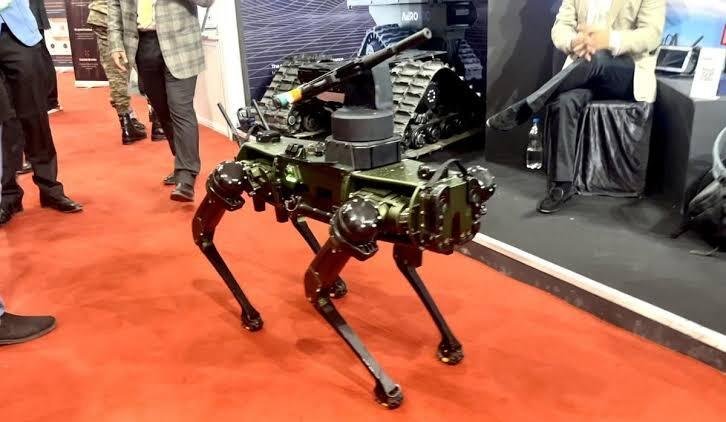
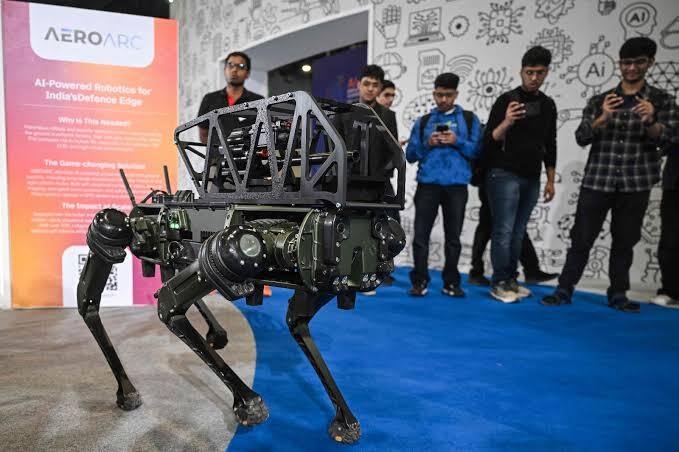
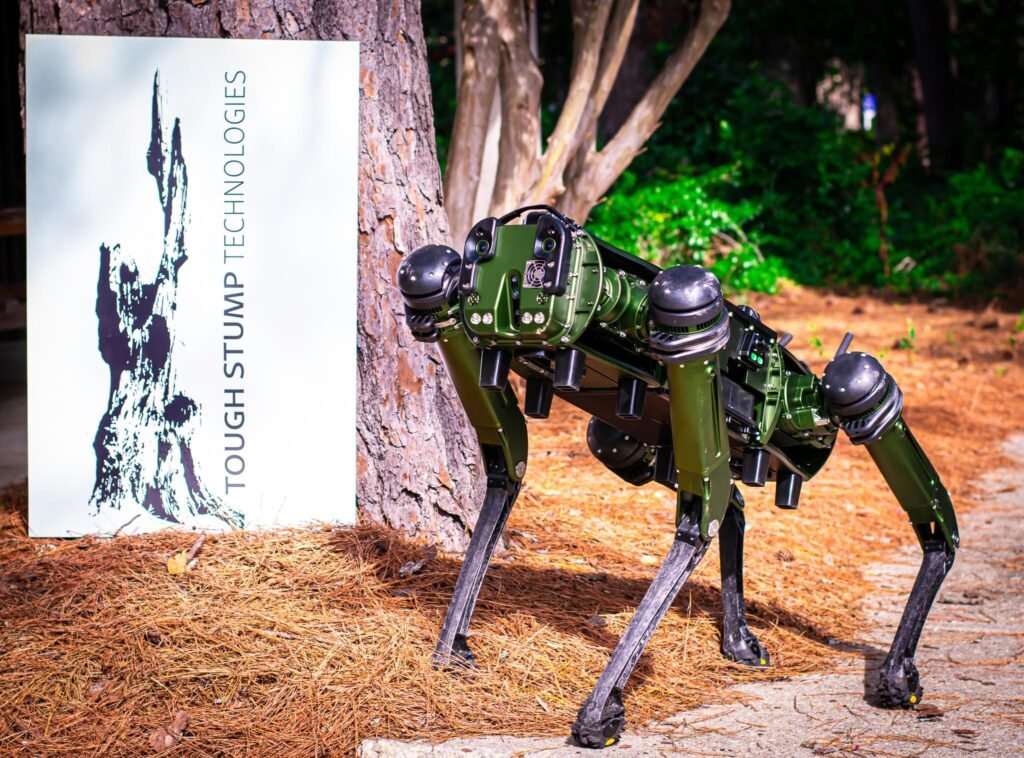
The ARCV MULE is a four-legged unmanned ground vehicle sold by AeroArc, a subsidiary of the New Delhi group Arc Ventures (ARCV). MULE stands for Multi-Utility Legged Equipment. The Indian Army has taken delivery of a fleet of 100 for perimeter security, hazardous material handling, bomb disposal and intelligence gathering, and the manufacturer lists weapons among the payloads it can carry. The most important fact about it is its origin. Indian reporting describes it as a licensed production version of the Ghost Robotics Vision 60, and the technical data supports that description closely. I have added it to this database because it shows how armed legged robots spread by licence and how procurement can outrun doctrine, law and public debate. AeroArc Robotic Mule: Revolutionising Indian Army operations
Not to be confused with
Search results for this name are muddled, so a clarification belongs at the top of the page.
- US Army MULE (Multifunction Utility/Logistics and Equipment). A 2.5 ton unmanned ground vehicle developed by Lockheed Martin for the Future Combat Systems programme, in transport, counter-mine, and armed variants. The armed XM1219 variant was cancelled in July 2011 over mobility concerns. fandom, Wikipedia
- BAE Systems ARCV (Armed Robotic Combat Vehicle). BAE reintroduced its Black Knight demonstrator under this name in March 2017. Wikipedia
- The ARCV MULE in this entry is an Indian quadruped robot weighing 51 kg. In the AeroArc context, ARCV refers to the parent company’s name, Arc Ventures, and I have found nothing that expands it further.
Key takeaways
- The ARCV MULE appears to be a licensed Indian version of Ghost Robotics’ Vision 60. AeroArc’s published specifications match the Vision 60’s on weight, ingress rating, speed, compute, standby time and assembly time.
- The Indian Army bought it through an emergency procurement route, which permits contracts up to ₹300 crore and is designed for speed. Standard operating procedures were written only after the first 25 units arrived in June 2024. indiandefensenews, tribuneindia
- Indian defence sources say the robots can be integrated with small arms and engage an enemy without putting a human life at risk. Which weapons, who authorises fire and what legal review applied: Unknown. theprint
- India views calls for a legally binding instrument on lethal autonomous weapons as premature. The CCW Seventh Review Conference meets in Geneva from 16 to 20 November 2026. carnegieendowmentreachingcriticalwill
Basic Weapon Facts
I. Background
| Field | Detail |
|---|---|
| Manufacturer | AeroArc (Arc Ventures), New Delhi, India. The company was established in 2019 and makes aerial drones and ground robots. |
| Suppliers | Ghost Robotics, Philadelphia, as design licensor. Ghost Robotics is itself majority owned by South Korea’s LIG Nex1. NVIDIA Xavier compute. Weapon integrators and licence terms: Unknown |
| Country of origin | India (assembly and branding). United States (underlying design) |
| Developmental stage | Operational. Delivery of the full order of 100 was reported complete in 2024. A larger order was reported as contingent on performance. |
| System version | Unknown. No public version designation for the Indian build |
| System type | Quadrupedal unmanned ground vehicle (Q-UGV), multi-utility, weapon-capable India’s Army of Robotic Dogs and Mules |
II. General Specifications
| Parameter | Specification |
|---|---|
| System dimensions | Unknown (not published by AeroArc in the sources I could verify) |
| Weight | 51 kg |
| Max payload | 12 kg. The Ghost Robotics page for the Vision 60 lists 10 kg, so the figures differ by 2 kg between the licensor and the licensee |
| Max operating time | About 3 hours walking and about 20 to 21 hours on standby |
| Max operating distance/reach | Wi-Fi control for short range and LTE control up to about 10 km |
| Max speed | 3 m/s (about 6.7 mph) |
| Environmental rating | IP67, with an operating temperature range of roughly minus 40 to 55 degrees Celsius. AeroArc’s own page gives both minus 40 and minus 45 as the lower bound |
| Mobility | Climbs steps up to 18 cm and operates in snow and rough terrain |
| Unit cost / contract value | Unknown Products |
The identity of the numbers is the evidence for the licensing relationship. AeroArc lists an assembly and disassembly time of 15 minutes, the same figure that appears in my Vision 60 entry, and the compute module, ingress rating, weight and speed also match. I regard this as strong circumstantial support for the reported licence and as a reason to treat Ghost Robotics’ documentation as a guide to this system. The Indian build may differ in software, communications and weapon integration, and none of those differences is public. aeroarc
History and operational record
Unveiling, September 2023. The Army showed the MULE at the North Tech Symposium in Jammu. It carries thermal cameras and radars, can run pre-programmed autonomous navigation missions, and can mount small arms to fire at enemy positions from a safe distance. An engineer quoted at the event described the use case in plain terms. The operator locates where an adversary is inside a room, and the firing platform is then available to engage. thedefensepost
Procurement, September 2023. ThePrint reported that the Army signed a contract that month for emergency procurement of 100 units. The emergency route allows contracts up to ₹300 crore, and the numbers were deliberately small pending performance. theprint, indiandefensenews
Induction, 2024. The first 25 arrived in June 2024. The Army then laid down standard operating procedures, and the robots were intended to be sent in ahead of troops if a terrorist hideout had to be raided. The MULE appeared at the Army Day Parade in Pune the following January. tribuneindia, millenniumpost
Corporate lineage. AeroArc’s founder Arjun Aggarwal described the MULE as a co-development with Ghost Robotics. The same company supplies Trinetra surveillance drones that are, in its words, Indianised at a Coimbatore facility from a design originated by the US firm Skydio. The pattern is consistent. AeroArc takes proven American designs, localises production and sells them to the Indian military under the banner of self-reliance. theprint, theprint
Weapons integration. AeroArc’s catalogue lists small arms, electro-optical and thermal sensors, loitering munitions, a robotic arm and chemical and radiation detection as available payloads, and separately lists the RS-1, a stabilised remote weapon station carrying a small calibre rifle. The product menu also names a “Precision Auto-Targeting System”. I could not establish whether that product is related to the MULE or what it does, and I mark it as an open question for the manufacturer. No public record shows any armed MULE in combat. aeroarcaeroarc
Autonomy: a forensic analysis
Sensors. Thermal cameras and radars are reported for the Army configuration. The catalogue adds electro-optical payloads and chemical and radiation sensors. Together they make a surveillance and detection platform that can also serve as a targeting sensor. thedefensepost
Algorithms. The compute module is an NVIDIA Xavier, a processor class designed for onboard machine vision. For the underlying Ghost Robotics platform, the manufacturer says its Mission Control software supports autonomous navigation in GPS-enabled and GPS-denied environments using LiDAR mapping. Whether the Indian build uses the same software stack is Unknown. The Army describes pre-fed missions that enable autonomous navigation. One secondary source says the MULE operates autonomously or by remote control, and I give that little weight, because it does not distinguish navigation from engagement. aeroarc, thedefensepost
Human intervention in the kill chain. The reporting describes operator-controlled weapon use. Defence sources say the robots can engage without putting a human life at risk, which describes the safety of the operator and says nothing about who decides to fire. I found no evidence of autonomous target selection or engagement. The comparable Ghost Robotics case is instructive. The US Marine Corps Special Operations Command tested a Ghost robot with a remote weapon system that can detect and track people, drones and vehicles but cannot shoot autonomously, because a human operator makes the firing decision. That arrangement is the plausible design for the Indian build, and it is an assumption I cannot confirm. theprint, warriormaven
Classification. On the public record the ARCV MULE is a remotely operated platform with autonomous mobility and sensing, and it is not a lethal autonomous weapon system as the CCW process uses the term. I list it because the capability gap between this system and one that is autonomous is small and entirely a matter of software and policy. I discuss that threshold in my Vision 60 entry, in the Unitree B2 entry, and on my stance page. For comparison across the region see Norinco Sharp Claw and Hanwha Arion-SMET.
Legal analysis
Weapons review
Article 36 of Additional Protocol I requires states parties to review new weapons for legality. India is not a party to Additional Protocol I, as far as I know, though the principle of legal review is widely treated as good practice and the underlying rules of distinction and proportionality bind India as customary law. I know of no public statement that the Indian Army reviewed an armed MULE configuration. The modular problem I described for the Vision 60 applies in full. The platform, the weapon station and the rules of engagement come from different hands, and no public document shows who assessed the whole.
Which legal regime governs the likely use
This is the question I find most important here. Reporting says the MULE is meant to go in ahead of troops in raids on hideouts, which describes counter terrorism operations on Indian territory. India has generally not accepted that situations such as Jammu and Kashmir amount to armed conflict, so the governing framework would be law enforcement and human rights law, not the conduct of hostilities rules. India is a party to the ICCPR, and Article 6 protects the right to life. The UN Basic Principles on the Use of Force and Firearms by Law Enforcement Officials allow intentionally lethal force only where strictly unavoidable to protect life. A robot that identifies a person in a room through a thermal camera and then fires on operator command sits uneasily with that standard, because the robot’s selling point is that it removes risk to the operator, and the legal test asks whether the person in the room posed an imminent threat to life. A machine that sees through walls and shoots without warning is built for the opposite assumption.
If an armed conflict framework applies, for instance on a front with Pakistan or China, then distinction, proportionality and precaution under Articles 48, 51 and 57 apply, together with Article 41’s protection of anyone hors de combat.
Indian law and accountability
The Indian domestic framework matters more than usual because the system is for home use. The Armed Forces (Special Powers) Act 1958 gives wide powers in notified areas, and Indian courts have drawn limits around it. In Naga People’s Movement of Human Rights v. Union of India (1997) the Supreme Court upheld the Act’s constitutionality while requiring that powers be exercised with care. In Extra Judicial Execution Victim Families Association v. Union of India (2016) it held that the Act does not give absolute immunity and that allegations of excessive force are open to inquiry. Article 21 of the Constitution protects life and personal liberty. Those cases concern soldiers, and none has addressed a robot firing at an operator’s command. The practical issue is evidentiary. Accountability depends on knowing who decided to fire, on what information, and from what record, and a remote weapon platform should generate that record by design. Whether the Army’s SOPs require it is Unknown. I flag all three case citations from my own knowledge for checking.
Arms transfer chain
A US-designed system, licensed for production in India, from a firm majority-owned in South Korea, creates a three-jurisdiction supply chain. US export control law governs the licence. Articles 6 and 7 of the Arms Trade Treaty require exporting states to assess the risk of serious violations, and South Korea is a party, the United States a signatory that has not ratified, and India a non-signatory. I have found nothing public about the export licence or end use conditions, so I treat the question of which state is responsible for a misuse as unresolved.
International relations implications
Mirror image arms racing in Asia. Chinese state media have shown armed Unitree robots, and India now fields a Ghost-derived robot that can carry small arms. My Unitree B2 entry sets out the Chinese side. Both countries face each other across the Line of Actual Control, where the 2020 Galwan clash cost lives and where pack animals have long carried loads at altitude. Armed or unarmed, a robot that can follow soldiers up a mountain slope has an obvious logistical purpose, and I do not want to dismiss it. The same robot also gives each side a reason to match the other’s capability, and that is how an arms race starts.
India as a swing state at the CCW. Carnegie India reports that India views calls for a binding instrument as premature, and notes that Russia also opposes any binding instrument and treats the GGE as the sole forum. I recall that India voted against UN General Assembly resolution 78/241 in 2023, which passed with 152 votes in favour, and I flag that for verification. The UN Secretary-General and the ICRC have called for a treaty by 2026. On 5 September 2026 the CCW Group of Governmental Experts reached consensus among 128 states on a document addressing lethal autonomous weapons systems, though critics argue major military powers weakened it. France says the text clarifies human control and judgment and that the Review Conference must decide next steps. The ICRC urges states to use the conference to launch negotiations on a new protocol. India’s position will matter, partly because it is both a large Global South state and a growing builder of these systems. A state that is arming its own forces with armed ground robots has an interest in the rules, and its stance should be judged against its procurement. • Research
Technology dependence and sovereignty. India calls its defence industrial push self-reliance, yet this system and AeroArc’s drones are localised foreign designs. The Trinetra drone is an Indianised version of a US design, and the MULE is reportedly a licensed Ghost Robotics platform. Dependence on a foreign licensor means that an export licence decision in Washington or a change of control in Seoul could affect a deployed Indian fleet. It also complicates accountability, because responsibility for design, software and weapon integration spreads across three countries. theprint
Procurement speed as a governance problem. The Army wrote the operating procedures after the first units arrived. Emergency procurement exists for good reasons, and it also bypasses the slower scrutiny that a new weapon category might attract. A capability that enters service this way tends to become permanent by default. I would like to see a published account of the legal review, the rules for armed use and the audit trail, for this system and any other. tribuneindia
The Global South as manufacturer. Most debate about autonomous weapons assumes a few advanced states build them and the rest receive them or suffer them. India, Turkey, South Korea and others are changing that picture. A broader set of producers makes consensus harder and makes export controls more important. It also gives states with real experience of conflict a stronger claim to shape the rules.
My assessment
I can see the value of a robot that carries a soldier’s load up a mountain, finds a bomb or goes into a contaminated room, and I take the Army’s stated purposes seriously. The weapon mount is where I become cautious. What troubles me about the ARCV MULE is how quietly it arrived. It came through an emergency route, under a licence whose terms are not public, from a platform whose maker has defended arming its robots, with procedures written after delivery and no public statement about legal review. The name does not help. A mule is a pack animal, familiar and uncontroversial, and the word makes the machine sound like the thing it replaces.
I hold the same position here that I hold on my stance page. Meaningful human control has to be designed in, written into law and attached to identifiable people, and it cannot rest on assurances from a manufacturer or a defence source. I would ask India to publish its weapons review process, state which legal framework governs domestic use of armed robots, and take that position to Geneva in November. I explain how I came to this work in my story, and I set out the wider risks on my AI safety page. The policy context is tracked in my research and the AI Policy Tracker.
Frequently asked questions
What is the ARCV MULE?
A quadruped robot made by the Indian firm AeroArc, with MULE standing for Multi-Utility Legged Equipment. It is reportedly a licensed version of the Ghost Robotics Vision 60, and the Indian Army has taken delivery of 100.
Is the ARCV MULE armed?
It can carry small arms and other payloads, according to the manufacturer and Indian defence sources. I found no public record of its use in combat or details of which weapons are fielded.
Is the ARCV MULE autonomous?
Its navigation can run pre-programmed missions autonomously. On the public record, weapon use is operator-controlled, and I found no evidence of autonomous target selection.
Is it the same as the US Army MULE?
No. The US Army MULE was a 2.5 ton Lockheed Martin vehicle for the Future Combat Systems programme, and its armed variant was cancelled in 2011.
What is India’s position on autonomous weapons regulation?
India is a CCW party and has described calls for a legally binding instrument as premature, according to Carnegie India.
Sources
Manufacturer website: AeroArc, Products (ARCV MULE)
News reports
- Millennium Post, AeroArc Robotic Mule: Revolutionising Indian Army operations
- ThePrint, Robo-dogs that can fire, surveil and carry load: Army set to induct its newest soldiers soon (June 2024)
- ThePrint, Army inducts drones in use with Ukrainian military: Trinetra to boost surveillance
- The Tribune, Hi-tech robots inducted into Army (31 August 2024)
- The Defense Post, Indian Army unveils MULE robot dog (September 2023)
- The Defense News, Indian Army receives full delivery of 100 robotic mules from AeroArc
- Warrior Maven, India adds armed robot dogs for war
- Army Times, Army cancels MULE unmanned ground vehicle (2011)
- Wikipedia, XM1219 armed robotic vehicle and Black Knight (vehicle) (secondary sources, for the disambiguation box only)
Policy and diplomatic documentation
- Carnegie India, India’s Normative Stance on Lethal Autonomous Weapons Systems (February 2024)
- Carnegie India, Understanding the Global Debate on LAWS: An Indian Perspective (August 2024)
- ICRC, Autonomous Weapons advocacy paper (June 2026)
- France, GGE communiqué (10 September 2026)
- UNODA, CCW GGE LAWS briefing
- Reaching Critical Will, CCW Meeting of High Contracting Parties (November 2025)
- Ghost Robotics, Vision 60 (licensor specifications for comparison)
Treaties, statute and case law
- Additional Protocol I, Arts 36, 41, 48, 51, 57 (ICRC database)
- ICCPR, Art 6
- UN Basic Principles on the Use of Force and Firearms by Law Enforcement Officials (1990)
- Arms Trade Treaty, Arts 6 and 7
- Constitution of India, Art 21; Armed Forces (Special Powers) Act 1958
- Naga People’s Movement of Human Rights v. Union of India (1997) 2 SCC 109
- Extra Judicial Execution Victim Families Association v. Union of India (2016) 14 SCC 536
- UNGA Resolution 78/241 (2023)

Avi is a researcher educated at the University of Cambridge, specialising in the intersection of AI Ethics and International Law. Recognised by the United Nations for his work on autonomous systems, he translates technical complexity into actionable global policy. His research provides a strategic bridge between machine learning architecture and international governance.