Clearview AI
Clearview AI: Technical Dossier & Legal Analysis
Lead Paragraph: Clearview AI is a facial recognition platform built upon an unprecedented database of billions of non-consensually scraped images from the public internet. Originally marketed to domestic law enforcement, the system has crossed the threshold into active conflict zones, most notably utilised by the Ukrainian Ministry of Defense for intelligence gathering and combatant identification. Its deployment on the battlefield represents the weaponisation of mass civilian surveillance, blurring the line between digital privacy violations and algorithmic targeting in warfare.
⚙️ Technical Specifications & Capabilities
| Parameter | Specification |
| Manufacturer | Clearview AI |
| State Actor / Primary User | Ukrainian Armed Forces, US Domestic Law Enforcement (ICE, FBI, local PDs) |
| System Type | AI Decision Support System / Facial Recognition Technology (FRT) |
| Data Inputs | >30 billion unverified, non-consensually scraped images from social media and the public web |
| Processing Capacity | Cloud-based neural network capable of real-time biometric mapping and facial vector matching against a global dataset |
| Output Mechanisms | Probabilistic identity matches, accompanied by direct hyperlinks to the source material (social media profiles, news articles, etc.) |
| Operational Scale | Transnational biometric database accessible via mobile application at the tactical edge |
🧠 Algorithmic Architecture & Autonomy
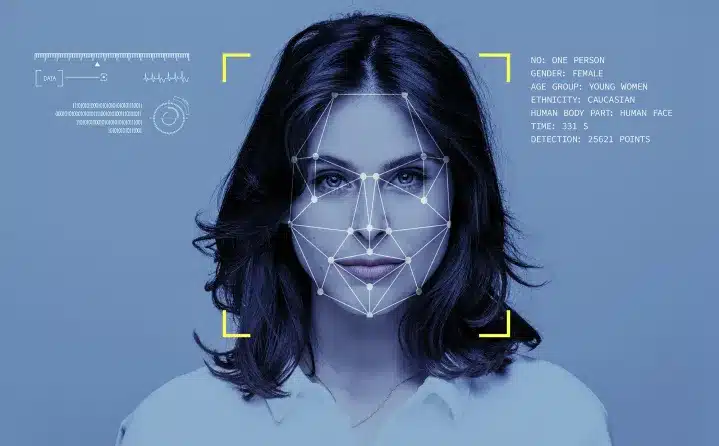
Clearview AI’s architecture is driven by a proprietary deep learning algorithm that converts a two-dimensional facial image into a mathematical vector or “faceprint.” When a user—such as a soldier at a checkpoint or an intelligence analyst—uploads a photograph, the neural network maps the geometry of the face and queries its database of over 30 billion scraped images to find the closest statistical vector match.
Unlike traditional military biometric databases (like the US military’s ABIS), which rely on high-fidelity, verified data collected under controlled conditions, Clearview AI relies on “dirty” open-source data. The algorithm processes low-resolution, angled, or partially obscured faces (such as CCTV grabs or drone footage) against its massive database. It does not provide absolute certainty, but rather a probabilistic ranking of likely matches, heavily depending on the quantity of a person’s digital footprint.
In the terminal phase of the kill chain or intelligence cycle, Clearview operates strictly as a decision-support identification layer. A human operator must decide how to act upon the algorithmic match. However, the system introduces severe automation bias into critical security environments. If the algorithm misidentifies a civilian as a hostile combatant at a military checkpoint, the human operator is highly likely to defer to the machine’s “objective” matching, potentially triggering unlawful detention or kinetic force based entirely on an algorithmic hallucination.
🔗 Deployment History & OSINT Verification
Clearview AI gained infamy for its covert adoption by hundreds of US law enforcement agencies before public exposure in 2020. Militarily, its most significant and verified deployment is in the Russo-Ukrainian War. Following the 2022 invasion, Clearview AI offered its services to the Ukrainian government free of charge. OSINT reports and official statements verify its use by Ukrainian forces to identify Russian prisoners of war, vet individuals at internal checkpoints, and identify deceased Russian soldiers to contact their families for psychological warfare purposes. The system has effectively transformed a domestic surveillance tool into a theatre-wide military intelligence asset.
⚖️ Legal Status & IHL Implications
- Article 36 Compliance: N/A (Civilian Software). As a commercial software application originally designed for law enforcement, Clearview AI completely bypasses Article 36 weapons reviews, highlighting a dangerous regulatory loophole where civilian tech is seamlessly integrated into military kill chains without IHL compliance checks.
- Principle of Distinction: The system presents catastrophic risks to the Principle of Distinction due to its documented error rates, particularly regarding demographic bias. Facial recognition algorithms historically struggle with accuracy across different ethnicities and lighting conditions. In a conflict zone, a false positive generated from a scraped social media photo could lead to a civilian being misidentified as an enemy combatant or spy, stripping them of their protected status based on algorithmic error.
- Algorithmic Complicity / Human Rights: Clearview AI is the epitome of digital dehumanisation and the commodification of civilian privacy for state violence. By turning the entire public internet into a non-consensual biometric lineup, it facilitates mass surveillance on an unprecedented scale. Its use in warfare erodes accountability; if an unlawful targeting or detention occurs due to a misidentification, the liability is diffused between the soldier, the proprietary “black box” algorithm, and the tech executives who unlawfully scraped the data, leaving victims of algorithmic war crimes with no recourse.
Closing Thought: The battlefield integration of Clearview AI proves that without immediate international prohibition on non-consensual biometric databases, the global civilian populace will become permanent, unwitting subjects in algorithmic targeting matrices.

Avi is a researcher educated at the University of Cambridge, specialising in the intersection of AI Ethics and International Law. Recognised by the United Nations for his work on autonomous systems, he translates technical complexity into actionable global policy. His research provides a strategic bridge between machine learning architecture and international governance.