Anduril Roadrunner
Executive Summary
Forensic analysis of Anduril's Roadrunner and Roadrunner-M: autonomy, Lattice, Kuwait sale, Iran war context, IHL and the CCW Review Conference.
Anduril Roadrunner and Roadrunner-M: The Reusable Interceptor and the Easy Case for Autonomous Weapons Law
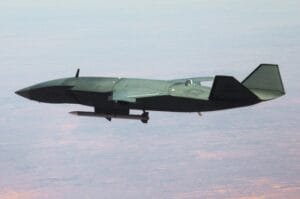
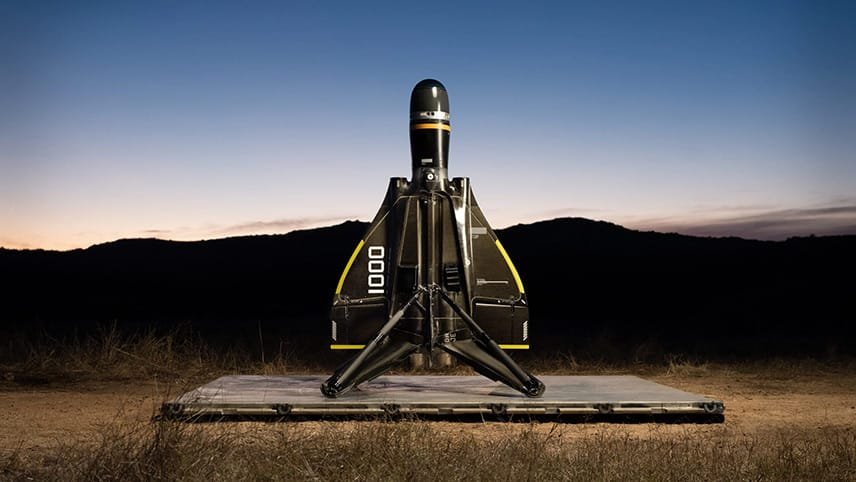
Anduril unveiled Roadrunner and Roadrunner-M on 1 December 2023 [4]. Founder Palmer Luckey called it a “totally new category of weapon”, something between a reusable missile and an autonomous vehicle [2]. The airframe launches vertically from a box, flies at high subsonic speed, intercepts hostile aircraft and, if nothing needs destroying, returns and lands for reuse [1][2]. A single operator can supervise several of them through Lattice, Anduril’s AI command and control software [1]. This report sets out what is verified, separates it from marketing, and tests it against law and the 2026 diplomatic calendar. I treat it as a test case, because defensive, anti-materiel autonomy is where states are most willing to accept machine-speed engagement, and where the precedent for everything else will be set.
Key findings
- Roadrunner is a twin-jet, vertical take-off and landing, recoverable autonomous aircraft built by Anduril Industries. Roadrunner-M carries a high-explosive warhead and is sold as a ground-based air defence interceptor. It is in service and, in 2026, being exported.
- It is the least objectionable category of autonomous weapon, an object-targeting defensive system. It is also the one most likely to set the precedent that machines may select and engage targets without a human decision.
- Anduril says its software gives operators decision points. Independent legal commentary says the aircraft can choose and prosecute targets once airborne unless a human intervenes. The difference between approval and veto is the legal question.
- The system is reported to be capable of engaging manned aircraft. History from the Vincennes in 1988 to the Patriot fratricides in 2003 shows what automated air defence does when classification fails.
- If a binding CCW instrument cannot impose published testing, positive identification and verifiable human control on this easy case, it will not constrain anything harder. The Review Conference opens on 16 November 2026.

Basic Weapon Facts
I. Background
- Manufacturer: Anduril Industries (United States)
- Suppliers: Unknown. Luckey has said Anduril builds the twin turbojet engines itself [3]
- Country of origin: United States
- Developmental stage: Operational. In combat evaluation with US forces since January 2024 [5][6]; a contract of $249,978,466 for more than 500 Roadrunner-M and Pulsar electronic warfare systems was announced in October 2024, with deliveries through 2025 [5]; the State Department approved a roughly $2 billion foreign military sale package to Kuwait in June 2026 that includes Roadrunner-Munition [7][8]
- System version: Roadrunner (reusable, modular payload); Roadrunner-M (high-explosive interceptor)
- System type: Reusable VTOL jet-powered autonomous air vehicle; counter-UAS interceptor munition
II. General Specifications
| Parameter | Specification | Evidential status |
|---|---|---|
| System dimensions | Shorter than Luckey, reported as about 1.5 m (5 ft) tall | Verbal statement [3] |
| Weight | Unknown | Not published |
| Max payload | Unknown; Anduril claims three times the warhead capacity of comparable offerings | Manufacturer claim [1] |
| Max operating time | Unknown | Not published |
| Max operating distance | Unknown; Anduril claims ten times the one-way effective range of comparable offerings | Manufacturer claim [1] |
| Max speed | “High subsonic” | Verbal statement [2] |
| Propulsion | Twin turbojets, vertical take-off and landing | Manufacturer [1][3] |
| Unit cost | “Low hundreds of thousands” of dollars at launch, expected to fall | Luckey [2] |
The lack of published weight, endurance and range is itself a finding. A weapons review cannot assess a system whose envelope is described only in comparative claims.
III. Autonomy
Autonomous targeting capabilities
Roadrunner-M, according to Anduril, autonomously computes the best flight path to intercept a target [3]. Detection, tracking and classification come from the wider system: radars and sensors, including Anduril’s Sentry towers, fused by Lattice, or from an air defence network the customer already owns [1][7]. The Kuwait package lists Roadrunner-Munition alongside Anvil-Kinetic interceptors, Lattice, Pulsar electromagnetic warfare, Sentry towers and tactical operations centres [7]. In practice the kill chain is spread across hardware that Anduril sells as a single product.
What the human does is contested. In a December 2024 demonstration reported by MIT Technology Review, Lattice flagged a drone as a threat and asked the operator whether to send an attack drone, which then flew itself and locked onto the target [10]. In Anduril’s air dominance demonstrations the software announces that authorisation is requested for approval [12]. Against that, the Lieber Institute at West Point describes Roadrunner as designed to intercept aerial threats autonomously and able to engage without real-time human input once airborne, with a human supervisor on the loop who may veto, and notes that the machine can choose and prosecute targets if the human does not intervene [11].
That difference is the whole legal question. A system that engages only after a human approves is a human decision with machine assistance. A system that engages unless a human stops it is a machine decision with human supervision. The second model is also the one that scales, because an operator supervising a squadron cannot approve each shot at machine speed. Anduril advertises exactly that squadron capability [1].
Two further features warrant attention.
Recoverability is a real safety feature. If no target needs destroying, the aircraft flies home [1]. This is the first weapon of its kind designed to abort without being lost [3], and it allows a late decision not to strike. I regard that as the most legally valuable feature of the design, because it gives precautionary obligations something to work with. It matters only if the abort decision reaches the aircraft in time, and only if someone is positioned and trained to make it.
The target set is wider than drones. Roadrunner can take on larger targets than Anduril’s earlier Anvil interceptor, including manned aircraft [2]. Autonomous engagement of a hostile Shahed is one problem. Autonomous engagement of an object that might be a friendly fighter or a commercial airliner is another, and the sensors and software that distinguish the two are not described in public.
Under US policy, Directive 3000.09 distinguishes semi-autonomous, human-supervised and fully autonomous weapons and requires senior review of certain autonomous systems [24]. As I read the 2023 text, it contains carve-outs for operator-supervised systems defending against materiel targets, and Roadrunner-M is likely to be argued into that space. Whatever the correct reading, the Department does not publish which weapons it has reviewed [24].

Strategic and technological context
Roadrunner belongs to a generation of weapons designed around cost. In the 2026 Iran war, low-cost Shahed drones worth about $80,000 forced Gulf air defences to expend interceptors costing millions of dollars each, an exchange ratio widely described as unsustainable [8]. Iranian drones and missiles attacked Kuwait’s airport days before Washington approved the Anduril sale, killing one person [7]. Roadrunner is Anduril’s answer: a reusable interceptor that is cheaper than a missile and can be fired repeatedly. At low hundreds of thousands of dollars per unit [2], however, it still costs several times a Shahed, so the economics improve only if recovery works at scale in combat.
Anduril says it is a heavy participant in the Iran war and has declined to say which systems are deployed, and analysts told Newsweek that US forces may have used Roadrunner for the first time in combat [9]. I treat actual combat use as unconfirmed. I treat the commercial logic as clear: war creates demand, demand creates exports, and exports create the installed base through which the norm is made.
The software layer matters more than the airframe. Lattice is linked with Palantir’s Maven system, an integration announced in December 2024, and Anduril’s counter-drone scenario sits at the centre of its partnership with OpenAI [10]. I analyse the Palantir side in my entry on Project Maven. Language models and sensor fusion now stand between a radar track and a decision to fire, and the public record contains no account of how they were tested. Anduril’s own record of public failure is relevant. The Wall Street Journal reported that an Anvil counter-drone aircraft crashed during a test and started a 22-acre fire in Oregon, and that Navy drone boats running Lattice shut down in an exercise, while the company’s response was that it fails a lot as part of fast iteration [13]. Iteration is a sound engineering method for an app. In an interceptor protecting an airport, it is an experiment on the people below.
My entries on the Altius-600 and the P.S. Killer examine the offensive end of the same spectrum. The architecture is the same and the argument that began with defence is now routinely used for attack.
Legal analysis
Baseline rules and weapons review
No treaty prohibits autonomous interceptors. Use is governed by distinction, proportionality and precaution in attack under Additional Protocol I, Articles 48, 51, 52 and 57 [14], reflected in customary law [16], and by the duty to review new weapons under Article 36 for parties to the Protocol [15]. An uncrewed hostile drone is a military objective. That makes the legal position of Roadrunner far easier than that of a system that selects people. I accept the point and press only on what it leaves open.
The classification problem and the history
Automated air defence has a documented record of misclassification. On 3 July 1988 the USS Vincennes, with the Aegis combat system, shot down Iran Air Flight 655, killing 290 people. Iran brought the matter to the ICJ in the Aerial Incident of 3 July 1988 case, which ended in 1996 after the United States agreed to pay compensation without admitting liability [17]. In the 2003 Iraq invasion, Patriot batteries engaged friendly aircraft, including a British Tornado and a US Navy F/A-18, killing the crews, an episode that Paul Scharre’s analysis at CNAS treats as a case study in automation bias, where operators trust a system they cannot realistically second-guess [20]. These systems also had human supervisors, which is the model now offered as reassurance.
Article 3 bis of the Chicago Convention, adopted after the 1983 shooting down of Korean Air Lines Flight 007, obliges states to refrain from using weapons against civil aircraft in flight [18]. A system capable of engaging manned aircraft in airspace shared with airliners must be assessed against that rule, and Gulf airspace is crowded and under attack.
Precautions, debris and the defender’s duties
Explosive interception over a populated area scatters fragments and wreckage, and the proportionality assessment under Article 51(5)(b) must account for that foreseeable harm [14]. Article 57(2)(b) requires cancellation if a target proves not to be a military objective, so the weapon’s recoverability helps if the abort path is fast and reliable [14]. Article 58 requires defenders to avoid placing military objectives within or near densely populated areas, which bears directly on where launch boxes and sentry towers are sited around cities and airports [14].
Contractors in the kill chain
Anduril personnel configure and update software in theatre. Civilians lose protection from attack for such time as they take a direct part in hostilities under Article 51(3). The ICRC Interpretive Guidance requires a threshold of harm, direct causation and a belligerent nexus [19]. Whether a technician who tunes target classification on a live air defence system crosses that line is unsettled, and I raise it because the company’s staff and its customers have not answered it publicly.
Responsibility and transfer
Criminal liability requires a human with the requisite intent and knowledge under the Rome Statute, Articles 25, 28 and 30 [21]. If a software update causes the misclassification of an airliner, no operator had the knowledge and no commander ordered the shot. The transfer regime offers the better lever. The Arms Trade Treaty requires an assessment of the risk of serious violations of humanitarian law at Articles 6 and 7 [22], although the United States signed in 2013 and later said it would not ratify. In R (Campaign Against Arms Trade) v Secretary of State for International Trade [2019] EWCA Civ 1020 the Court of Appeal held that licensing decisions were unlawful for failing to assess past violations [23], and its logic applies to any state that re-exports or co-produces these systems.
International relations and the state of play
The Kuwait sale shows how autonomy spreads. The package was notified within days of an attack on the host’s airport, which is the moment when scrutiny is weakest and urgency strongest [7]. Production is moving to the Gulf, with American companies co-producing interceptors regionally, and the Stimson Center notes that the same cost logic that favours cheap interceptors favours cheap strike drones for everyone [8]. Each sale installs a template of machine-speed defence, and states without the Gulf’s financial means will build cruder copies without Anduril’s engineering or legal review.
The diplomatic calendar is tight. The CCW Group of Governmental Experts adopted a consensus report on 5 September 2026 [28]. Human Rights Watch reports that 70 High Contracting Parties, a majority, back moving to negotiations, although the final report does not fully reflect that progress [27]. The ICRC proposes a two-tier instrument that prohibits unpredictable autonomous weapons and those that target people, and regulates the rest by limiting target types, duration, geographic scope and requiring human supervision [30]. Under that structure, Roadrunner is a regulated rather than a prohibited system, which is why it is the test case. The EU Council has called for an ambitious mandate [32], and 166 states supported UN General Assembly Resolution 79/62 in 2024 [33]. The Seventh Review Conference runs from 16 to 20 November 2026 [29]. The Lieber Institute describes the United States and Russia as leading states that hold that existing humanitarian law and weapons review are enough [31]. Press accounts suggest the final text was weakened under their pressure, a detail I would confirm against the official record.
Washington’s domestic course points the other way. National Security Presidential Memorandum 11 of 5 June 2026 ordered a rewrite of Directive 3000.09 within 90 days [25], and Senator Ruben Gallego has warned that compressing testing and weakening safeguards risks friendly fire and civilian harm [26]. As far as I could establish on 27 October 2026, no revised directive has been published. That is the setting in which a company that expects to fail often is selling systems that fire on their own.
My assessment
I will say first what I think Anduril has got right. A recoverable interceptor that can decline to fire is a better design than a missile that cannot. A defensive system that destroys drones, not people, is far less troubling than a loitering munition that hunts soldiers. I have no wish to deny a state under missile and drone attack the means to protect its airport, and I do not pretend that every autonomous function is equal.
What I will not accept is the rhetoric that follows from that. “Defensive” and “anti-materiel” are doing a great deal of moral work in the marketing, and they cannot carry it. The same company sells the same software architecture to attack ships and tanks, as I set out in the Altius-600 report. The history of autonomy in weapons is a history of defensive exceptions that grew outward, and I see no reason this one will be different. A system capable of engaging manned aircraft with no published false positive rate and no public account of how its classifiers were tested should not be described as safe on the strength of a founder’s confidence.
I set out on my AI stance page the principle that meaningful human control is an architecture. Applied here, it means a human decision that is real in time, information and authority, in the form of a veto that can actually be exercised before the engagement and not a log entry afterwards. Vincennes and the Patriot fratricides were not failures of absent humans. They were failures of present humans who could not meaningfully contradict their machines, and the squadron model that Anduril advertises makes that worse by design.
My minimum conditions are these: published test results including false positive and fratricide rates against manned aircraft and civilian drones; a binding exclusion of civil aircraft from the target set, consistent with Article 3 bis; an auditable record of every human decision and every software update; independent legal review that does not depend on the vendor’s disclosures; and a rule that no autonomous interceptor is exported without end-use conditions on siting near civilians. This is the easy case. If the CCW process cannot require this, I see no basis for confidence that it will constrain anything harder. I made the broader argument for a binding treaty in my work with the Campaign to Stop Killer Robots and at the UNIDIR conference in Geneva, and set out the wider risk picture in my AI safety analysis. For context, see the AI Policy Tracker.
Frequently asked questions
What is the Anduril Roadrunner? A reusable twin-jet, vertical take-off and landing autonomous air vehicle. Roadrunner-M carries a high-explosive warhead and is sold as an interceptor for ground-based air defence [1][2].
Is Roadrunner-M fully autonomous? It plans its own intercept and can engage after launch, with human involvement described as approval in demonstrations and as veto-based supervision in legal analysis. The exact mode in operational use is not public [3][10][11].
Who has bought it? The US military placed a contract worth over $249 million for more than 500 Roadrunner-M systems in 2024, and Kuwait received State Department approval in June 2026 for a package that includes it [5][7].
Has it been used in combat? It has been in combat evaluation since January 2024. Analysts suggest it may have been used in the 2026 Iran war, which Anduril has not confirmed [6][9].
Is it legal? No treaty prohibits it. Lawfulness turns on correct classification of targets, precautions and the quality of human control [14][16].
Will law change? The CCW Review Conference, 16 to 20 November 2026, can authorise negotiation of a binding instrument [29].
Sources
Manufacturer website: anduril.com/roadrunner
News reports and technical documentation
- Anduril, Anduril Debuts Twin-Jet Autonomous Aircraft for Combatting Aerial Threats, December 2023.
- Inside Unmanned Systems, Anduril Unveils Jet-Powered Roadrunner, Roadrunner M UAS.
- Defense Daily, Anduril set to produce reusable jet-powered autonomous air vehicles for air defense, other missions.
- Euro-SD, Anduril unveils Roadrunner and Roadrunner-M twin-jet-powered VTOL UAVs, 1 December 2023.
- Unmanned Airspace, Anduril to support US forces facing significant drone threats, October 2024.
- Air & Space Forces Magazine, Pentagon Spending Big to Counter Cheap Drones.
- Breaking Defense, US approves $2B sale of Anduril counter-drone systems to Kuwait, June 2026.
- Stimson Center, Made in the Gulf, Designed in America: How the Iran War Has Incentivized Drone Production in the GCC, 2026.
- Newsweek, How Iran Became a Testing Ground for New US Weapons.
- MIT Technology Review, We saw a demo of the new AI system powering Anduril’s vision for war, 10 December 2024.
- Lieber Institute, West Point, Diverging Standards in the Legal Review of LAWS.
- Air & Space Forces Magazine, Sneak Peek: Anduril Lifts Veil on Its Combat Drone Software.
- Sherwood News, WSJ: Anduril’s weapons systems have failed during several tests, reporting The Wall Street Journal, November 2025.
Law, cases and legal documentation
- Additional Protocol I to the Geneva Conventions, 1977, Articles 36, 48 to 52, 57, 58.
- Article 36, New weapons, ICRC IHL Databases.
- ICRC, Customary IHL, Rule 15: Principle of precautions in attack.
- ICJ, Aerial Incident of 3 July 1988 (Islamic Republic of Iran v United States of America).
- ICAO, Convention on International Civil Aviation (Chicago Convention), Doc 7300, Article 3 bis.
- ICRC, Interpretive Guidance on the Notion of Direct Participation in Hostilities, 2009.
- Paul Scharre, Autonomous Weapons and Operational Risk, Center for a New American Security, 2016.
- Rome Statute of the International Criminal Court, Articles 25, 28, 30.
- Arms Trade Treaty, Articles 6 and 7.
- R (Campaign Against Arms Trade) v Secretary of State for International Trade [2019] EWCA Civ 1020.
- US Congressional Research Service, Defense Primer: Lethal Autonomous Weapon Systems (IF11150); DoD Directive 3000.09, 25 January 2023.
- The White House, National Security Presidential Memorandum 11, 5 June 2026.
- DefenseScoop, Senator questions Pentagon’s plan to revise autonomous weapons policy, 15 June 2026.
- Human Rights Watch, UN Talks on Killer Robots End with Calls for Negotiations Growing, 7 September 2026.
- Opinio Juris, Symposium on the CCW GGE LAWS: The End of the Beginning, 5 October 2026.
- Janes, Special Report: Autonomous weapons talks advance, but verification obstacles remain, October 2026.
- ICRC, Advocacy paper: A key opportunity to prevent the development of unacceptable autonomous weapons, June 2026.
- Lieber Institute, West Point, No New Rules Needed: Russia’s Minimalist Vision of Human Oversight for LAWS, April 2026.
- Council of the European Union, Council Conclusions on the Seventh Review Conference of the CCW, 13 October 2026.
- UN General Assembly, Resolution 79/62 on lethal autonomous weapons systems, December 2024.

Avi is a researcher educated at the University of Cambridge, specialising in the intersection of AI Ethics and International Law. Recognised by the United Nations for his work on autonomous systems, he translates technical complexity into actionable global policy. His research provides a strategic bridge between machine learning architecture and international governance.