
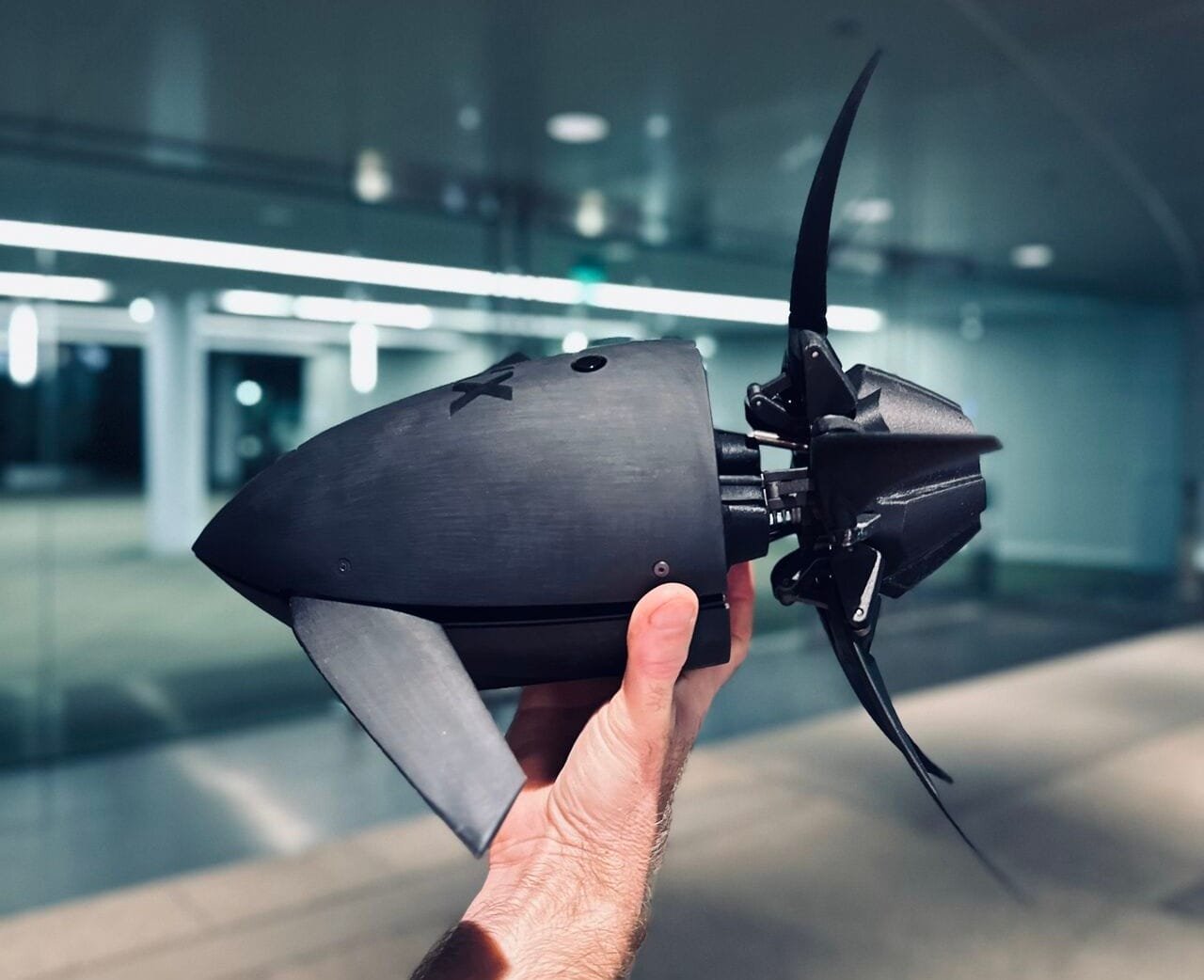
P.S. Killer Kamikaze Drone
P.S. Killer Kamikaze Drone (PSK): XDOWN’s Hand-Thrown Autonomous Loitering Munition
The P.S. Killer (PSK) is a hand-thrown, one-way attack unmanned aerial system (UAS) developed by XDOWN Incorporated, a defence start-up founded by Alexander Balan. It is shaped like an American football so that a soldier can switch it on and throw it, after which, in the manufacturer’s words, the user can “forget about it” while it finds and strikes a target. XDOWN markets it for special operations, counterterrorism, convoy protection, counter-drone interception and maritime security, with claimed swarming and GPS-denied navigation [1][2][3]. The evidence base is almost entirely promotional. That does not make the system unimportant. It makes it a clear case study in how a weapon can be sold on autonomy claims long before anyone has demonstrated the legal controls those claims require.
Key findings
- The PSK is a hand-launched, one-way attack drone developed by XDOWN Incorporated of California. On the public record it is a prototype in testing, not a fielded weapon.
- Its marketing describes a “throw-and-forget” weapon that classifies and strikes armour, aircraft and people without a further human decision. None of this has been independently verified.
- The sharpest legal problem is autonomous attack on persons. A signature-based seeker cannot recognise surrender, injury or civilian status, and the flight time between launch and impact leaves room for the facts to change.
- The wider significance is diplomatic. The PSK appeared in the same year that the CCW Group of Governmental Experts completed its mandate, and weeks before the Seventh Review Conference decides whether to open treaty negotiations.
Basic Weapon Facts
I. Background
- Manufacturer: XDOWN Incorporated
- Suppliers: Corvid Technologies (North Carolina) is reported as a development partner; other partners and component suppliers are Unknown [1]
- Country of origin: United States
- Developmental stage: Prototype and testing as reported in March 2025. XDOWN said training models would ship by midsummer 2025 and full production would follow in 2026, and claimed “thousands of preorders” [1]. In the sources I reviewed I found no independent confirmation of deliveries, a government contract or a programme of record
- System version: PSK (single publicised variant); a non-lethal resupply version is said to be in work [1]
- System type: Hand-launched one-way attack UAS (loitering munition) with counter-UAS and reconnaissance roles
II. General Specifications
| Parameter | Specification | Evidential status |
|---|---|---|
| System dimensions | Unknown; football-sized oval body | No figures published |
| Weight | 0.8 kg (1.77 lb) empty | Manufacturer claim [1][4] |
| Max payload | About 0.77 kg (1.7 lb); one or two 40 mm grenades | Manufacturer claim [1] |
| Max operating time | Unknown | At 250 km/h, 64 km takes roughly 15 minutes |
| Max operating distance | More than 64 km (40 miles); one outlet reports 15 or 40 miles depending on payload | Manufacturer claim [3][5] |
| Max speed | 250 km/h (135 knots) | Manufacturer claim [1][4] |
| Activation time | About 2 seconds after throw | Manufacturer claim [2] |
| Acoustic signature | 55 dB at 6 m (20 ft) | Manufacturer claim, implausible without data [1] |
III. Autonomy
Autonomous targeting capabilities
The operator uploads mission parameters and general target signatures before launch, then throws the drone. Balan describes the targeting logic as layered, and says the onboard system classifies and tracks threats using optical cameras, infrared sensors, radar and lidar, and selects targets against predefined threat-assessment parameters [1]. Intended targets include armoured vehicles, enemy UAVs and personnel [1]. Multiple units are said to communicate in real time and divide targets among themselves to avoid duplicate strikes [1]. Where no viable target is found, an abort function reportedly returns the drone to the operator or brings it down in a controlled descent [1].
Three features of that account deserve forensic attention.
First, the sensor claim is hard to credit. Radar, lidar, infrared and visible light sensors, a processor capable of onboard classification, thrust vectoring, a 40 mm grenade payload and a 64 km range, all inside an airframe of 0.8 kg, would be an exceptional feat of size, weight and power engineering. Miniature radar and lidar of useful range are not trivial loads for a football-sized airframe. Fast Company itself reports that XDOWN has not completed the planned capabilities and was still refining guidance through controlled throws and simulation [1]. I treat the full sensor suite as an aspiration until someone shows it working.
Second, the abort function implies a command link. XDOWN says the abort relies on telemetry override [1]. If a link exists, a human may be able to intervene after launch, which would bear directly on the legal classification of the weapon. If the drone is meant to work in GPS-denied and jammed environments, that link may not survive contact. Whether the production weapon retains a human veto in a contested electromagnetic environment is the central unknown.
Third, the human role sits before launch, not at engagement. Selecting a target class and throwing the weapon is a human decision. The selection of the individual object to be struck, at a moment of the machine’s choosing up to a quarter of an hour later, is not. The kill chain (find, fix, track, target, engage, assess) is compressed into the interval after the throw, and the quality of human judgment is limited to what the operator could foresee at that moment. That is the architecture I describe on my AI stance page as human presence without human agency.
The classification under United States policy is genuinely uncertain. Department of Defense Directive 3000.09 treats “fire-and-forget” homing munitions that engage only targets or target groups selected by a human operator as semi-autonomous, whereas a system that can “select and engage targets without further intervention by a human operator” after activation is a lethal autonomous weapon system requiring senior review [17]. Which category the PSK falls into depends on facts XDOWN has not disclosed: how narrowly the operator defines the target set, and whether the drone chooses among individual persons or objects inside it.
Strategic context
The PSK is a product of the Ukraine war, and says so. Balan has cited Ukrainian success with cheap first-person-view drones as his inspiration, and Fast Company reports estimates of roughly 15,500 Russian armoured vehicles lost to them [1]. FPV drones are labour intensive, since each needs a trained pilot with goggles and a link. The commercial promise of the PSK is to remove that pilot from the loop and make the strike a matter of seconds, which is an attractive proposition to any army short of skilled operators.
That logic is already operating elsewhere. Helsing’s HX-2, supplied to Ukraine, is reported to carry AI targeting but to require human approval for the strike, and Fast Company expects such safeguards to be tested by battlefield need [1]. Vincent Boulanin of SIPRI is quoted in the same piece observing how hard it is for Ukraine to consider high-level principles on responsible autonomy while fighting for survival [1]. I do not dismiss that argument. I note only that necessity pressures are precisely why rules must be written before the pressure peaks.
The empirical precedent is the March 2020 Libya incident. The UN Panel of Experts reported that STM Kargu-2 loitering munitions and similar systems “were programmed to attack targets without requiring data connectivity between the operator and the munition: in effect, a true ‘fire, forget and find’ capability” [15]. Analysts debated whether any autonomous kill actually occurred, a debate that itself illustrates the accountability problem, since neither the report nor the operators could say [16]. The PSK is marketed to the same class of use, at a much smaller and cheaper scale.
Size matters for proliferation. A weapon that fits in a rucksack and weighs under a kilogram is below the thresholds of the Missile Technology Control Regime, which concentrates on UAVs of 300 km range or more [29]. Export governance therefore falls to national controls such as the US International Traffic in Arms Regulations and to the Arms Trade Treaty’s risk assessment under Articles 6 and 7, a treaty the United States signed in 2013 and later announced it would not ratify [28]. States are free to export, in practice, on the basis of their own self-assessment, and a hand-thrown autonomous munition is easy to copy, to repurpose and to lose.
Legal analysis
Weapons review and the baseline rules
The PSK is not unlawful as such. A drone that destroys armoured vehicles or other drones, which are military objectives by nature, can be used lawfully, and nothing in treaty law bans autonomy as a feature. The question is whether a particular use satisfies the rules of international humanitarian law (IHL). Those rules are the principle of distinction (Articles 48, 51 and 52 of Additional Protocol I), the prohibition of indiscriminate and disproportionate attacks (Article 51(4) and (5)), and the duty to take precautions in attack (Article 57) [7]. The ICJ has described distinction and the prohibition of unnecessary suffering as “cardinal principles” of humanitarian law [10], and the ICRC study of customary IHL treats them as binding on all states, including those not party to the Protocol [9].
Parties to Additional Protocol I must also review any new weapon, means or method of warfare for compatibility with international law under Article 36 [8]. The United States is not a party to the Protocol but conducts legal reviews under its own directives, and the 2023 text of Directive 3000.09 adds specific testing and senior review requirements for autonomous functions [17]. The difficulty is that these reviews are classified and unpublished. The Department has not publicly reported how many autonomous weapon systems it has reviewed [17], so nobody outside government can test whether the PSK has passed one.
Distinction and the targeting of persons
The central test is whether the weapon can distinguish lawful targets from protected persons and objects in the circumstances of use. Against a tank in an open field, a target library may well suffice. Against “personnel” it does not. A combatant who has surrendered, a wounded soldier, a medic, a civilian carrying a rifle for protection and a civilian who has taken a direct part in hostilities for a period each present a different legal status that no visual signature reliably encodes. Article 41 protects persons recognised as hors de combat, and Article 50(1) requires that a person be treated as a civilian in case of doubt [7]. A machine has no capacity for doubt, only a confidence score, and a confidence threshold is a design choice made by an engineer long before the engagement.
The Israeli Supreme Court’s decision in Public Committee Against Torture in Israel v Government of Israel (HCJ 769/02, 2006) is instructive. The Court rejected categorical approaches to targeted killing and required individualised, verified information about the person targeted, together with a feasibility assessment of arrest and a proportionality review after the fact [13]. Those are assessments of a kind that cannot be settled in advance for a class of targets, which is exactly what a signature-based munition does.
XDOWN’s claim that the PSK reduces collateral damage in urban environments rests on no published test data [1][3]. Even if the airframe is small and the warhead modest, accuracy of impact is a different matter from accuracy of identification. Fast Company’s own reporting notes that a system preprogrammed for recognised target types can be confused in cluttered environments, and that adversaries can disguise themselves to exploit it [1].
Proportionality and precautions
Proportionality under Article 51(5)(b) requires weighing anticipated civilian harm against concrete and direct military advantage, assessed on the information reasonably available to the person deciding. The ICTY Trial Chamber in Prosecutor v Galić framed the standard as what a reasonably well informed person in the circumstances of the perpetrator, making reasonable use of the information available, could have expected [11]. That formula presumes a person. A drone launched 60 km from its operator, travelling for fifteen minutes, will encounter conditions the operator never saw, and the proportionality judgment must be made at the moment of attack, not at the moment of throw. Precautions under Article 57, including the duty to cancel or suspend an attack if it becomes apparent that the target is not a military objective, are only as good as the abort link, which brings us back to the unanswered question of whether it works under jamming [7].
Martens Clause and the public conscience
Where treaty law is silent, civilians and combatants remain under the protection of “the principles of humanity and the dictates of public conscience”, the formulation of the Martens Clause in Article 1(2) of Additional Protocol I [7]. The ICJ in its Nuclear Weapons Advisory Opinion observed that the clause has proved an effective means of addressing the rapid evolution of military technology [10]. Over 160 states voted in December 2024 for UN General Assembly Resolution 79/62 on lethal autonomous weapons, with three against and fifteen abstentions [26]. I regard that vote as meaningful evidence of the public conscience the Martens Clause invokes.
Accountability
If a PSK kills a surrendering soldier, who is responsible? The operator who threw it may lack the intent required for a war crime under Article 30 of the Rome Statute, because the specific engagement was the machine’s choice [12]. Superior responsibility under Article 28 requires that a commander knew or should have known of the crimes of subordinates, and a machine is not a subordinate. The ICTY’s decision in Čelebići set the modern doctrine on command responsibility, and it presupposes human agents [14]. The designer sits in a different jurisdiction and was never at the scene. No court has prosecuted the use of an autonomous weapon. I have called this the accountability gap, and the PSK is a clean illustration: a weapon whose selling point is that the human can forget about it is a weapon whose human may later be unable to answer for it.
International relations and the state of play
The diplomatic situation is more consequential than usual. After a decade of discussion, the CCW Group of Governmental Experts on lethal autonomous weapons systems completed its 2024 to 2026 mandate in the early hours of 5 September 2026 with a report adopted by consensus, which the chair called the “end of the beginning” [21]. Human Rights Watch reports that 70 High Contracting Parties, a majority of the Convention’s members, have backed moving to negotiations on the basis of the rolling text, though the final report does not fully reflect that progress [20]. The ICRC and the UN Secretary-General have called for binding prohibitions and restrictions, and the ICRC’s June 2026 paper urges that autonomous weapons which target people directly, and those that are unpredictable, be prohibited, pointing to the success of Protocol IV in banning blinding lasers before they spread [23]. The EU Council adopted conclusions on 12 October 2026 urging an ambitious negotiating mandate [25].
The decisive meeting is the CCW Seventh Review Conference in Geneva, 16 to 20 November 2026 [22]. The obstacle is the consensus rule, which gives any single state a veto. The Lieber Institute at West Point describes the United States and Russia as leading “traditionalists” who maintain that existing IHL and Article 36 reviews are sufficient and who resist moving the discussion outside the CCW [24]. Press and civil society accounts suggest the final text was weakened under American and Russian pressure. I would treat the detail of those accounts with caution until the official record is public, but the pattern is consistent with the stated positions.
Washington’s domestic direction is also relevant. National Security Presidential Memorandum 11, signed on 5 June 2026, ordered the Secretary of War to update Directive 3000.09 within 90 days and to review it annually [18]. Senator Ruben Gallego warned that compressing testing timelines or reducing safeguards could cause friendly fire and civilian harm [19]. When I last checked, I could not find a published revision. The outcome will indicate whether the one American policy requiring “appropriate levels of human judgment over the use of force” survives the pursuit of speed [17].
For states in my own region, Southeast Asia, the implication is practical. A cheap, portable, hard-to-attribute autonomous munition lowers the threshold of use for states and non-state groups alike, and a region with several live territorial disputes and thin arms control capacity has little protection if such weapons proliferate. I have set out the wider case on the AI Policy Tracker and in my work on the Systems Database.

My assessment
I have no objection to the counter-drone mission as such. A drone that intercepts another drone, or a munition limited to vehicles of a defined type in a defined area, raises manageable questions and could even reduce risk to soldiers. My concern is the claim that the PSK can autonomously strike personnel. It is the point at which a marketing line becomes a legal and moral problem, and it is where I think the line has to be drawn in law.
What troubles me most is the casual register. “Grab it, switch it on, throw it” is the language of a toy, and the quotation from a Defense Department official that this is “the most American munition I have ever seen” [1] tells us the weapon is being received as a novelty and not as a decision about killing. I have said on my stance page that we cannot delegate the decision to kill to a machine, and that meaningful human control is a structural condition, not a checkbox. At the UNIDIR conference in Geneva and in my work with the Campaign to Stop Killer Robots, I have argued for a binding instrument. A weapon like the PSK shows why waiting for the technology to mature is the wrong strategy: by the time it has matured, it will be in a thousand backpacks. See also my analysis of AI safety for the broader argument.
There is a fair counter-argument. Proponents say that machines do not panic, take revenge or tire, and that a precise munition with a small warhead is preferable to an airstrike. That is a case for careful, verified, narrowly scoped autonomy against objects. It is not a case for an unverified system that classifies people at a distance. I would require, at minimum, published test data against civilian and surrendering-person scenarios, a demonstrated abort link under jamming, a prohibition on autonomous anti-personnel selection, and public confirmation of an Article 36 style review before any transfer.
Frequently asked questions
What is the P.S. Killer drone? A hand-thrown, football-shaped, one-way attack drone developed by XDOWN, a California defence start-up, and marketed as a “throw-and-forget” autonomous munition [1][2].
Is the PSK a fully autonomous weapon? Not demonstrably. XDOWN claims onboard AI selects targets after launch, but the drone remains a prototype with unverified claims, and an abort function suggests some command link [1].
Is the PSK legal? It is not prohibited by any treaty. Lawfulness depends on use. Autonomous strikes against persons raise serious distinction, proportionality and accountability problems under IHL [7][10].
Is it in service? I found no independent confirmation of deliveries or a government contract as at 27 October 2026 [1].
Will the CCW regulate weapons like it? That depends on the Seventh Review Conference, 16 to 20 November 2026, which can authorise treaty negotiations [20][22].
Sources
Manufacturer website: xdown.us (cited by Fast Company [1])
News reports
- Jesus Diaz, This killer drone is designed to be thrown like a football, Fast Company, 5 March 2025.
- US startup develops football-sized kamikaze drone, Defence Blog.
- Grab, Switch On, Throw! New US Hand-Launched Kamikaze Drone, Kyiv Post.
- US Startup Unveils Hand-Thrown, Football-Shaped Combat Drone, The Defense Post, 7 February 2025.
- American-made football drone could become battlefield game changer, Newsweek.
- Football-like kamikaze drone with 155 mph speed, 40-mile range unveiled in US, Interesting Engineering.
Law, cases and legal documentation
- Missile Technology Control Regime, Equipment, Software and Technology Annex.
- Protocol Additional to the Geneva Conventions (Additional Protocol I), 1977, Articles 1(2), 36, 41, 48, 50 to 52, 57.
- Article 36, New weapons, ICRC IHL Databases.
- ICRC Customary IHL Database, Rule 1.
- ICJ, Legality of the Threat or Use of Nuclear Weapons, Advisory Opinion, 8 July 1996, paragraph 78.
- ICTY, Prosecutor v Galić, IT-98-29.
- Rome Statute of the International Criminal Court, Articles 8, 25, 28, 30.
- Public Committee Against Torture in Israel v Government of Israel, HCJ 769/02, 2006.
- ICTY, Prosecutor v Delalić et al. (Čelebići), IT-96-21.
- UN Security Council, Final report of the Panel of Experts on Libya, S/2021/229, 8 March 2021 (ICRC Casebook extract).
- NPR, A UN report suggests Libya saw the first battlefield killing by an autonomous drone, 1 June 2021.
- US Congressional Research Service, Defense Primer: Lethal Autonomous Weapon Systems (IF11150), updated 26 March 2026; DoD Directive 3000.09, 25 January 2023.
- The White House, National Security Presidential Memorandum 11, 5 June 2026.
- DefenseScoop, Senator questions Pentagon’s plan to revise autonomous weapons policy, 15 June 2026.
- Human Rights Watch, UN Talks on Killer Robots End with Calls for Negotiations Growing, 7 September 2026.
- Opinio Juris, Symposium on the CCW GGE LAWS: The End of the Beginning, 5 October 2026.
- Janes, Special Report: Autonomous weapons talks advance, but verification obstacles remain, October 2026.
- ICRC, Advocacy paper: A key opportunity to prevent the development of unacceptable autonomous weapons, June 2026.
- Lieber Institute, West Point, No New Rules Needed: Russia’s Minimalist Vision of Human Oversight for LAWS, April 2026.
- Council of the European Union, Council Conclusions on the Seventh Review Conference of the CCW, 13 October 2026.
- UN General Assembly, Resolution 79/62 on lethal autonomous weapons systems, December 2024.
- UNODA, Convention on Certain Conventional Weapons, including Protocol IV on Blinding Laser Weapons.
- Arms Trade Treaty, Articles 6 and 7.

Avi is a researcher educated at the University of Cambridge, specialising in the intersection of AI Ethics and International Law. Recognised by the United Nations for his work on autonomous systems, he translates technical complexity into actionable global policy. His research provides a strategic bridge between machine learning architecture and international governance.




One Comment