Why Astrology Is a Form of Prejudice: The Same Bias in a Softer Costume
Executive Summary
Astrology and racism run on the same cognitive engine: sorting people into fixed categories by something they never chose. Here's the evidence.
I don’t believe in star signs. I’m also not a Christian, a Muslim, a Jew, or an atheist making a case for atheism. If anything, my own frame of reference leans slightly Buddhist, and Buddhism spends a great deal of time arguing that the fixed, essential self is an illusion in the first place. So this isn’t a piece written from the position of one belief system knocking down a rival. It’s written from a much plainer position: I care about evidence, and I care about what happens to people when we stop asking for it.
Here is the claim. Astrology and racism are not morally equivalent, and I’ll say exactly where that analogy breaks down, because pretending otherwise would be dishonest and would hand every critic an easy exit. But the two run on the same cognitive engine. Both take a fact a person had no hand in choosing, a birth date in one case, an ancestry in the other, and use it to predict their character, their competence, and their fate. Both dress the prediction up as nature, as “it’s just how they are.” And both, wherever anyone has actually gone looking, produce real discrimination against people who did nothing but exist inside the wrong set of dates.
Astrology is not a charming personality quiz. It is a belief system that teaches people to sort human beings into bins by an accident of timing, and then act on that sort. That deserves the same contempt we’d show any other system built on the same move, scaled down, not excused.
What astrology actually claims, and why it’s empty
Strip the poetry away and astrology makes one specific, testable claim: that the position of celestial bodies at your birth shapes your personality, your relationships, and your future. It fails on its own terms. Karl Popper used astrology as his standing example of a pseudoscience, precisely because its predictions are vague enough to survive any outcome, which means they were never built to be tested in the first place. Neurologist Terence Hines makes the same point from the clinical side: astrology doesn’t respond to falsification, which is the one factor that separates a science from a story.
It has been tested directly, not just philosophically, and it has failed directly. Physicist Shawn Carlson ran a double-blind trial in 1985, published in Nature, in which astrologers nominated by their own professional body as the field’s best tried to match real birth charts to real people. Given three personality profiles, one genuine and two belonging to strangers, they picked the correct one in 28 of 83 cases, statistically indistinguishable from chance. A modern replication of that design found people could pick their own real psychological profile only 55% of the time when given a three-way choice, with the researchers noting drily that the result was “less of an endorsement of psychological measures than a further indictment of astrology.”
At population scale, the result holds. MIT Sloan’s Jackson Lu and colleagues ran the largest test of astrological personality claims to date, checking whether sun sign predicted personality across more than 173,000 people and job performance across nearly 33,000 employees, published in the Journal of Personality and Social Psychology. It predicted neither. Zero. The researchers were blunt about it: astrological stereotypes are groundless.
So the premise is empty. On its own, that makes astrology a curiosity, not a moral problem. The moral problem starts the moment someone decides to act on the premise anyway.
The part where it stops being harmless
Here is the sentence that does the actual damage: people born in this window are, by nature, like this. Once you accept that sentence, you have accepted essentialism, the belief that a category reflects some fixed, inner truth about the people inside it rather than being a label we’ve drawn around them after the fact. Psychologists have studied this exact belief for decades, and it is very well understood, because it is the same belief that sits underneath racial prejudice.
Researchers led by Nick Haslam built the standard measures of this thinking: does someone believe a category is natural rather than invented, stable across cultures and time, and deeply informative about the person inside it. Their research found essentialism doesn’t just sit there neutrally. It biases how people perceive others across group lines and predicts stereotyping, prejudice, and discrimination directly. Apply the same measure specifically to race and the finding sharpens further: a large study published via the National Institutes of Health found racial essentialism was associated with increased prejudice toward Black people among both Black and white adult participants, and experimentally increasing essentialist beliefs increased people’s endorsement of social hierarchy, which in turn drove more negative attitudes, suggesting essentialism increases prejudice toward low-status groups by increasing endorsement of social hierarchy and existing inequality. sagepubnih
Astrology is essentialism with the birth month standing in for the birth ancestry. Its language even gives the game away: not “people who happen to read this way,” but “Virgos are.” Not what someone does, but what they are. That is the exact grammatical structure of a stereotype, and grammar has consequences, because it tells the listener that the trait in question is fixed, biological, and inescapable, precisely the belief that the research above ties to prejudice.
Where it becomes literal discrimination
This is the section I find hardest to write cheerfully, because it stops being theoretical. The data on real-world outcomes exists, and it is damning.
In China, where Western sun signs took off through social media, Lu’s team didn’t stop at proving the stereotypes false. They tested whether the false stereotypes changed real outcomes, and found they did, hardest against Virgos, whose Chinese name translates close to “virgin” and who had picked up a reputation for being fussy and difficult. MIT Sloan’s own summary doesn’t soften it: astrological stereotypes formed with zero basis in reality were actively shaping social reality through discrimination, against Virgos specifically, in both dating and hiring. This wasn’t hypothetical. Journalists documented real job listings naming acceptable signs and excluding others, with one HR representative telling a Chinese newspaper outright that she avoided hiring Scorpios and Virgos because, in her experience, they were “feisty and critical” and didn’t last in the role. An Austrian insurance company ran a near-identical advertisement naming preferred signs for sales positions. When investigated, regulators found it wasn’t illegal, not because it was harmless, but because the country’s anti-discrimination law at the time covered gender, age, and race, and simply hadn’t anticipated this one.
I am not going to pretend that a rejected job application over a star sign carries the same weight, the same history, or the same violence as racial discrimination. It plainly doesn’t. Racism is backed by centuries of structural power, slavery, colonialism, and law built to entrench it. Astrology has no comparable machinery of harm behind it, and collapsing that difference would be intellectually dishonest, which is the last thing I want this piece to be.
But look closely at what happens on the hiring manager’s desk in both cases, because the machinery making the decision is identical even where the history isn’t. The classic American resume study found applicants with white-sounding names received close to 50% more callbacks than identical applicants with Black-sounding names, a gap roughly equivalent to what an extra eight years of experience would buy a white applicant, and one that didn’t close even when the Black-sounding applicant had the stronger resume. In China, Lu’s team documented the same event, structurally: a decision-maker sees one arbitrary, unchosen fact about a candidate and quietly downgrades them for it. Different category. Identical mechanism. A manager who won’t hire a Virgo and a manager who won’t hire a name that sounds Black are running the same subroutine on different inputs, and neither one earns a pass because their particular input happens to be less historically lethal than the other.
Who believes it, and what the research actually shows
I’m not going to pretend the believer base is a monolith, because the evidence doesn’t support that, and inflating it would hand critics a free target. But the research on who ends up inside this belief, and why, is worth taking seriously rather than tiptoeing around.
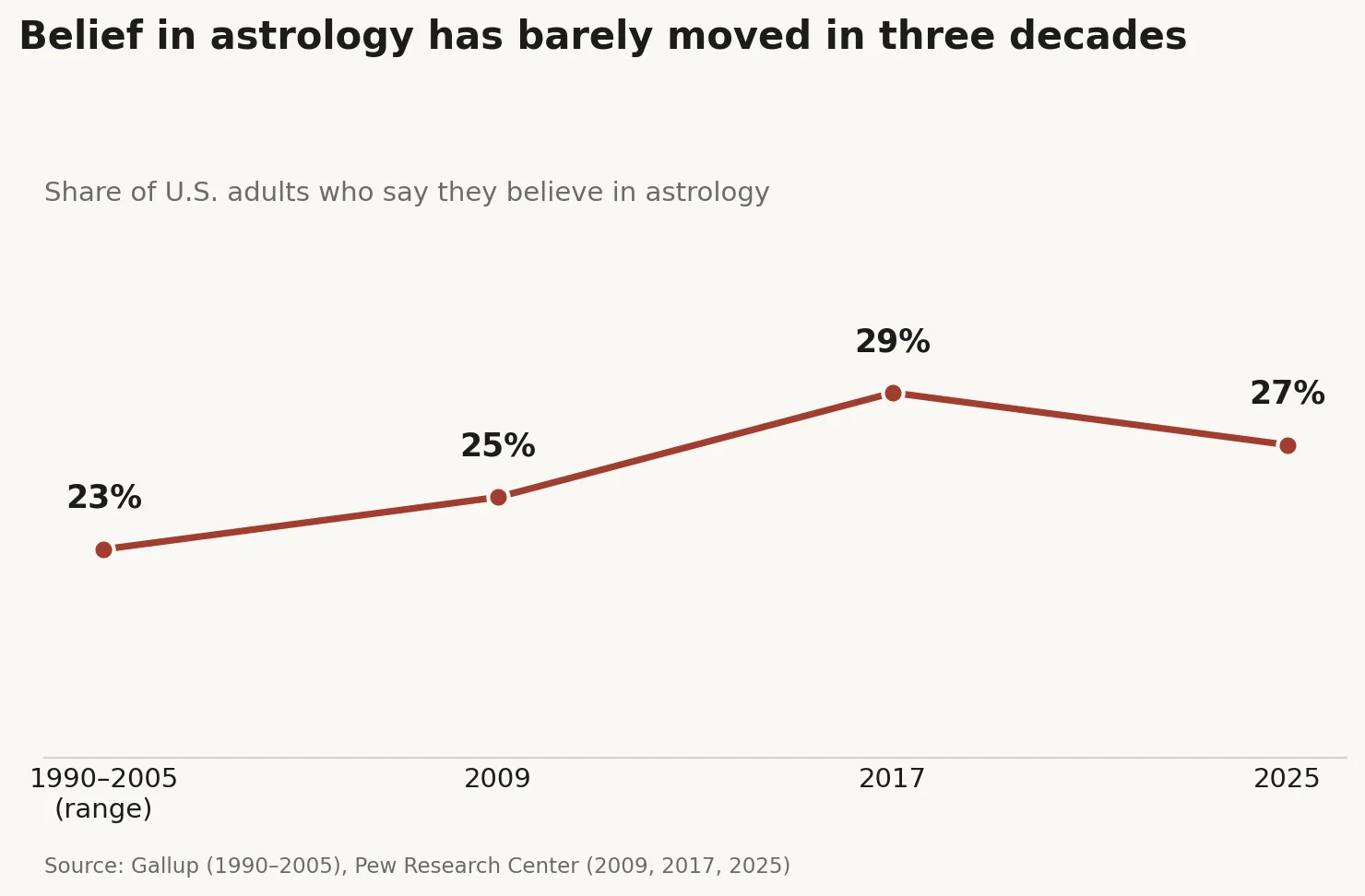
Start with scale. Pew Research’s 2025 survey found women are roughly twice as likely as men to believe in astrology, 35% against 18%, with belief peaking among women aged 18 to 49 at 43%. That number has barely shifted in three decades of polling. Meanwhile, the National Science Board has tracked a more troubling trend since 1979: the share of Americans willing to call astrology “not at all scientific” has actually fallen over time rather than risen, even as the evidence against it only accumulated.

Now the mechanism. The largest and most methodologically serious study on who believes is a 2025 analysis of 8,553 Americans drawn from the General Social Survey, published in the Journal of Individual Differences and reported by PsyPost. Intelligence, measured through a standard vocabulary assessment, was the single strongest predictor of disbelief. Years of formal education predicted disbelief as well, supporting what researchers call the “superficial knowledge hypothesis“: limited exposure to how evidence actually gets tested makes a person more likely to accept a cold reading at face value. This is not a trivial finding, and I won’t dress it up as one. People with less practice evaluating claims are measurably more likely to accept this particular claim.
A second, smaller study adds a sharper edge. In 2021, three researchers at Lund University surveyed 264 people and found that narcissism, not any other personality trait, was the single strongest predictor of belief in astrology, published in Personality and Individual Differences. Intelligence again came out negatively associated. The researchers’ own explanation is worth repeating plainly: horoscopes are built almost entirely out of flattering, universally applicable statements, phrased to make the reader feel uniquely understood, which is precisely the kind of feedback narcissistic traits are wired to chase. It’s real, peer-reviewed, and worth citing by name.
Part of the appeal is a well-documented quirk of human psychology called the Barnum effect, the tendency to read a vague, universally applicable statement (“you sometimes doubt whether you’ve made the right decision”) and experience it as uncannily personal. Astrology is built almost entirely from Barnum statements. It also offers something real, which is comfort. Life is unpredictable and often frightening, and a system that promises pattern and meaning is genuinely soothing, whatever its scientific standing.
So my argument isn’t that people who enjoy astrology are bad people. Though they certainly can be. It’s that the structure underneath the enjoyment, sorting humans into fixed types by something outside their control, is the same structure that, applied to a different unchosen trait, we correctly call prejudice. The fact that one version is entertaining and the other is monstrous doesn’t mean they’re unrelated. It means one of them hasn’t yet been asked to answer for what it teaches.
Here’s the part that actually matters for the argument you’ll find elsewhere online: the same 8,553-person study tested, directly, the older theory that astrological belief tracks with authoritarian or prejudiced psychology, the Adorno hypothesis, and found the opposite. Right-wing respondents were less likely to believe, not more, and religiosity had no measurable effect either way. I’m reporting that because it’s true and because a piece that only cites the evidence flattering to its own thesis is doing exactly what astrology does: reading a confident story off a thin correlation. The honest picture is narrower and, frankly, more useful than the inflated one. Astrology doesn’t appeal to cruelty. It appeals to people who haven’t had much practice telling a comforting story from a tested one, and, for a smaller slice, to people who enjoy being told they’re special. That’s bad enough. It doesn’t need embellishing.
What I can tell you without needing a study is what it feels like from the other side of the judgment. I’ve had people decide who I am, my character, my competence, before a single real conversation, and I don’t think the stars were doing that work. The birth date, when it eventually came up, arrived afterwards, offered as confirmation rather than diagnosis. “Oh, that explains it.” I don’t know what was actually doing the explaining in those moments. I have my suspicions. What I won’t do is dress up a suspicion as a finding, because that’s the one move this entire piece exists to criticise.
Who profits while believers pay
Astrology isn’t just a belief. It’s an industry, and the people running it are frequently open about not holding the belief they sell.
The “mystical services” market, astrology, tarot, psychic readings combined, was estimated at $2.2 billion in 2018 by IBISWorld, and CBS News reported it had grown to roughly $3 billion, with industry analysts projecting it could triple again within five years. Co-Star, the most downloaded astrology app, has raised tens of millions in venture capital from investors who talk about the opportunity in exactly the flat, unsentimental language they’d use for any other consumer product. One investor backing a rival app told the New York Times he had “zero doubts about the business potential,” while describing himself, by his own sign’s supposed reputation, as naturally sceptical.
That is the tell, and it should make anyone paying for a monthly reading angry rather than comforted. The people closest to the machinery are, by their own public statements, frequently the least persuaded by the product. That isn’t automatically cynical on its own; you can run a wellness business sincerely without personally buying the premise, the way a casino turns a profit without the house believing in luck. But it means the people handing over a subscription fee for a personalised chart are, disproportionately, the same people the research above says are least equipped to price the claim correctly, while the people collecting the fee are, in their own words, often the ones who trust it least. That is not a neutral transaction. That is exploitation with a nicer font.
A Buddhist footnote, briefly
I said I’d bring this back to where I actually stand, so here it is. Buddhist psychology has a word, anatta, for the idea that there is no fixed, unchanging self sitting behind a person, waiting to be read off a chart. What we call a self is a pattern in motion, shaped by causes and conditions, capable of changing under new ones. Astrology asks you to believe the opposite: that you were sealed at birth into a type, and that type is who you are. I find that not just empirically wrong but philosophically a little sad. It’s a smaller way of seeing a person than the one most contemplative and scientific traditions, for all their disagreements, actually converge on.
Where this connects to how I think about AI
I’ve written elsewhere about where I stand on AI, and the throughline is the same one running through this piece: judge the thing in front of you by what it actually does, not by the category you’ve already decided it belongs to. That applies to a person born in late August as much as it applies to a language model, a job applicant, or a stranger’s accent. Evidence first. Labels earn their keep or they don’t.
FAQ
Is astrology a form of prejudice?
Astrology sorts people into fixed personality categories based on an unchosen fact, their birth date, and treats that category as predictive of who they are. That is the same cognitive mechanism, psychological essentialism, that underlies racial and other forms of prejudice, even though the two carry vastly different histories and stakes.
Has astrology been scientifically tested?
Yes, repeatedly. Shawn Carlson’s 1985 double-blind study in Nature found astrologers performed no better than chance at matching birth charts to people. A 2020 study of over 173,000 people found astrological sign predicted no personality traits and no job performance across nearly 33,000 employees.
Does astrology actually cause real-world discrimination?
Yes. Peer-reviewed research from MIT Sloan documented astrological sign affecting hiring and dating decisions in China, particularly against people born under Virgo. Job advertisements naming acceptable or excluded star signs have also surfaced in Austria and China.
Does believing in astrology mean someone is less intelligent or more narcissistic?
Two real studies have tested this, and they have indeed linked belief in astrology to lower intelligence and higher narcissism. The larger, nationally representative one, 8,553 Americans, found intelligence and education were the strongest predictors of disbelief. A smaller, self-selected study of 264 people found narcissism was the strongest predictor in that sample. Together they describe a real pattern.
Is believing in astrology the same as being racist?
No, and this piece doesn’t argue that. Racism carries structural power, historical violence, and legal entrenchment that astrology does not. The claim is narrower: the underlying cognitive habit, treating an unchosen category as destiny, is shared between them, and it’s worth naming even where the consequences differ sharply in scale.
Why do so many people still believe in astrology despite the evidence?
Largely the Barnum effect, our tendency to read vague, universal statements as personally accurate, combined with a genuine and understandable desire for comfort and pattern in an unpredictable life. Belief has stayed remarkably stable in U.S. polling for over thirty years, around a quarter to a third of adults.
Sources, for your reference list
- Popper, K. Conjectures and Refutations (falsifiability critique); overview at Wikipedia, Astrology and Science
- Carlson, S. (1985). “A Double-Blind Test of Astrology.” Nature, 318, 419–425.
- Lu, J.G., et al. (2020). “Disentangling stereotypes from social reality: Astrological stereotypes and discrimination in China.” Journal of Personality and Social Psychology.
- Haslam, N., Rothschild, L., & Ernst, D. “Are essentialist beliefs associated with prejudice?” British Journal of Social Psychology.
- Racial essentialism and prejudice: PMC7643920
- Bertrand, M., & Mullainathan, S. (2004). “Are Emily and Greg More Employable than Lakisha and Jamal?” PDF, American Economic Review.
- Job discrimination by star sign, Austria and China: LiveScience
- Pew Research Center (2025). “3 in 10 Americans Consult Astrology, Tarot Cards or Fortune Tellers.”
- National Science Board, “Public assessment of astrology, 1979–2018.”
- Edwards, T., et al. (2025). “Intelligence and Individual Differences in Astrological Belief.” Journal of Individual Differences, 46(1), 50–57.
- Andersson, I., Persson, J., & Kajonius, P. (2022). “Even the stars think that I am superior: Personality, intelligence and belief in astrology.” Personality and Individual Differences, 187, 111389.
- Griffith, E. (2019). “Venture Capitalists Are Betting on Astrology.” The New York Times.
- Study shows people who believe in astrology tend to be less intelligent and more narcissistic
- Belief in Astrology Linked to Lower Intelligence and Higher Narcissism: A New Study’s Insights

Avi is a researcher educated at the University of Cambridge, specialising in the intersection of AI Ethics and International Law. Recognised by the United Nations for his work on autonomous systems, he translates technical complexity into actionable global policy. His research provides a strategic bridge between machine learning architecture and international governance.