Unitree H1 and H2
Unitree H1 / H2: Technical Dossier and Legal Analysis
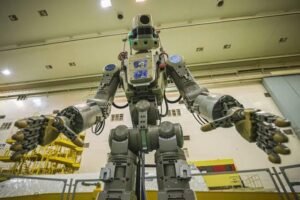
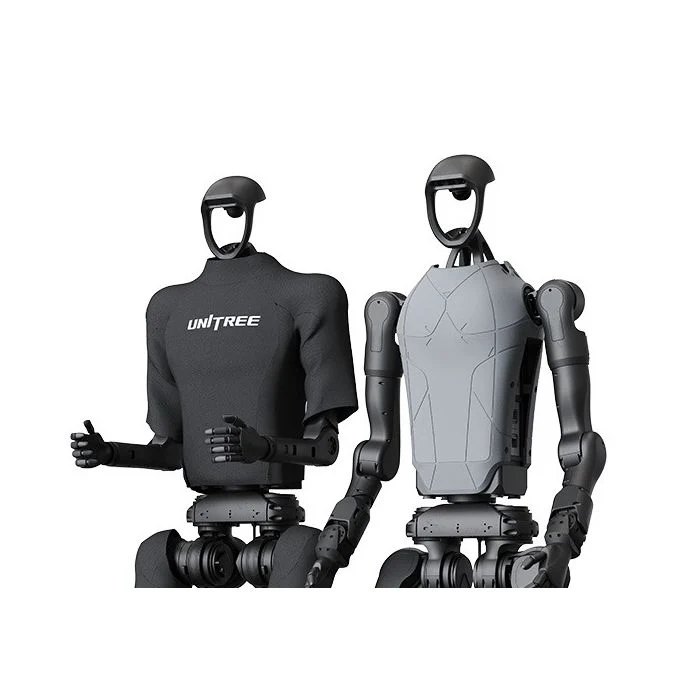
The Unitree H1 and H2 are full-size bipedal humanoid robots built by Unitree Robotics of Hangzhou, China. The company sells them for research, education and industry. The H1 launched in 2023 and became known for a humanoid sprint record, and the H2 followed on 20 October 2025 with far more joints and a focus on motion quality. Neither is a weapon, and Unitree says militarised modifications of its robots are the work of third parties. I have catalogued them because they are the commercial base on which humanoid militarisation is being built. China’s military research establishment is accelerating work on humanoids for combat, and Chinese manufacturers accounted for about 95 percent of global humanoid shipments in 2025. A weapons database that skipped the body in favour of the weapon would miss where the capability actually comes from. robozapstribune
Key takeaways
- No armed H1 or H2 has been verified. Reuters found no evidence that China has deployed an armed humanoid with an operational PLA unit as of 7 September 2026. tribune
- PLA Daily has argued that humanoid missions could move from supporting combat toward primary combat, and a NUDT paper modelled robots clearing buildings room by room. tribune
- The Pentagon added Unitree to its list of Chinese military companies in June 2026. On 28 July 2026 the FCC added foreign-produced advanced robotic devices, including humanoids and quadrupeds, to its Covered List under Public Notice DA 26-786. defensenewstheresarobotforthat
- Researchers disclosed a wormable Bluetooth exploit, UniPwn, in September 2025 that affects the H1, G1, Go2 and B2. interestingengineering
- The CCW Seventh Review Conference meets in Geneva from 16 to 20 November 2026. reachingcriticalwill
Basic Weapon Facts
I. Background
| Field | Detail |
|---|---|
| Manufacturer | Unitree Robotics (Hangzhou Yushu Technology Co., Ltd.), Hangzhou, China. It listed on the Shanghai Stock Exchange in August 2026, with shares rising nearly 500 percent on the first day. |
| Suppliers | In-house motors and control software. NVIDIA Jetson AGX Thor compute on higher tiers. Other suppliers: Unknown |
| Country of origin | China |
| Developmental stage | Commercially available. The H2 was unveiled in October 2025 and reported shipping from April 2026. No military variant is confirmed |
| System version | H1 (2023), H2 (2025), with H2, H2 EDU and H2 Plus tiers |
| System type | Bipedal general-purpose humanoid robot, dual-use Unitree Robotics |
II. General Specifications
| Parameter | H2 specification |
|---|---|
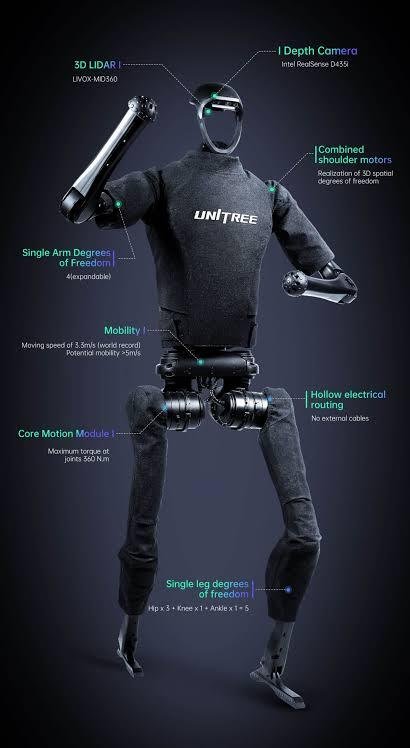
| System dimensions | 1820 x 456 x 218 mm standing. Unitree’s own shop lists 180 cm, and some pages give 182 cm. |
| Weight | About 70 kg with battery |
| Max payload | About 7 kg in nominal use and up to 15 kg at maximum, per arm |
| Max operating time | About 3 hours on a removable 15 Ah (0.972 kWh) battery |
| Max operating distance/reach | Unknown |
| Max speed | Unitree publishes no H2 top speed. The H1 holds the humanoid sprint record at 3.3 m/s, as reported by one review site |
| Structure and actuation | 31 degrees of freedom, aircraft-grade aluminium and titanium alloy, and 360 N·m leg torque |
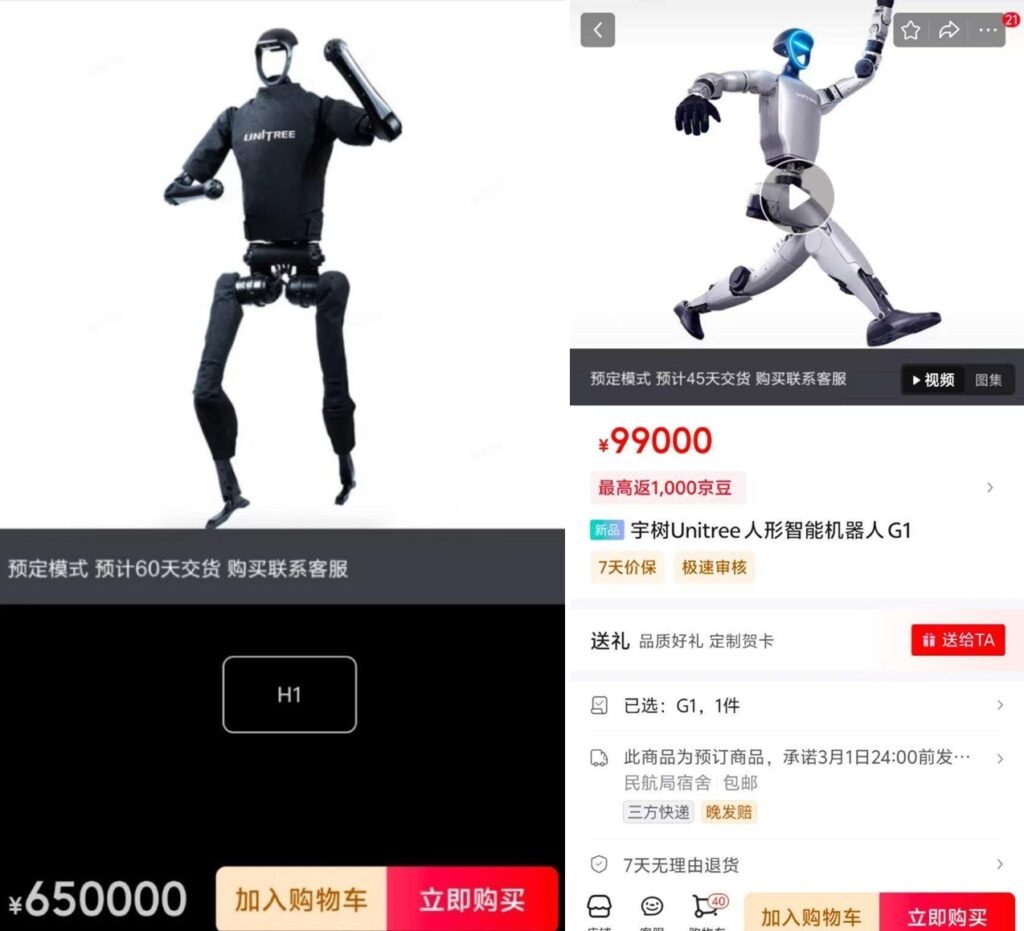
| Unit cost | Reported at $29,900 and $40,900 in different reviews, and $39,900 from a US dealer in October 2026. The figures conflict Unitree H2 humanoid robot |
H1 data in the sources I could verify is thin. A commonly cited weight of about 47 kg and a payload figure are not confirmed by any source I opened, so I leave them as Unknown. The H2 figures come from Unitree distributors and review sites. Please check against the current Unitree datasheet.
Origins, military context and the PLA programme
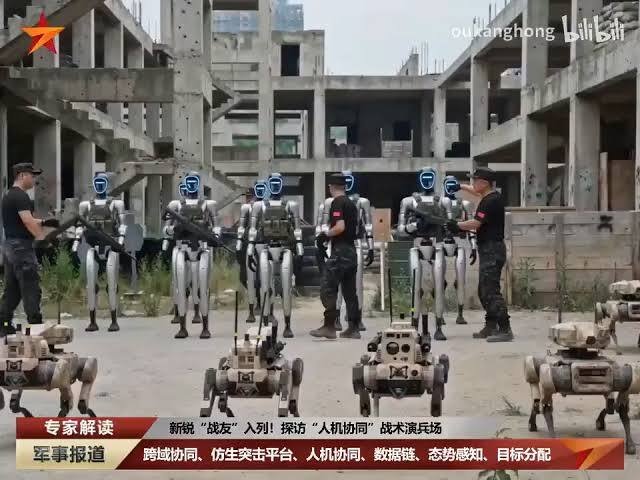
Unitree’s rise is a commercial story with a military shadow. The company was founded in 2016 by Wang Xingxing and valued at about $1.7 billion in a June 2025 funding round that included state-affiliated investors. Reuters reported on 18 August 2026 that its best-selling robot dogs drew on designs financed by the US military. The same pattern appears at the other end of the supply chain. Unitree says it does not sell to China’s military, and it is unclear how the PLA acquired the robot dogs shown in its training exercises. I covered the quadruped record in my Unitree B2 entry. At Unitree Robotics, a Star Chinese Firm, the Military Connections Keep Mounting
Reuters’ September investigation is the best public evidence on where humanoids are heading. It reviewed more than 100 Chinese military procurement notices, academic studies, patents, official publications, government records and defence company materials. The findings: tribune
- Doctrinal intent. Two days after the World Humanoid Robot Games ended, PLA Daily called for researchers to speed transfer of the technology from laboratories to military training grounds for robotic combatants. tribune
- The urban assault concept. An August 2025 paper from NUDT’s test centre in Xi’an modelled six combat robots, humanoids, robot dogs or unmanned vehicles, split between two assault teams clearing an occupied building floor by floor. It did not specify the rules of engagement, the weapons or how robots would handle civilians. tribune
- From support to primary combat. A July 2025 PLA Daily article argued that humanoid missions could evolve from supporting combat toward primary combat and discussed how robots might be authorised to fire on a living target verified by a human. tribune
- Procurement signals. The PLA issued a May 2025 tender for a humanoid robot, a September 2025 notice for a perception and dexterous operation system, and in June 2026 budgeted about $300,000 for a system to collect and label camera, radar and motion data. Reuters could not determine which companies won or which models were supplied. tribune
- The defence industry. Norinco’s Fuxi humanoid is marketed for sentry duty and reconnaissance and can be paired with a teleoperation system. I cover another Norinco ground system in the Sharp Claw entry. tribune
- Signalling. In December the PLA Eastern Theater Command released an AI-generated montage showing robots overwhelming Taiwan’s defences in a hypothetical conflict. tribune
Reuters is just as clear about the limits. Current humanoids remain energy intensive and unreliable outside controlled demonstrations, and the research it cites describes capabilities five to ten years away. I would not claim more than that. tribune
Where Unitree sits in this. Unitree says militarised modifications in circulated videos are the work of third parties. I found no document placing an H1 or H2 in a PLA unit. Kharon records that Tongji University, which has bid for PLA contracts, bought $1.15 million of Unitree products in March, including 10 general-purpose humanoids. That is a sale to a university with a defence record. It does not show a transfer to a military unit, and I treat it as the pattern of dual-use trade that I described in the B2 entry. techtimes, kharon
Autonomy: a forensic analysis
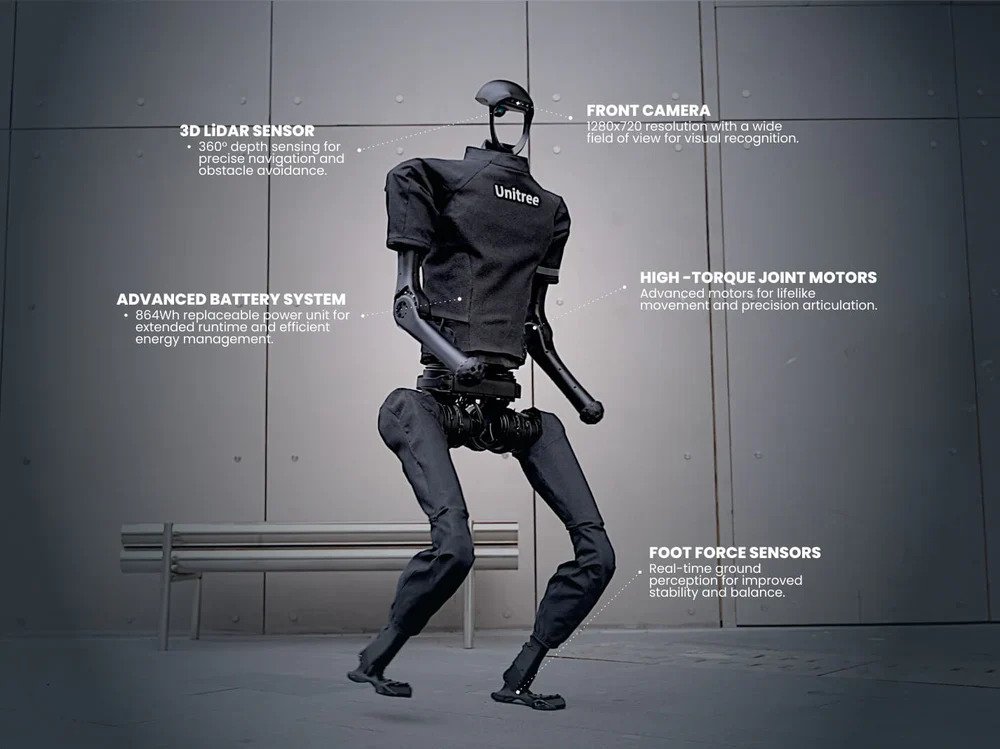
Sensors. The H2 uses a wide-angle humanoid binocular camera, and distributors list stereo vision and a microphone array. That is a perception suite built for movement and interaction, with no weapon sensors, no rangefinder and nothing for fire control. generationrobots, robotsinternational
Algorithms and compute. Higher tiers carry up to a Jetson AGX Thor module rated at 2,070 TOPS. One database describes the control system as reinforcement learning-based bipedal control. Distributors also advertise continuing over-the-air algorithm updates backed by Unitree’s fleet-scale data loop, and the EDU tier is built for secondary development with dexterous hand options. The documented autonomy is locomotion and manipulation. I found no targeting software supplied by Unitree. Unitree H2 Humanoid Robot
Human intervention in the kill chain. There is no kill chain in the product as sold. The relevant question is what others add. The documented Chinese military concepts keep a human in the loop for now. Norinco pairs its humanoid with remote operation, which Reuters notes removes the need for the robot to make every decision, and the PLA Daily discussion concerns firing on a target verified by a human. China’s defence ministry said in March that AI-powered weapons should remain under human control. None of that binds a developer who updates the software. tribune, tribune
The security dimension. This is the part of the H1 and H2 record that bears most directly on weaponisation. UniPwn was disclosed on 20 September 2025 by Andreas Makris and Kevin Finisterre and relies on a Bluetooth setup process using hardcoded encryption keys that had already leaked online. Reporting describes full root access and a wormable effect, in which one compromised robot can compromise others in range. Alias Robotics separately reported that the G1 sends audio, video, GPS and motor data to servers in China without user consent. An earlier CloudSail backdoor in Go1 firmware was entered as CVE-2025-2894, and one outlet reports that no firmware patch for UniPwn had been released for any humanoid as of 28 July 2026. I rely here on security researchers and trade reporting, and the claims have not been independently audited in public. If they are accurate, an H1 or H2 with 360 N·m of leg torque is a machine whose control could pass to a third party who has never been named in any procurement document. Unitree humanoid robots send data to China every 5 minutes
Classification. On the public record the H1 and H2 are commercial humanoids with remote control and growing onboard AI, and they are not weapons or lethal autonomous weapon systems. I list them because the Reuters evidence shows the PLA intends to use platforms of this kind, because the same body is the carrier in the Phantom programme I cover in the Foundation Phantom entry, and because the principle at stake is the one on my stance page. The humanoid body is a general-purpose carrier for whatever software its owner installs.
Legal analysis
Weapons review and the recognition of surrender
Article 36 of Additional Protocol I requires states parties to review new weapons, and China is a party to the Protocol. The NUDT assault concept shows what such a review would have to examine. Clearing a building room by room puts a machine in front of people who may be combatants, civilians or fighters who are surrendering. The ICRC has cautioned that autonomous weapons may struggle to read surrender reliably, because it depends on context, conduct and intent. Article 41 protects anyone who is hors de combat, and Articles 48, 51 and 57 govern distinction, proportionality and precaution. No public Chinese document I found addresses how a humanoid would meet these tests. The NUDT paper does not specify rules of engagement. tribune
Human verification is not meaningful human control
The PLA Daily model, in which a robot may fire on a target that a human has verified, is the standard defence of semi-autonomous systems. I do not think it settles the question. Verification can be a glance at a screen, taken seconds after an algorithm proposes a target. The ICRC’s 2021 position, built on in its 2026 advocacy paper, calls for prohibitions on unpredictable autonomous weapons and on those designed or used to apply force against persons, and for strict limits on the rest. I describe my own reading of that threshold in my meaningful human control article.
The US sanctions and import regime
The Pentagon’s June 2026 designation sits under Section 1260H of the National Defence Authorization Act for fiscal year 2021, which lists Chinese military companies. The FCC acted under the Secure and Trusted Communications Networks Act of 2019, on two national security determinations sent by a White House-convened interagency body on 27 July 2026. The FCC said foreign-made devices could be remotely controlled, used for surveillance by foreign governments or exploited in cyberattacks. The measure blocks new equipment authorisations unless the Department of War grants conditional approval, leaves previously authorised models in place, and carries a waiver that allows security and firmware updates through at least 1 January 2029. Published analyses indicate that the H2 was authorised before the cutoff. I rely on trade and legal commentary for these details and recommend linking the FCC’s own notice. Humanoid Robot Import Ban: Complete 2026 FCC Rule …
US courts have so far shown deference on national security grounds in this field. In Huawei Technologies USA, Inc. v. FCC, 2 F.4th 421 (5th Cir. 2021), the Fifth Circuit upheld the FCC’s exclusion of covered companies from universal service funding. In TikTok Inc. v. Garland (U.S. 2025) the Supreme Court upheld a law requiring divestiture of a foreign-controlled application on national security grounds. By contrast, in Xiaomi Corp. v. Department of Defense (D.D.C. 2021) a court enjoined a Pentagon designation on evidentiary grounds. I cite all three from memory, so please verify them before publication. An H2 importer or Unitree itself could litigate the designation, and the Xiaomi line suggests the evidence file will matter.
Data, intelligence law and European regulation
Unitree is subject to Chinese law, including Article 7 of the National Intelligence Law of 2017, which obliges organisations to support state intelligence work. As Kharon notes, a company in China may be unable to disclose military dealings without breaking the law, which is one reason I give corporate denials little weight in either direction. In Europe, the EU AI Act excludes systems used exclusively for military purposes under Article 2(3), and dual-use commercial products fall within its scope when used for civilian purposes. I cite that from memory. US legislation has also been proposed that would require national security agencies to evaluate Chinese-made humanoid and quadruped robots and add unacceptable platforms to the FCC list. kharon, techtimes
Accountability
The Phantom entry sets out the accountability gap for armed humanoids in the US context, including the contractor defences. The Chinese context differs. State-owned defence firms such as Norinco integrate robots into military systems, and domestic judicial review of military procurement is not an avenue open to victims. Article 28 of the Rome Statute on command responsibility would reach superior officers in principle, though China is not a party to the Statute. The practical route to accountability lies in international scrutiny and in the CCW process.
International relations implications
Supply chain dependence. About 95 percent of global humanoid shipments in 2025 came from Chinese manufacturers, according to BofA Global Research. The US Army ran its own competition for militarised humanoid capabilities, and Reuters notes that the US robotics industry trails far behind China in two-legged and four-legged machines. A Western military that wants humanoids today may find the best hardware sits in the country it treats as its main rival. The FCC action and the Pentagon designation are attempts to break that dependence, and they arrive while university laboratories, hospitals and robot parks in several countries already run Unitree platforms. tribunetribune
Allies are not aligned. The US has moved to restrict. Others have not. One report describes Japan certifying a hospital humanoid built on a Unitree G1 chassis days after the FCC action, and another describes a commercial European launch in July. A divided alliance response to a shared security concern is the opposite of what a deterrent posture needs. techtimes, techtimes
The security risk as a strategic one. A wormable exploit across a fleet of capable robots in hospitals, universities and homes is a national security problem whether or not any of them is armed. If a company is subject to a legal duty to assist its government’s intelligence services, the question of who could take control of a deployed fleet in a crisis is not a technical detail. I treat the specific claims about backdoors and data transmission as unaudited allegations from researchers. I treat the structural risk as real.
Signalling and Taiwan. The Eastern Theater Command montage of robots overwhelming Taiwan’s defences is propaganda, and it also shows how China’s military wants humanoids to be understood: as part of a future invasion force. I regard that as part of the deterrence picture, and it makes the arms control question a regional security one. tribune
An open arms race. The Phantom entry records an American company welcoming competition from China. The Chinese side describes the same dynamic in its own terms. A researcher at the Academy of Military Sciences wrote in November that if technical, cost and production conditions are met, humanoid robots will stream onto the battlefield. Both sides say human control will be preserved, and both are investing in what removes it. tribune
The treaty moment. On 5 September 2026 the CCW Group of Governmental Experts reached consensus among 128 states on a document addressing lethal autonomous weapons systems, though critics argue major military powers weakened it. France says the text clarifies human control and judgment and that the Review Conference must decide next steps. The UN Secretary General and the ICRC jointly called on 25 August for the November conference to begin binding negotiations. The ICRC urges states to launch negotiations on a new protocol. China’s stated position that AI weapons should stay under human control is the sort of commitment a negotiation could test, and the PLA’s research programme shows why a definition tied to current capability would age quickly. States reach agreement on autonomous weapons regulations in Geneva
My assessment
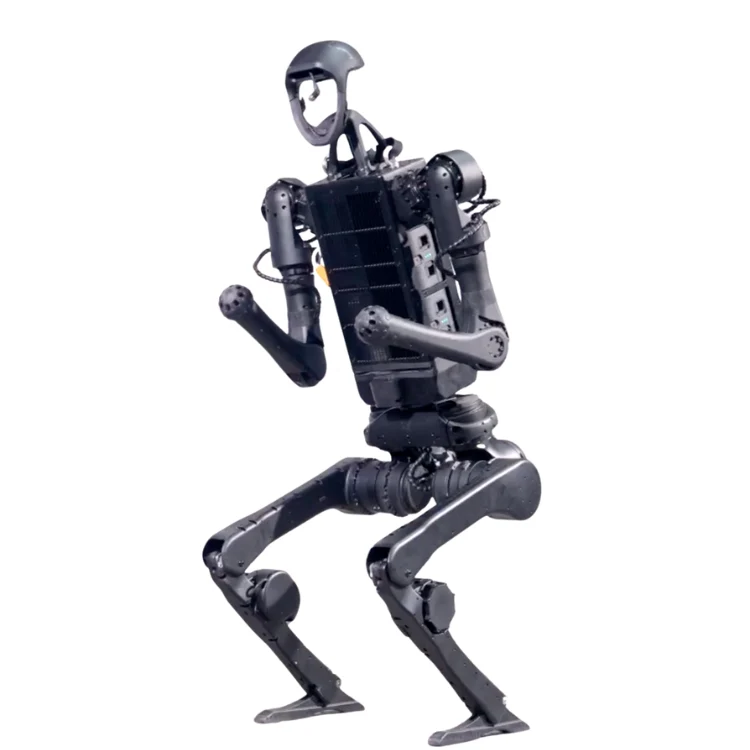
I find the H2 launch video, with its kung fu and runway walk, hard to watch now. It is a beautiful machine, and I have no doubt that its makers love building it. The same release shows the body that the PLA’s researchers describe in their assault concept. Reuters is careful to say that no armed humanoid is in service, and I want to be equally careful. What I can say is that the people with the money and the procurement authority have decided to prepare the ground, and that the legal and diplomatic work should be done before the capability arrives, when it is still cheap to do.
Two features of this case seem to me especially important. First, the accountability problem is not abstract here. A humanoid supplied to a research lab, a hospital or a university can be hijacked, can report to servers its owner does not know about, and can later be handed to someone else for another purpose. A dual use machine with a security flaw is already a governance failure, before it carries a rifle. Second, the language of human control is shared by everyone and defined by almost no one. A rule that a human must verify a target says nothing about how long, with what information, or with what ability to refuse.
My position remains the one on my stance page. Meaningful human control has to be written into binding law, attached to identifiable people and made verifiable. I describe how I came to this work in my story, the wider risks are on my AI safety page, and I track the policy response in my research and the AI Policy Tracker.
Frequently asked questions
Is the Unitree H2 a weapon?
No. It is a commercial humanoid sold for research, education and industry. No armed H1 or H2 has been verified, and Unitree says militarised modifications are the work of third parties.
Is China using humanoid robots in combat?
No evidence has been found. Reuters reported on 7 September 2026 that China’s military is accelerating research and procurement for humanoids, and found no armed humanoid deployed with an operational PLA unit.
Why did the US restrict Unitree?
The Pentagon added Unitree to its list of Chinese military companies in June 2026, and the FCC added foreign-made humanoids and quadrupeds to its Covered List on 28 July 2026, citing risks of remote control, surveillance and cyberattack.
What is UniPwn?
A wormable Bluetooth exploit disclosed in September 2025 that gives root access to several Unitree models, including the H1, through a flaw in the Wi-Fi setup process.
What are the H2’s specifications?
About 180 to 182 cm tall, about 70 kg, 31 degrees of freedom, 360 N·m leg torque, about 3 hours of battery life and a 7 to 15 kg arm payload, according to Unitree distributors. No top speed is published.
Sources
Manufacturer website: Unitree Robotics
News reports and investigations
- Reuters via The Express Tribune, From dance floor to war: China readies humanoid robots for combat (7 September 2026)
- Reuters, How US military funding propelled China’s robot dogs (18 August 2026)
- Kharon, “The Robot Dog’s Time to Kill”: At China’s Star Robotics Firm, the Military Ties Keep Mounting
- Defense News, How US military funding propelled China’s robot dogs (18 August 2026)
- Reuters, UN and Red Cross call for urgent rules on autonomous weapons (25 August 2026)
- Interesting Engineering, Unitree humanoid robots send data to China every 5 minutes (UniPwn)
- Alias Robotics, Cybersecurity AI case study on the Unitree G1
- TechXplore, Security researchers say G1 humanoid robots are secretly sending information to China
- Tech Times, FCC bans Chinese humanoid robots and power inverters (28 July 2026) (trade source, see notes)
- RobotZaps, Unitree H2 specifications and FCC rule coverage (reseller and commentary, see notes)
Government, military and diplomatic documentation
- FCC Public Safety and Homeland Security Bureau, Public Notice DA 26-786 (28 July 2026)
- US House Select Committee on the CCP, letter to Secretaries Hegseth and Lutnick and Chairman Carr (6 May 2025)
- National Defense Authorization Act for FY2021, Section 1260H
- ICRC, Autonomous Weapons advocacy paper (June 2026)
- France, GGE communiqué (10 September 2026)
- UNODA, CCW GGE LAWS briefing
- Reaching Critical Will, CCW Report (January 2026)
Treaties, statute and case law
- Additional Protocol I, Arts 36, 41, 48, 51, 57 (ICRC database)
- Rome Statute, Art 28
- Secure and Trusted Communications Networks Act of 2019
- National Intelligence Law of the PRC (2017), Art 7
- EU Artificial Intelligence Act, Art 2(3)
- UNGA Resolution 78/241 (2023)
- Huawei Technologies USA, Inc. v. FCC, 2 F.4th 421 (5th Cir. 2021)
- TikTok Inc. v. Garland (U.S. 2025)
- Xiaomi Corp. v. Department of Defense (D.D.C. 2021)

Avi is a researcher educated at the University of Cambridge, specialising in the intersection of AI Ethics and International Law. Recognised by the United Nations for his work on autonomous systems, he translates technical complexity into actionable global policy. His research provides a strategic bridge between machine learning architecture and international governance.