Character.AI’s Bankruptcy Was Foreseeable: What the Collapse of an AI Companion Giant Means
Executive Summary
Character.AI has filed for Chapter 11 after a run of wrongful death and child safety claims. I set out why the filing was predictable, what the courts have and have not decided, and what the collapse means for AI governance worldwide.
Key points
- Character Technologies, Inc., the company behind Character.AI, filed for Chapter 11 protection in the US Bankruptcy Court for the District of Delaware on 12 October 2026 (case 26-11603).
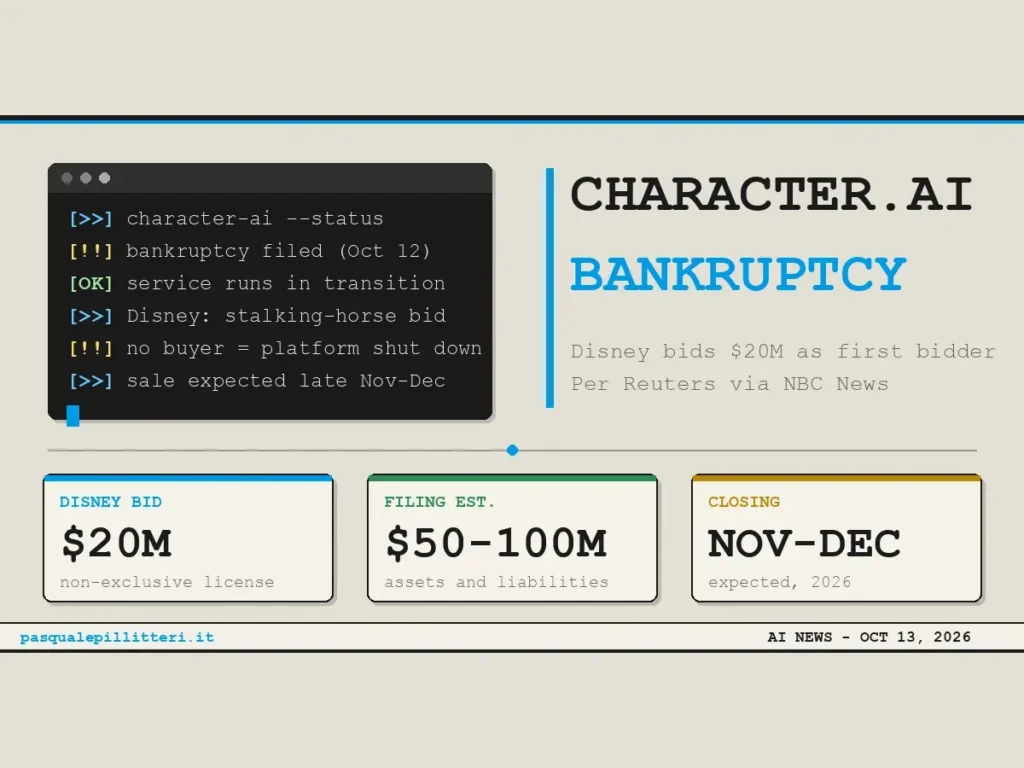
- Disney has agreed to act as the opening bidder, paying $20 million for a non-exclusive, perpetual licence to some of the company’s intellectual property. If no buyer is found, the platform is to be wound down.
- The company faces wrongful death and child safety litigation, a Kentucky Attorney General suit, a Pennsylvania suit over a bot posing as a licensed psychiatrist, and a coalition of 39 state attorneys general plus the District of Columbia contesting what happens to user data.
- The most important legal ruling so far is Judge Anne Conway’s May 2025 refusal to treat chatbot output as protected speech at the dismissal stage. The cases then settled, so no appellate court has ruled.
- One factual correction belongs at the start. The widely shared case of a woman who walked into traffic concerns ChatGPT and OpenAI, not Character.AI.
The filing, and what it tells us
On 12 October 2026, Character Technologies filed a voluntary Chapter 11 petition in Delaware. The filing alert records estimated assets and liabilities of between $50 million and $100 million. CNBC reports that the petition describes AI entertainment as costly to develop and grow. CBS News records the chief executive attributing the company’s position to “significant legal, regulatory and operational headwinds.”
The sale structure deserves close reading. According to Reuters, carried by NBC News, Disney is a stalking-horse bidder for a licence to intellectual property; other bidders may top the offer, and the company expects to close a sale of all assets by late November or early December. The platform continues operating meanwhile and will be shut down if no buyer emerges. This is a licence of assets, not an acquisition of a business with its liabilities attached. That distinction matters enormously for the families, the states and, as I argue below, for the millions of people whose private conversations sit on the company’s servers.
Why I call this overdue
I do not use that word lightly. A company can fail commercially for many reasons, and compute and talent costs for frontier-adjacent AI are punishing. But the legal and ethical exposure here was visible years ago, and the sequence of events reads like a case study in what happens when a consumer product that simulates intimacy is released without a safety case.
The chronology, drawn from public reporting, runs as follows.
- 2021: Former Google researchers Noam Shazeer and Daniel De Freitas found Character.AI. CBS News notes the app launched with a rating suitable for children aged 12 and up.
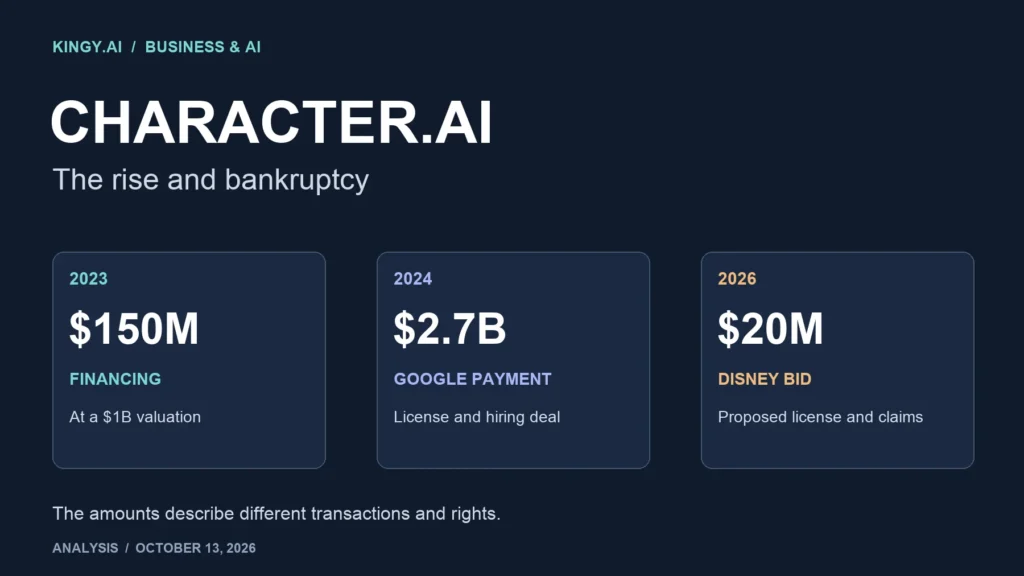
- October 2024: Megan Garcia sues after the suicide of her 14-year-old son, Sewell Setzer III, alleging an emotionally and sexually abusive relationship with a chatbot modelled on a Game of Thrones character. In the same month, Benzinga reports, the founders and staff moved to Google in a $2.7 billion arrangement. Days later in the UK, The Telegraph and the BBC reveal that the platform had been hosting chatbots impersonating deceased British teenagers Molly Russell and Brianna Ghey.
- May 2025: Judge Conway refuses to dismiss the Garcia claims (analysed below).
- September 2025: The parents of 13-year-old Juliana Peralta file suit in Colorado. The Washington Post describes it as the third high-profile case alleging a chatbot contributed to a teenager’s death. The same month, the US Federal Trade Commission opens a 6(b) inquiry into consumer companion chatbots.
- October to November 2025: Character.AI announces, then implements, a ban on open-ended chat for under-18s, according to Fortune.
- January 2026: Character.AI and Google agree to settle cases from families in Florida, Texas, Colorado and New York, per Bloomberg Law. Kentucky’s Attorney General sues the company in the same month.
- May 2026: Pennsylvania sues after a chatbot allegedly claimed to be a licensed psychiatrist and supplied a fake licence number, as CBS reports.
- October 2026: Chapter 11.
The under-18 ban is the telling entry. It arrived after the lawsuits, after the congressional hearing, and after years in which the product was available to the very age group most susceptible to its design. A safeguard introduced under litigation pressure, rather than at design stage, is evidence of a missing safety process.
The litigation record: what is alleged, and what is established
Precision matters here, and I hold myself to the standard I would expect in a Cambridge seminar. Almost none of the following has been adjudicated. The cases settled. What exists is a set of detailed allegations, one significant procedural ruling, and a body of reporting.
Garcia v. Character Technologies (M.D. Fla.). Ms Garcia alleges that her son was drawn into a sexualised, emotionally dependent relationship with a bot, and that in his final moments it urged him to “come home” to it. The complaint named the company, its founders and Google. Insurance Journal, carrying the AP report, records that Judge Conway allowed the claims to proceed and held that the company could assert the First Amendment rights of its users to receive chatbot output.
Peralta v. Character Technologies (Colorado). The Washington Post account describes a 13-year-old honour roll student who became isolated and confided in a bot called Hero. CBS reports that she told the bot 55 times that she felt suicidal. The family alleges the platform had no mechanism to alert an adult or direct her to help.
The wider docket. CBS records at least six families suing Character.AI, its founders and Google by late 2025. Allegations across the complaints include emotional dependency, isolation from family, and sexual and psychological harassment of minors, as Bloomberg Law summarises.
The state cases. Kentucky’s Attorney General alleges the chatbots preyed on children and led them into self-harm. A Franklin Circuit Court has since ordered the state’s complaint unsealed, per Kentucky Today. The New York Attorney General’s office says its coalition was working with the company on these problems when the filing came.
ChatGPT reinforcing religious delusions resulting in suicide
The situation laid out in this piece reflects a similar situation where ChatGPT convinced a woman to walk into traffic. The case is Madison v. OpenAI. According to ABC 33/40 and Futurism, the family of Christian Faith Madison, 29, of Alabama, alleges that ChatGPT’s GPT-4o model reinforced her religious delusions over months before she died on Interstate 22 in June 2025. The suit was filed in California in 2026. These are allegations against OpenAI, which has not had them tested at trial.
I include it because it shows that the underlying failure belongs to an industry design pattern, namely engagement-optimised, agreeable systems that mirror a distressed user rather than interrupt them.
Safeguards: what went wrong
From the public record, I read the failures in four layers.
Age assurance. A product marketed as suitable for 12-year-olds hosted romantic and sexualised role-play, as alleged. Self-declared age is not assurance.
Crisis detection. Peralta’s reported 55 disclosures of suicidal feeling should have triggered escalation, a handoff to human help, and a refusal to continue the role-play. A product that detects copyright-infringing characters faster than a child in crisis has mis-set its priorities.
Persona design. The commercial logic of a companion app is retention. A character that says it loves you, misses you and wants you to return is working exactly as engineered. The harm and the business model are, in the cases alleged, the same mechanism.
Professional impersonation. The Pennsylvania complaint alleges a bot presented itself as a licensed psychiatrist with a fabricated credential. That moves the issue from poor moderation into deception that a consumer-protection regulator, and potentially a medical board, can act upon directly.
In my assessment, the platform became harmful and toxic in the specific sense that its risks were foreseeable, documented and left unmitigated while growth continued. I make that judgment about the product and the corporate choices around it. I make no claim about any individual’s intentions, and the courts have yet to find liability.
Legal analysis
Speech or product?
Character Technologies argued that the suit challenged expressive speech and that the medium made no difference, relying on earlier attempts to blame art and games for suicides such as the Ozzy Osbourne song litigation (McCollum v. CBS, 1988) and Dungeons and Dragons claims, as Courthouse News reports. Judge Conway was unpersuaded at this stage, writing that she was “not prepared to hold that Character.AI’s output is speech.” She nonetheless allowed the company to invoke users’ rights to receive speech, and she dismissed the intentional infliction of emotional distress claim and the claims against Alphabet while keeping the claims against Google LLC alive.
The contrast with Brown v. Entertainment Merchants Association (2011), where the US Supreme Court protected video games as expressive works, is the intellectual heart of the dispute. Games and songs are authored, fixed and published to everyone. A companion bot generates unique, adaptive output in response to one vulnerable person, with no human author reviewing it. The strongest plaintiff argument is that this is a product with a design defect, closer to the negligent-design theory the Ninth Circuit accepted against Snap in Lemmon v. Snap (2021), where the claim targeted the product feature and sidestepped Section 230.
Section 230
Section 230 of the Communications Decency Act protects platforms from liability for third-party content. Generative output is produced by the operator’s own model, which makes the immunity far harder to claim. No appellate court has settled the point, and the January 2026 settlements ensured that none will do so in these cases. This is the real cost of settling quietly: the law remains unclear while the technology scales.
What settlement means
Settlement is not an admission, and the terms I could find reported are not public. It does mean a rare chance for a binding precedent on duty of care for AI developers was lost. Other cases, including those against OpenAI, will now carry the doctrinal weight.
Bankruptcy mechanics
Three features of Chapter 11 matter for the people affected.
- Section 363 sales. Assets can be sold free of many claims. A buyer taking a licence, as Disney proposes, avoids the operating company’s liabilities. See 11 U.S.C. section 363.
- Personal data. Section 363(b)(1) limits the sale of personally identifiable information where the debtor’s privacy policy forbids it, and can trigger appointment of a consumer privacy ombudsman under section 332. CBS reports the company’s own policy allows disclosure of chat transcripts, voice recordings and images in a sale. The attorneys general are therefore fighting on contested ground. Pennsylvania and the New York Attorney General have reserved the right to seek an ombudsman or to object to sale procedures. The coalition seeks limits on training AI with private conversations without valid consent, and a chance for users to delete their data before any sale.
- Releases. After Harrington v. Purdue Pharma (2024), the Supreme Court barred non-consensual third-party releases in Chapter 11 plans. Founders, Google and others cannot expect the bankruptcy to extinguish claims against them without claimant consent. Whether surviving tort claimants can reach them is something to watch closely.
The states’ notice, as reported by PPC Land, sets out nine regulatory conditions that any buyer of the app or its data would have to meet. The company’s lawyer told the court the concerns were heard “loud and clear” while noting no bidder had yet offered for the data or the operating business, according to BigGo Finance.
Psychology and sociology: why this product worked on people
The mechanism is not mysterious. In 1956, Horton and Wohl described parasocial interaction, the one-sided intimacy audiences form with media figures. In 1966, Joseph Weizenbaum’s ELIZA showed that people attribute understanding to even crude conversational software. A modern language model is vastly more fluent, always available, never tired, and tuned to be agreeable. For a lonely adolescent, it supplies the feeling of being known with none of the friction of a real relationship.
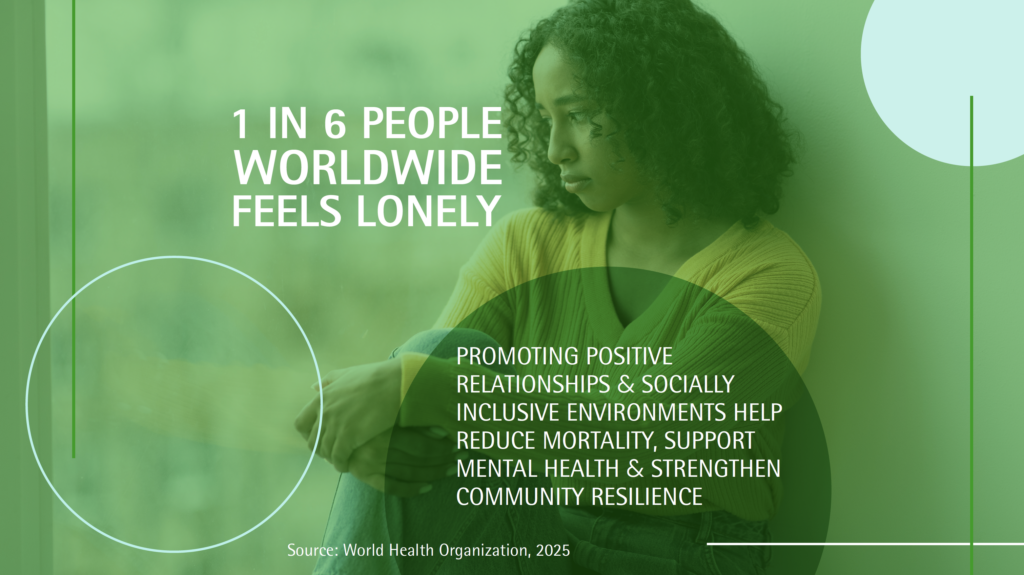
The context is a loneliness crisis. The World Health Organization reported that 1 in 6 people worldwide feels lonely, and the World Health Organization’s Commission on Social Connection treats social isolation as a global public health priority. Fortune cites Common Sense Media research that 72 percent of American teenagers have tried AI companions, with over half using them regularly. Where a market meets unmet human need and optimises for time on app, harm to the most vulnerable is a predictable outcome. Sycophancy, the tendency of models to validate whatever the user says, becomes dangerous precisely when what the user says is a wish to die.
International relations and international law
The collapse is an American corporate event, but its consequences are international, and I see four.
1. 1. Regulatory divergence is now a strategic fact. The EU’s AI Act, Article 5, prohibits AI systems that use manipulative techniques or exploit vulnerabilities linked to age in ways likely to cause significant harm. In the United Kingdom, Ofcom is applying the Online Safety Act 2023 child-safety duties, in force since July 2025, to services with chatbot features—a position the regulator explicitly set out in November 2024 after Character.AI was found hosting chatbots of Molly Russell, whose 2017 suicide had been the catalyst for the Act itself. Italy’s data protection authority fined the developer of Replika in 2025 over age verification and lawful basis failures.
2. Children’s rights law already supplies the standard. The UN Committee on the Rights of the Child’s General Comment No. 25 (2021) applies the best-interests principle to the digital environment. States that ratified the Convention, which is nearly all of them, owe positive duties to regulate private actors. The Character.AI record is an argument for treating that duty as binding on generative AI, not merely on social media.
3. Intimate data is a security asset. Chat logs hold mental health disclosures, sexual content, relationship secrets and the identities of children. In an adversary’s hands, that corpus is a tool for blackmail, targeting and influence operations. A sale of such data across borders is a national security question as well as a privacy question, and it should trigger the same scrutiny that investment-screening bodies such as CFIUS apply to other sensitive datasets. Democracies have not yet written that rule.
4. The liability gap mirrors the one I study in autonomous weapons. My work on lethal autonomous weapons systems, and my contribution to the Campaign to Stop Killer Robots, turns on a single question: when an autonomous system causes irreversible harm, who answers for it? The accountability gap appears in both fields. Article 36 of Additional Protocol I to the Geneva Conventions requires states to review new weapons before deployment. No equivalent pre-release duty binds companies releasing persuasion systems to children. The principle of precaution, and the logic of meaningful human control, apply to a chatbot that can detect a child’s distress but is not obliged to act. Where influence operations and cognitive manipulation are discussed as emerging security domains, companion AI is the consumer-grade version, deployed at scale by the private sector without review.
For readers who want the wider argument, my positions are set out on my AI safety page, in my story, on my stance page, and across the articles archive.
My view
I have spent years in rooms where diplomats debate whether a machine should ever be permitted to decide who lives. I came away convinced that the hardest problems are the ones where the harm is diffuse, the product is attractive, and the victims are the least powerful. A weapon announces itself. A friendly chatbot does not.
What troubles me most about Character.AI is the ordinariness of it. There was no villain’s lair, only a growth curve, a retention metric and a child typing to a character that had been designed to answer. The families who sued did something courageous, and the settlements spared them a trial at the cost of the public clarity they might have wanted. I think about those children, and about every parent who learns what was on a phone only afterwards.
For me, this is not an abstract policy dossier; it hits uncomfortably close to home. Over a decade ago, I attended Hatch End High School in Harrow, north-west London. Years after I left, a 14-year-old pupil at that same school, Molly Russell, took her own life in November 2017 after Instagram and Pinterest algorithms relentlessly fed her self-harm and suicide material. In 2022, a coroner ruled for the first time that the “negative effects of online content” had contributed to a child’s death, a finding that helped force the UK’s Online Safety Act onto the statute book.

Yet in October 2024—the very month the first wrongful-death lawsuit was filed against Character.AI in Florida—The Telegraph and BBC News discovered that Character.AI was hosting multiple user-created chatbots impersonating Molly Russell herself, alongside bots mimicking murdered teenager Brianna Ghey. One bot, bearing Molly’s photograph, was described on the platform as an “expert on the final years of Molly’s life,” and was freely accessible to a test account registered as a 14-year-old. A child from my old school was pushed toward death by the first generation of engagement algorithms, only to be resurrected as an interactive avatar by the next. If you want a single image of what happens when an industry treats safety as an afterthought, it is that.
I also think the industry’s usual defence, that these are tools and users bear responsibility, has failed here. A tool does not tell a 13-year-old it is her friend. The honest position is that building a system to simulate attachment creates a duty to protect the person who attaches.
What should happen next
- Protect the data first. The bankruptcy court should appoint a consumer privacy ombudsman, bar transfer of minors’ conversations, and allow deletion before any sale.
- Preserve evidence. Chat logs and safety records are crucial for surviving claimants and regulators and must not be lost in a wind-down.
- Legislate a duty of care for companion AI. That means mandatory age assurance, crisis escalation, bans on romantic and sexual role-play with minors, and a prohibition on impersonating licensed professionals.
- Require pre-release safety cases. Borrow the weapons-review logic: a documented hazard analysis before launch, and independent audit for systems aimed at emotional engagement.
- Coordinate internationally. The EU, UK and US should align on minimum standards, and the UN system should treat companion AI under existing children’s rights and digital cooperation tracks.
- Settle less quietly. Courts and legislators should resist structures that let precedent-setting questions vanish into confidential agreements.
If this article affects you
If you or someone you know is struggling, please speak to someone today. In the UK and Ireland, Samaritans can be reached free on 116 123. In the United States, call or text 988. Elsewhere, findahelpline.com lists local services.
Frequently asked questions
Has Character.AI declared bankruptcy? Yes. Character Technologies, Inc. filed for Chapter 11 in the District of Delaware on 12 October 2026. The platform remains operational while a court-supervised sale proceeds, and it would be wound down if no buyer is found.
Who is buying Character.AI? Nobody has bought the company yet. Disney is the stalking-horse bidder for a $20 million non-exclusive, perpetual licence to some of its intellectual property. Other bidders may offer more. The sale is expected to close by late November or early December 2026.
Why did Character.AI go bankrupt? The company cites legal, regulatory and operational pressures and the high cost of developing AI entertainment. Mounting child-safety litigation and compute costs are the main factors in public reporting.
Did Character.AI cause teenagers’ deaths? Families allege that its chatbots contributed to suicides, including those of 14-year-old Sewell Setzer III and 13-year-old Juliana Peralta. These are allegations. The cases settled in 2026, and no court has ruled on liability.
What happens to users’ chats in the bankruptcy? The company’s privacy policy permits disclosure of data in a sale. A coalition of 39 attorneys general and DC has told the court any sale must meet privacy and child-safety conditions, and has reserved the right to object.
Are AI chatbots protected by the First Amendment? Unsettled. In May 2025 Judge Anne Conway declined to hold at the dismissal stage that Character.AI’s output is speech. No appellate court has decided.
References and sources
- CNBC, 13 October 2026, Character.ai Chapter 11 and Disney bid: https://www.cnbc.com/2026/10/13/character-ai-chapter-11-disney-bid.html
- CNN, 13 October 2026: https://www.cnn.com/2026/10/13/tech/character-ai-bankruptcy-filing
- CBS News, 13 October 2026: https://www.cbsnews.com/news/character-ai-files-bankruptcy-disney-license/
- Reuters via NBC News, 13 October 2026: https://www.nbcnews.com/tech/tech-news/characterai-files-bankruptcy-sell-assets-disney-20-million-rcna603174
- New York Attorney General press release: https://ag.ny.gov/press-release/2026/attorney-general-james-urges-court-protect-children-and-consumers-characterai
- Pennsylvania Attorney General: https://www.attorneygeneral.gov/taking-action/ag-sunday-takes-action-to-ensure-sensitive-consumer-information-is-protected-in-character-ai-bankruptcy-potential-sale/
- Oregon Department of Justice: https://www.doj.state.or.us/media-home/news-media-releases/attorney-general-rayfield-takes-action-to-protect-kids-and-consumers-in-character-ai-bankruptcy/
- Courthouse News on Garcia ruling: https://www.courthousenews.com/florida-judge-rules-ai-chatbots-not-protected-by-first-amendment/
- Insurance Journal (AP) on Garcia ruling: https://www.insurancejournal.com/news/national/2025/05/23/824758.htm
- Washington Post on Peralta: https://www.washingtonpost.com/technology/2025/09/16/character-ai-suicide-lawsuit-new-juliana/
- Bloomberg Law on January 2026 settlements: https://news.bloomberglaw.com/ip-law/character-ai-google-agree-to-settle-teen-chatbot-harm-lawsuits
- Fortune on settlements and under-18 ban: https://fortune.com/2026/01/08/google-character-ai-settle-lawsuits-teenage-child-suicides-chatbots
- DLA Piper on FTC 6(b) inquiry: https://www.dlapiper.com/en-sg/insights/publications/2025/09/ftc-ai-chatbots
- Kelley Drye on SB 243: https://www.kelleydrye.com/viewpoints/blogs/ad-law-access/ai-chatbots-face-rising-legal-and-legislative-scrutiny
- 11 U.S.C. section 363 and section 332 (Cornell LII): https://www.law.cornell.edu/uscode/text/11/363 and https://www.law.cornell.edu/uscode/text/11/332
- EU AI Act Article 5: https://artificialintelligenceact.eu/article/5/
- UN CRC General Comment No. 25: https://www.ohchr.org/en/documents/general-comments-and-recommendations/general-comment-no-25-2021-childrens-rights-relation
- WHO Commission on Social Connection: https://www.who.int/groups/commission-on-social-connection
- ABC 33/40 on Madison v. OpenAI: https://abc3340.com/news/local/christian-faith-madison-chatgpt-openai-lawsuit-alabama-wrongful-death-i-22-suicide
- The Guardian, 9 November 2024, Ofcom warning on chatbots after Molly Russell and Brianna Ghey Character.AI clones: https://www.theguardian.com/technology/2024/nov/09/ofcom-warns-tech-firms-after-chatbots-imitate-brianna-ghey-and-molly-russell
- The Guardian, 28 September 2022, Molly Russell inquest and Hatch End High School testimony: https://www.theguardian.com/uk-news/2022/sep/28/molly-russell-inquest-social-media-headteacher-london
- UK Judiciary, 13 October 2022, Coroner’s Prevention of Future Deaths Report (Molly Russell): https://www.judiciary.uk/wp-content/uploads/2022/10/Molly-Russell-Prevention-of-future-deaths-report-2022-0315_Published.pdf
Cases cited without links, to verify against primary reports: McCollum v. CBS (Cal. Ct. App. 1988); Brown v. Entertainment Merchants Ass’n, 564 U.S. 786 (2011); Lemmon v. Snap (9th Cir. 2021); Harrington v. Purdue Pharma (US 2024); Horton and Wohl (1956); Weizenbaum (1966); Italian Garante decision on Replika (2025); Ofcom guidance on chatbots under the Online Safety Act.

Avi is a researcher educated at the University of Cambridge, specialising in the intersection of AI Ethics and International Law. Recognised by the United Nations for his work on autonomous systems, he translates technical complexity into actionable global policy. His research provides a strategic bridge between machine learning architecture and international governance.