Inside the UN Playbook for Algorithmic Warfare
Executive Summary
The speed of military AI is outstripping international law. The UNIDIR Scenario Compendium offers a practical blueprint for the era of lethal autonomous weapons. Discover 5 surprising lessons shifting global defence policy from abstract theory to operational reality.
The Future of Force: 5 Surprising Lessons from the UN’s Playbook for Autonomous Warfare
The speed of artificial intelligence is currently outstripping the deliberate pace of international law. As algorithms move from the laboratory to the front line, a profound tension has emerged: how can ancient laws of war, written for human soldiers, govern machines that make decisions in milliseconds? The central question for modern global security is no longer just if autonomous systems will be used, but how they can make life-or-death decisions while remaining “legal.”
To address this, the United Nations Institute for Disarmament Research (UNIDIR) has released a landmark Scenario Compendium. Designed as a “stress-test” for global policy, this document moves beyond science fiction to provide a practical framework for the era of Lethal Autonomous Weapon Systems (LAWS). For those of us navigating the high-stakes diplomacy of the Convention on Certain Conventional Weapons (CCW) and the Group of Governmental Experts (GGE), this compendium represents a pivotal shift from abstract theory to operational reality. Here are five surprising lessons from the UN’s new playbook for the future of force.
1. It’s Not Just About the “Robot”—It’s About the Context
In the debate over autonomous weapons, we often fixate on the technical specifications of the machine—its sensor range, processing power, or payload. However, the UNIDIR methodology suggests a fundamental shift: LAWS cannot be analysed in the abstract. Instead, the focus must be on “context-appropriate human judgment.”
The legal requirement for a machine depends entirely on its tactical environment. An autonomous system operating in an open, empty field faces a vastly different legal threshold than one deployed in a dense urban centre like the fictional “Beta Prime.” The UNIDIR report emphasises that the environment—mission type, target characteristics, and civilian presence—dictates whether a system can comply with International Humanitarian Law (IHL).
“Operational context is central in determining quality and extent of human–machine interaction… a range of factors should be considered including the operational context, and the characteristics and capabilities of the weapons system as a whole.”
This shift enables a sophisticated “backwards-design” approach to tech ethics. Rather than just evaluating existing systems, policy analysts can now “reverse-engineer” technical requirements. By starting with the legal constraint—such as the need for distinction in a cluttered environment—planners can derive necessary system specifications like sensing accuracy or communication resilience.
2. The “Two-Tier” Approach: A New Global Blueprint
The path to international consensus on LAWS has long been blocked by binary arguments: total ban versus no regulation. The UNIDIR compendium highlights a “traction-gaining” middle ground known as the “two-tier approach.”
This framework, championed by the United Nations Secretary-General in the New Agenda for Peace, suggests a clear distinction:
- Tier 1 (Prohibition): Systems that must be banned because they function without human control or oversight and are inherently incapable of IHL compliance.
- Tier 2 (Regulation): All other types of autonomous weapon systems that can be used legally but require strict international regulation.
While this approach is informally recognised within the GGE but not yet institutionalised into formal international law, it serves as the most viable blueprint for a legally binding instrument. It allows states to preserve technological advancement while establishing a “red line” against systems that remove the human element from the moral equation of war.
3. Tech is Magnifying Our Oldest Legal Arguments
One of the most surprising findings in the UNIDIR study is that our fears about AI are often just old arguments in new clothes. The report notes that many of the disagreements regarding LAWS are actually rooted in “pre-existing and long-standing differences in legal interpretation.”
The introduction of AI acts as a magnifying glass, amplifying existing ambiguities in IHL regarding distinction and proportionality. However, there is a strategic silver lining: this complexity is serving as a catalyst for capacity-building. Many states currently lack a formal national position or the technical capacity to engage in GGE sessions. By anchoring these debates in concrete scenarios, the UNIDIR toolkit helps developing nations build their own legal frameworks, ensuring a more diverse range of voices in global security governance.
4. “Human Judgment” is the New “Human Control”
For years, the debate centred on “human control”—the idea of a person having their hand on the literal or metaphorical joystick. However, the UNIDIR framework introduces a more robust safeguard: “human judgment.”
There is a critical difference between the two:
- Control often refers to the narrow, technical operation of a system (being “in the loop”).
- Judgment refers to the broader, holistic decision-making process—encompassing the entire lifecycle, from the initial system design and training data selection to the final deployment order.
The Compendium argues that judgment is a superior safeguard for IHL compliance because it anchors the weapon’s use in a human’s assessment of necessity and proportionality.
“Human judgement is essential in order to ensure that the potential use of LAWS is in compliance with international law, and in particular IHL.”
5. The “Sigma War”: Why Fictional Conflicts Save Real Lives
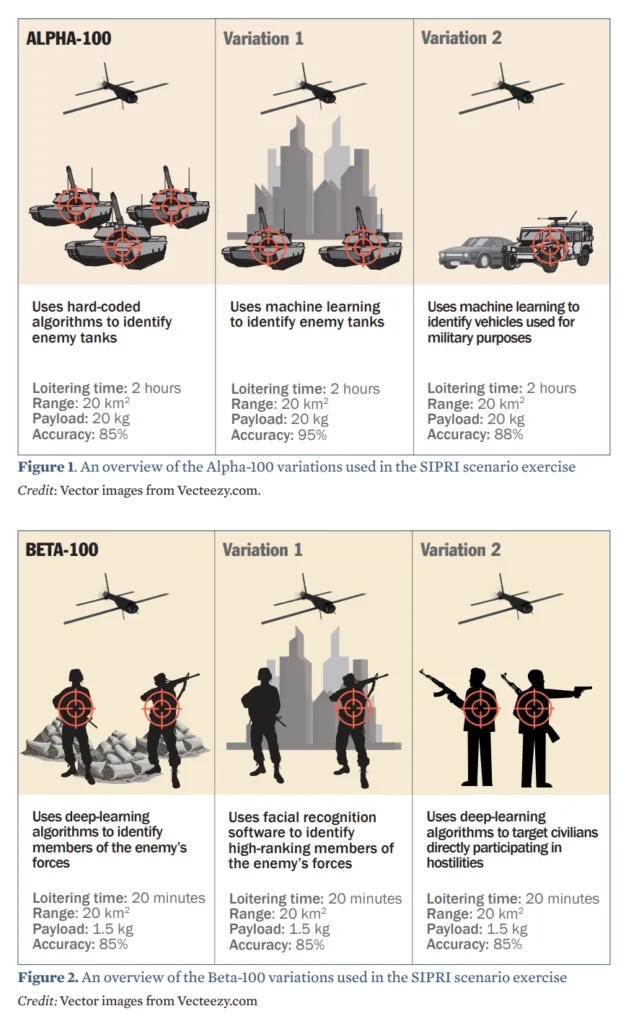
How do you get rival nations to discuss their secret military doctrines without compromising national security? You invent a war. The Compendium introduces the “Sigma War,” a domain-spanning fictional conflict between the states of Alpha and Beta.
This “system-agnostic” baseline allows states to “stress-test” their doctrines across land, naval, and air domains without revealing sensitive technical data. The engine of this stress test is the use of operational variables presented in three variants: Favourable, Adverse, and Uncertain.
By forcing analysts to consider an “Adverse” variant—such as a scenario where electronic warfare (EW) degrades sensor performance or an “Uncertain” variant where civilian distribution is unknown—the playbook handles the inherent unpredictability of AI. This allows experts to debate the logic of autonomous force rather than the politics of current real-world conflicts, fostering international trust through shared analytical baselines.
Conclusion: Beyond the Kill Code
The UNIDIR Scenario Compendium makes one thing clear: as we move toward an era of autonomous machines, the most critical “system” remains human responsibility. We cannot outsource the moral weight of war to an algorithm. Instead, we must rely on “context-appropriate” safeguards that keep human judgment at the centre of the lifecycle.
As AI development continues to accelerate, we must ask a demanding question: Can a framework based on “human judgment” survive a “Sigma War” scenario where electronic warfare has totally severed the link between the commander and the machine? In an environment of total EW degradation, where abort and override contingencies fail, the “two-tier” approach faces its ultimate trial. While the code may be autonomous, the consequences remain human. In the age of the algorithm, our legal and ethical frameworks must be as sophisticated—and as resilient—as the systems they seek to govern.
Want to explore more of my work on the intersection of geopolitics, ethics, and machine intelligence?
- See my stance on AI here: aviperera.com/stance
- See more about AI safety: aviperera.com/aisafety

Avi is a researcher educated at the University of Cambridge, specialising in the intersection of AI Ethics and International Law. Recognised by the United Nations for his work on autonomous systems, he translates technical complexity into actionable global policy. His research provides a strategic bridge between machine learning architecture and international governance.