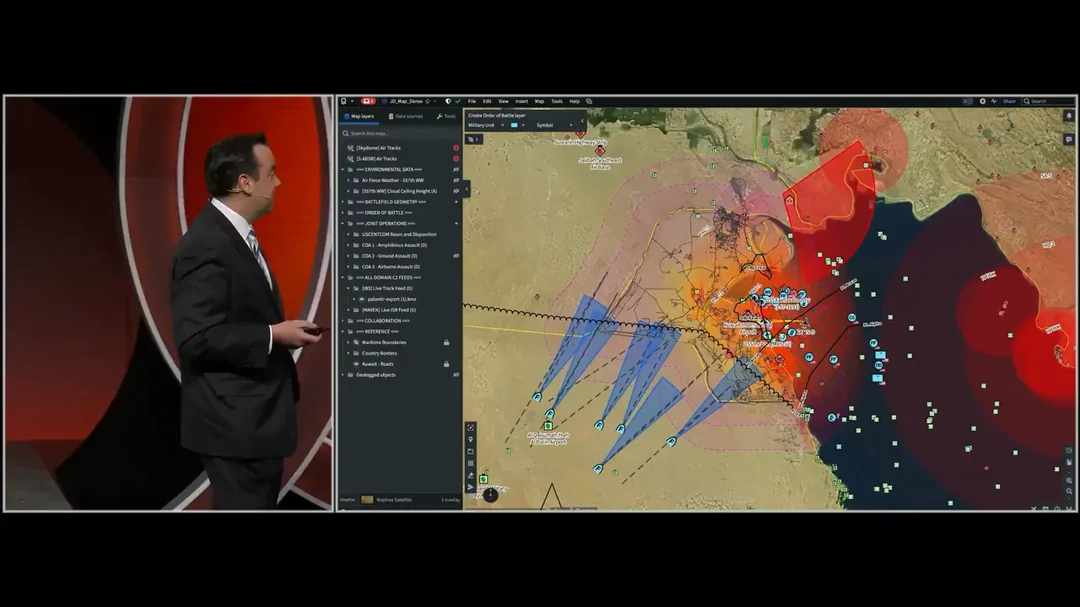
Palantir Project Maven
Project Maven: Technical Dossier & Legal Analysis
Lead Paragraph: Project Maven, formally known as the Algorithmic Warfare Cross-Functional Team, is a flagship U.S. Department of Defense initiative that leverages artificial intelligence and computer vision to autonomously analyse massive volumes of drone surveillance footage. Developed by a consortium of defence contractors and tech corporations, the system accelerates the kill chain by automating the identification and tracking of human targets and vehicles. By transforming raw visual intelligence into algorithmic strike recommendations, Project Maven obscures the line between human deliberation and machine-directed violence, severely degrading meaningful human control over lethal force.
⚙️ Technical Specifications & Capabilities
| Parameter | Specification |
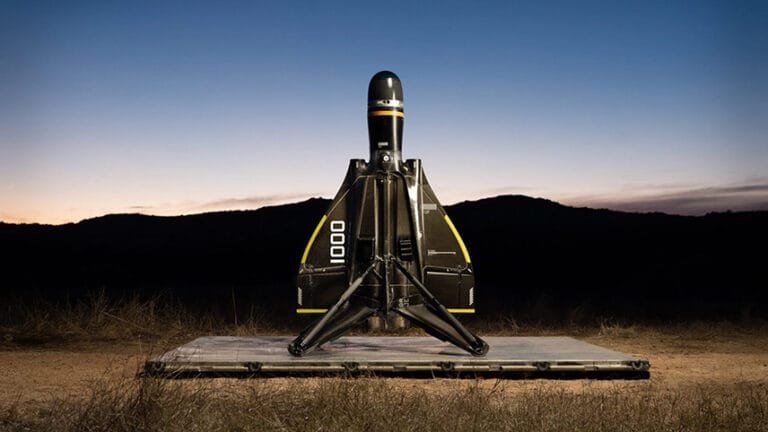
| Manufacturer | Palantir Technologies, Anduril Industries, AWS, Microsoft, ECS Federal |
| State Actor / Primary User | U.S. Department of Defense (CENTCOM, SOCOM), Armed Forces of Ukraine |
| System Type | AI Decision Support System / Computer Vision Intelligence Platform |
| Data Inputs | Full-Motion Video (FMV) from UAVs, Satellite Imagery, Wide-Area Motion Imagery (WAMI), Radar |
| Processing Capacity | Cloud-based and edge-computing analysis of petabytes of multi-domain visual intelligence |
| Output Mechanisms | Automated bounding boxes, target coordinate generation, predictive threat tracking |
| Operational Scale | Theater-wide Intelligence, Surveillance, Reconnaissance (ISR), and target generation |
Algorithmic Architecture & Autonomy
Project Maven’s core architecture relies on deep learning and convolutional neural networks (CNNs) trained specifically for object detection, classification, and tracking. The system ingests live Full-Motion Video (FMV) streams from unmanned aerial vehicles (such as the MQ-9 Reaper) and automatically draws digital “bounding boxes” around entities of interest. It is designed to autonomously classify these entities—distinguishing between civilian vehicles, armoured personnel carriers, infrastructure, and individual human beings—without prior human prompting.
Originally reliant on massive, centralised cloud servers to process video asynchronously, Maven has evolved into the “Maven Smart System” (MSS). This iteration pushes algorithmic processing to the tactical edge. By integrating hardware directly onto drone platforms or into forward operating bases, the AI parses visual data in real-time, functioning effectively even in bandwidth-limited or electronically jammed environments.
In the terminal phase of the kill chain, Project Maven operates as an AI decision-support tool rather than an autonomous trigger mechanism. It generates the target package and highlights the threat, but a human commander must officially authorise the kinetic strike. However, because the system processes visual data at a speed and volume that far exceeds human cognitive limits, commanders are subjected to profound automation bias. The human operator is effectively reduced to a rubber-stamp on the machine’s target identification, severely undermining the requirement for independent, contextual verification of a target before deploying lethal force.
🔗 Deployment History & OSINT Verification
Project Maven was first deployed in 2017 by U.S. Central Command (CENTCOM) to support counter-insurgency operations against ISIS in Iraq and Syria, actively analysing drone feeds to identify insurgent networks and direct airstrikes. Following Google’s high-profile withdrawal from the project in 2018 due to internal employee protests over AI militarisation, the DoD transitioned the architecture’s expansion to defence-focused contractors like Palantir and Anduril. More recently, Maven’s computer vision capabilities have been deeply integrated into the Russo-Ukrainian War. The system has been utilised to autonomously scan satellite and drone feeds to detect concealed Russian artillery, command posts, and troop movements, proving its lethal efficacy in high-intensity, conventional warfare environments.
⚖️ Legal Status & IHL Implications
- Article 36 Compliance: N/A (Software Loophole). Because Project Maven is classified as an intelligence analysis and decision-support software rather than a direct kinetic munition, it bypasses the rigorous legal weapons reviews mandated by Article 36 of Additional Protocol I to the Geneva Conventions, creating a perilous regulatory blind spot.
- Principle of Distinction: Maven inherently struggles with the Principle of Distinction due to the fundamental limitations of computer vision in chaotic battlefields. The system analyses pixels, not human intent. An algorithm cannot reliably distinguish between an insurgent carrying a rifle and a civilian carrying a farm tool or camera if the visual resolution is degraded by weather, distance, or camouflage, directly leading to algorithmic false positives and unlawful strikes.
- Algorithmic Complicity / Human Rights: The project operationalises digital dehumanisation by reducing human lives to algorithmically generated “bounding boxes.” By systematically accelerating target generation, Maven facilitates a framework for automated war crimes. It diffuses accountability across software developers, intelligence analysts, and strike commanders, ensuring no single individual bears full legal and moral responsibility for an AI-induced civilian casualty.
Closing Thought: The unchecked integration of computer vision platforms like Project Maven into the lethal kill chain necessitates an immediate, binding international treaty to regulate algorithmic targeting systems and close the software loopholes currently evading the Geneva Conventions.

Avi is a researcher educated at the University of Cambridge, specialising in the intersection of AI Ethics and International Law. Recognised by the United Nations for his work on autonomous systems, he translates technical complexity into actionable global policy. His research provides a strategic bridge between machine learning architecture and international governance.