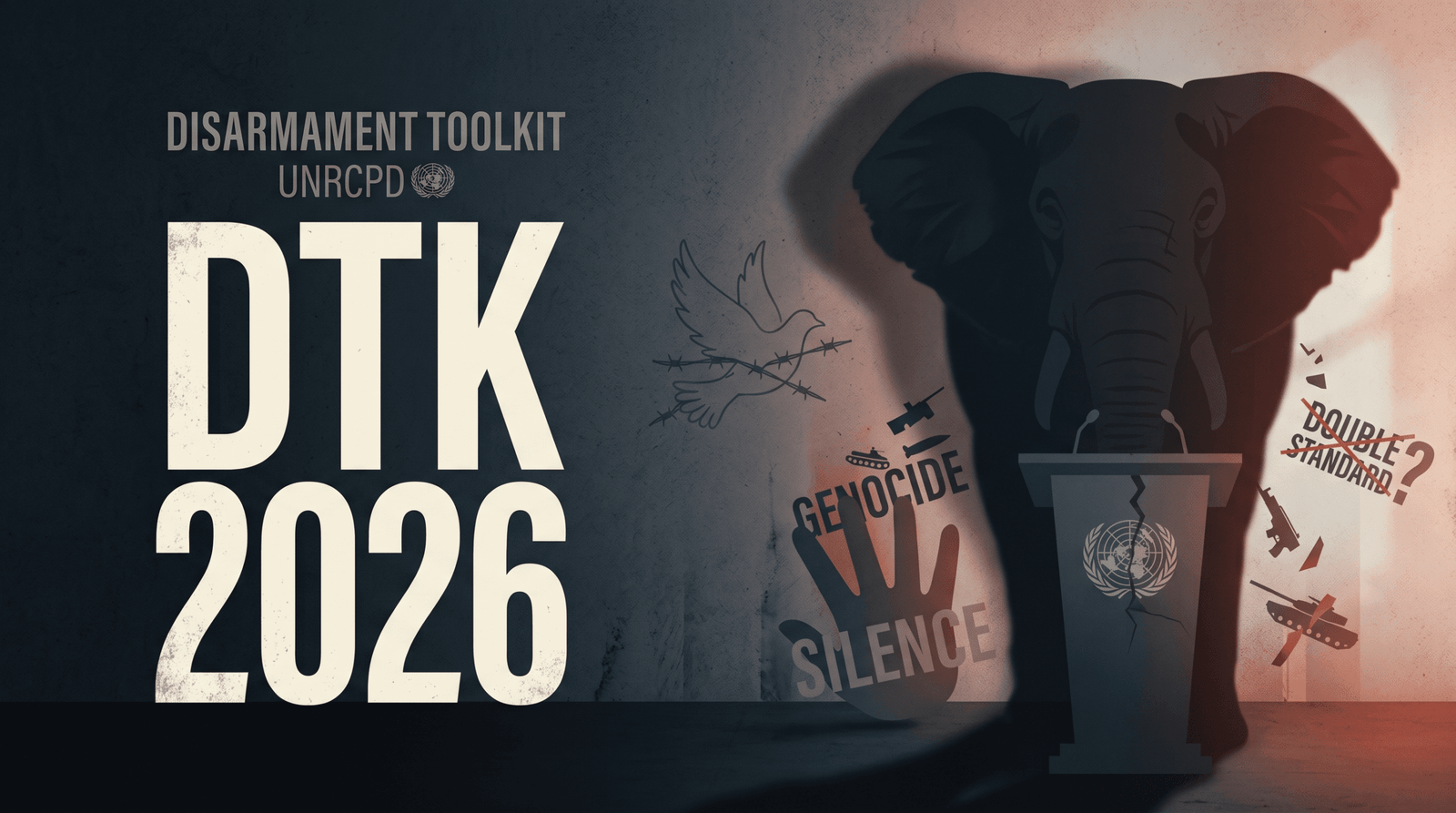
Disarmament Toolkit 2026: What UNRCPD Taught Me About Autonomous Weapons, and What It Wouldn’t Name
This is the second consecutive year I have sat through the United Nations Regional Centre for Peace and Disarmament in Asia and the Pacific’s flagship course, the Disarmament Toolkit, first as a participant in DTK 2025 and now in the 2026 edition. UNRCPD runs the Toolkit jointly with the Chennai-based Prajnya Trust, and it has grown from roughly fifty participants in its first 2022 cohort to more than 1,650 people from 136 countries by last year’s edition, making it, by some distance, the largest free public education programme the UN disarmament apparatus runs anywhere in the world.
I want to be precise about what this piece is and is not. It is not a rebuttal of the Toolkit’s value, which I think is real and which I will get to. It is a considered, sourced argument that a curriculum built almost entirely around the architecture of disarmament law, its treaties, its review conferences, its groups of governmental experts, cannot also be a curriculum about disarmament in practice if it declines, as a matter of institutional design, to say who is currently obstructing that architecture and why. That omission is not incidental to this year’s Toolkit. It is structural to how UN bodies of this kind are permitted to speak, and I think anyone doing this work seriously, particularly from inside a Cambridge-trained international law and IR background, has an obligation to name the gap rather than politely work around it.

What the Toolkit Gets Right
I’ll start with what deserves genuine credit, because I mean it and because a critique that pretends there is nothing to praise is not a critique worth reading.
The sessions anchored by practitioners rather than diplomats were, without exception, the strongest parts of both editions I have attended. The Regional Spotlight format, introduced in the 2024 edition and carried forward since, does something UN plenary sessions rarely manage: it lets someone who works the small arms beat in the Sahel, or the gender and disarmament portfolio in South Asia, speak in their own register rather than the flattened language of a General Assembly statement. The gender-inclusive design that has run through every edition since the Toolkit began, tying disarmament explicitly to the Women, Peace and Security agenda rather than treating it as an afterthought, is not decorative. It reflects a genuine, and still contested, argument within the disarmament field that arms control divorced from a gendered analysis of who is armed, who is targeted, and who is excluded from the negotiating table produces worse treaties. And the sheer accessibility of the thing matters. A free, six-session course that has scaled from fifty to over sixteen hundred participants in four years is doing something that expensive Geneva-based track-one diplomacy structurally cannot: it is building a constituency for disarmament outside the small, credentialled circle of people who already have UN badges. I say this as someone who has that badge, or something close to it, and who still thinks the constituency-building matters more than the badge does.
The Article That Prompted a Response
Among the resources UNRCPD compiled for this year’s AI and emerging technologies section was T.X. Hammes’s 2023 Atlantic Council piece, Autonomous weapons are the moral choice. I want to be fair to the framing here before I disagree with it: UNRCPD’s own Padlet is explicit that inclusion in the educational resources list does not imply UN endorsement of the views expressed, and curating a range of positions, including hawkish ones, on a genuinely contested question is defensible pedagogy rather than institutional cowardice. That distinction matters, and I don’t think the two critiques I’m making in this piece, one about curatorial breadth and one about institutional silence on state conduct, should be collapsed into each other.
Hammes’s core claim is that the ongoing use of AI-enabled targeting and precision fires in the Russia-Ukraine war demonstrates that autonomy in weapons systems is not a future hypothetical to be debated at the CCW but an operational reality democratic states are morally obligated to field, on the grounds that failing to do so costs more lives than it saves. I wrote a full response to this on my own site, Autonomous Weapons Are Not the Moral Choice, and I won’t repeat the whole argument here, but the short version is this. The claim that autonomy is “already happening” is doing a great deal of unexamined work in that piece. It treats an accountability gap as a fait accompli rather than a policy choice, and it collapses the distinction between semi-autonomous precision-guided munitions, which have existed under human authorisation for decades, and systems where a human is no longer meaningfully in the targeting loop. That distinction is not academic. It is the entire subject matter of the CCW’s Group of Governmental Experts, and eliding it is, I think, either a category error or a rhetorical convenience.
The more serious problem with treating operational necessity as moral justification is the one I explored at length in a separate piece on the IDF’s Lavender system, the AI decision-support tool Israel’s Unit 8200 used to generate human targets in Gaza at what has been reported as industrial scale. Lavender is not a hypothetical slippery-slope argument. It is a documented instance of exactly the dynamic critics of LAWS warn about: statistical scoring of a civilian population standing in for the deliberate, case-by-case verification international humanitarian law requires, with meaningful human oversight compressed to something closer to a rubber stamp. When a moral defence of autonomous targeting is written in the abstract, at the level of Ukraine’s battlespace and NATO doctrine, it is easy to sound reasonable. When the same logic is traced through to how it is actually being operationalised elsewhere, the “moral choice” framing gets a great deal harder to sustain. This is, in essence, the argument I lay out more fully on my stance on AI page: the risks that matter most right now are not primarily the speculative frontier scenarios that dominate AI safety discourse, but the current, compounding, already-documented harms, and autonomous weapons sit near the top of that list.
Consensus Without Confrontation
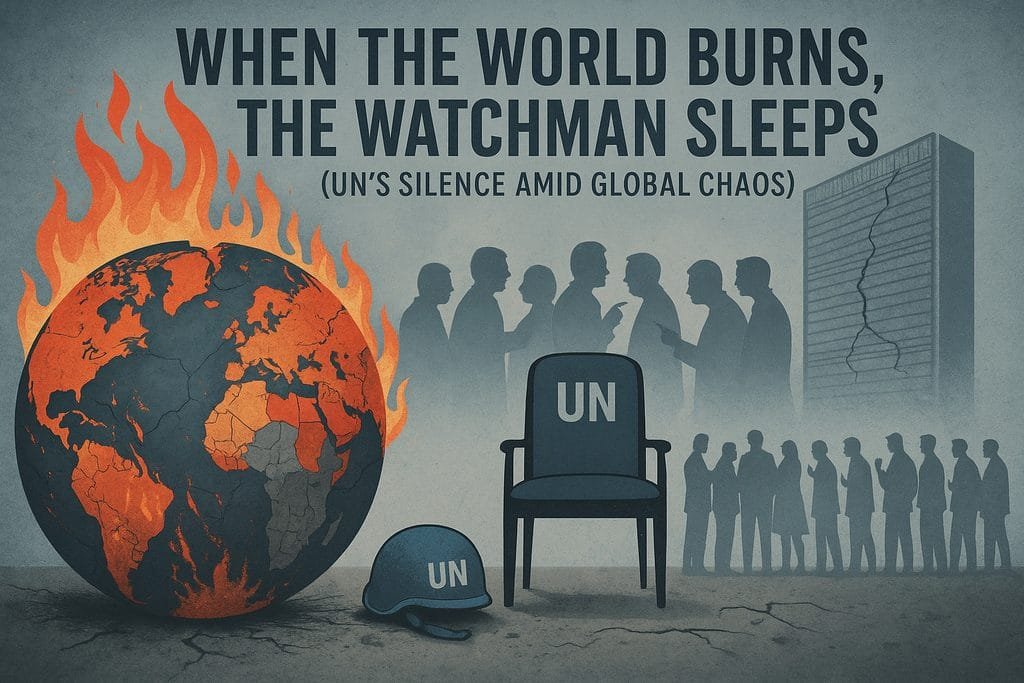
Here is where I want to be direct about what bothered me most across both editions of the Toolkit. Session after session walked participants through the normative architecture with real rigour: the Non-Proliferation Treaty, the Treaty on the Prohibition of Nuclear Weapons, the Chemical Weapons Convention, the Biological Weapons Convention, the CCW’s work on emerging technologies. What was conspicuously absent, in both years, was any sustained discussion of the specific states currently obstructing that architecture, or of the wars underway right now in which the weapons under discussion are being used. Gaza was not named as a case study in autonomous targeting, despite Lavender being one of the best-documented real-world examples of AI-enabled targeting anywhere in the world. Ukraine came up mainly as a technology showcase rather than as a live test of whether existing IHL constraints on autonomy are holding. The states most actively blocking a binding LAWS instrument were never named from the podium.
I understand why. UN subsidiary bodies and UN-adjacent educational programmes operate on a consensus model that depends on the participation of every member state, including the ones with the worst records, because a treaty regime that excludes major military powers is not a treaty regime, it is a statement of intent by the states willing to sign it. Naming states by name from an official UN platform risks exactly the kind of politicisation that can cause a state to walk away from the table altogether, and UNRCPD’s mandate is regional technical assistance and education, not adjudication. I take that structural constraint seriously. It is a real constraint, not an excuse invented after the fact.
But I don’t think acknowledging the constraint requires pretending it doesn’t distort the pedagogy, and the facts, when you actually assemble them rather than leave them implicit, are not ambiguous. When the UN General Assembly’s First Committee brought the most recent Lethal Autonomous Weapons Systems resolution, A/C.1/80/L.41, to a vote in the full Assembly in late 2025, it passed 164 to 6. The resolution did not mandate a treaty. It did not even mandate negotiations. It simply called on CCW parties to keep working toward a future instrument. The six states that voted against even that were Belarus, Burundi, North Korea, Russia, the United States, and Israel. Out of 193 member states, the United States and Israel chose to stand alongside Pyongyang and Minsk against a resolution that Stop Killer Robots accurately described, at the earlier committee stage, as a modest approach that didn’t even prejudge the GGE’s outcome. That is not a marginal data point. That is close to the entire story of why, three years into a Secretary-General’s call for a binding instrument by 2026, the CCW’s Group of Governmental Experts closed its final 2026 session at the end of August with roughly 128 states agreeing on a definitional text but no negotiating mandate for an actual treaty.
The same pattern holds on accountability, which is the part of this that I think matters most and that a purely technical disarmament curriculum is least equipped to address. In November 2024 the International Criminal Court issued arrest warrants for Israeli Prime Minister Benjamin Netanyahu and former Defence Minister Yoav Gallant, finding reasonable grounds to believe they bore criminal responsibility for the war crime of starvation as a method of warfare and for crimes against humanity including murder and persecution, warrants the Court’s Appeals Chamber upheld when Israel challenged its jurisdiction. Ten months later, the Independent International Commission of Inquiry on the Occupied Palestinian Territory, a UN Human Rights Council body chaired by the former ICC judge and UN High Commissioner for Human Rights Navi Pillay, concluded that Israeli authorities had committed four of the five acts of genocide defined under the 1948 Genocide Convention, a finding Israel has rejected outright and did not participate in the Commission’s process to contest directly. Rather than engage with either finding, the United States government responded by sanctioning, under Executive Order 14203, ICC prosecutor Karim Khan and, over the course of 2025, four sitting ICC judges, an escalation the Court itself has publicly deplored as an attempt to undermine judicial independence at an institution operating under a mandate from 125 states parties. Meanwhile, the Gaza ceasefire that took effect in October 2025 has been violated, by Al Jazeera’s tracking, thousands of times.
I raise all of this not to single out one conflict for rhetorical effect. Russia’s conduct at the CCW, and its own accelerating deployment of loitering munitions like the Lancet system in Ukraine, sits on precisely the same list of obstruction, and I don’t think a serious analysis gets to exempt Moscow because the United States and Israel happen to be closer to my own professional and personal proximities as a researcher working largely out of the UK and Southeast Asia. The point is structural, not selective: the handful of states with the most sophisticated autonomous weapons programmes and the greatest capacity to absorb reputational cost are, almost without exception, the same states blocking both a binding LAWS instrument and functioning accountability mechanisms for how those weapons and others are actually being used. A curriculum that teaches the treaty architecture in careful detail while leaving that pattern implicit is teaching half the subject. The missing half is not a footnote. It is the actual politics of why disarmament keeps failing to disarm anyone with real capability.
Why the Institution Can’t Say It, and Why That Isn’t the End of the Conversation
I don’t think UNRCPD or the UN system more broadly is being disingenuous here so much as operating exactly as its founding logic requires it to. A UN regional centre survives on the goodwill of its member states, including the ones whose conduct I’ve just described, and a disarmament education programme that named and shamed specific governments from an official platform would likely lose access to precisely the states whose eventual participation any future treaty needs. Sovereign equality and consensus-based diplomacy are not just diplomatic nicety, they are, in a genuinely pluralist international order, one of the only mechanisms that keeps a treaty regime from becoming an instrument that only the weak are bound by. I take that argument seriously, and I think students of international law should resist the temptation to treat institutional caution as pure cowardice.
But that is precisely why the work has to be picked up somewhere else, by researchers, civil society organisations like the Campaign to Stop Killer Robots, and independent commentators who are not bound by the same institutional constraint. If the UN cannot name the states blocking a binding LAWS instrument without jeopardising the process itself, then someone outside the UN has an obligation to do it anyway, with sourcing rigorous enough to survive scrutiny, which is the standard I have tried to hold this piece to throughout.
A Personal Note
The piece of the framework I find myself returning to most in this work is the basic, almost banal claim that harm is harm regardless of the uniform worn by the person causing it, and that naming suffering accurately is itself a form of care rather than an act of aggression. I don’t think that requires abandoning analytical rigour for moral posturing. If anything it requires more rigour, not less, because the temptation in this field is to let outrage substitute for sourcing. I have tried, in the section above, to make sure every specific claim about state conduct is attached to a primary or authoritative source rather than to sentiment. What I am not willing to do is treat institutional diplomacy’s necessary silences as though they were my own.
Looking Ahead
The CCW’s Group of Governmental Experts closed its current three-year mandate at the end of August 2026 with a text roughly 128 states could agree on but no mandate to begin binding negotiations. What happens next, whether the CCW’s High Contracting Parties choose to extend the Group’s mandate toward actual treaty talks, or whether the process stalls the way chemical and biological weapons governance nearly did before dedicated conventions finally arrived, will shape what the Disarmament Toolkit 2027 has to teach. I hope, genuinely, that next year’s cohort gets to learn about a negotiating mandate rather than another extension. I’ll be there either way, and I expect I’ll still be writing pieces like this one.
If you work in AI governance, international humanitarian law, or autonomous weapons policy and want to talk through any of the sourcing above, my stance on AI, research and consultation details are here.
Frequently Asked Questions
What is the UN Disarmament Toolkit?
The Disarmament Toolkit is a free annual online course run by the UN Regional Centre for Peace and Disarmament in Asia and the Pacific (UNRCPD), in partnership with the India-based Prajnya Trust, covering nuclear, chemical, biological, and conventional weapons governance alongside gender and regional dimensions of disarmament. It launched in 2022 and has grown to more than 1,650 participants from 136 countries by its 2025 edition.
Who organises the Disarmament Toolkit 2026?
UNRCPD and the Prajnya Trust, with contributions from UNODA, UNIDIR, OPCW, and a range of academic and civil society partners.
What is the current status of a binding treaty on lethal autonomous weapons?
As of the CCW Group of Governmental Experts’ final 2026 session, roughly 128 states had agreed on a text defining lethal autonomous weapons systems, but there is still no mandate for binding treaty negotiations. A November 2025 UN General Assembly resolution supporting continued work toward an instrument passed 164 to 6, with the United States, Israel, Russia, Belarus, Burundi, and North Korea voting against.

Avi is a researcher educated at the University of Cambridge, specialising in the intersection of AI Ethics and International Law. Recognised by the United Nations for his work on autonomous systems, he translates technical complexity into actionable global policy. His research provides a strategic bridge between machine learning architecture and international governance.