
Autonomous Weapons Are Not the Moral Choice
Executive Summary
Thomas X. Hammes argued in the Atlantic Council that fielding autonomous weapons is a moral imperative. The accountability record, the current state of the Geneva talks and recent warnings from AI researchers suggest otherwise.
Thomas X. Hammes wants the case for autonomous weapons to sound obvious: cheaper, safer for troops, inevitable, so build them and field them as fast as possible. I have spent enough time around the CCW process in Geneva to know why every part of that argument needs unpacking before anyone treats it as settled.
The argument I’m responding to
In November 2023, the Atlantic Council published a piece by Hammes, a nonresident senior fellow in its Forward Defense program and a research fellow at the US National Defense University, arguing that fielding lethal autonomous weapons systems is not merely permissible for democratic states but a moral obligation.
The case he is making rests on five moves. First, that narrow autonomous weapons have existed for decades, so objecting to LAWS now is naïve. Second, that commanders and operators remain legally accountable for what their weapons do, so the concerns raised by the International Committee of the Red Cross about assigning responsibility do not hold up. Third, that dying by machine carries no less dignity than dying by a human soldier’s hand, so the human dignity objection fails too. Fourth, that Ukraine shows electronic warfare is pushing both sides toward full autonomy regardless of anyone’s preferences, which makes the debate academic. Fifth, that treaties restricting new weapons have a poor historical track record, so a LAWS ban is unlikely to succeed where the crossbow ban and the Washington Naval Treaty did not. Hammes closes by arguing that failing to arm soldiers with the most effective available weapon is itself the greater moral failure, pointing to Deputy Secretary of Defense Kathleen Hicks’s argument that autonomous systems are “less expensive, put fewer people in the line of fire” and can be updated faster than traditional platforms.
It’s not a well-built argument, despite parts of it being true. Naval mines, fire-and-forget torpedoes and loitering munitions with autonomous functions have indeed existed for decades. Ukraine has genuinely pushed both sides toward more autonomy as jamming degrades radio links between pilots and drones. Neither fact does the work Hammes needs it to do.
Existing autonomy and LAWS are not the same category
The weapons Hammes lists, the Captor mine, the Quickstrike mine, the Mark 48 torpedo, Harpy and Harop, all operate within a tightly bounded engagement envelope against a predefined class of military object: a submarine’s acoustic signature, a ship’s magnetic field, a radar emission. A human decided in advance, in detail, exactly what the weapon could and could not strike, and the weapon’s “autonomy” consists of recognizing that narrow signature and nothing else.
That is a different thing from what the CCW’s Group of Governmental Experts on LAWS has actually been negotiating for over a decade. The ICRC defines the systems under debate as ones that, after launch, select and apply force based on a generalized “target profile” built from sensor data, meaning the operator does not choose, or necessarily know, the specific target or the moment and place force gets applied. That is a loss of human control and judgement over the individual act of killing, which is exactly why the ICRC recommends new legally binding rules rather than treating existing weapons law as sufficient. A sea mine that reacts to a magnetic signature is not a system that builds a probabilistic profile of a human being and decides, on its own, that the profile matches. Collapsing that distinction is the article’s central sleight of hand, and it is worth noting that the Pentagon’s own Directive 3000.09, which Hammes cites, still requires “appropriate levels of human judgement over the use of force.” Even the document he uses to argue for speed does not claim what he claims.
The accountability argument fails in practice, not just in theory
Hammes answers the accountability problem by pointing out that commanders and operators are legally responsible for what their weapons do, so nothing has really changed. Gaza is the clearest evidence that this is not how accountability actually behaves once target volume outpaces human review capacity.
Reporting from +972 Magazine and Foreign Policy, based on interviews with Israeli intelligence officers, describes an AI-assisted targeting system called Lavender that generated a list of roughly 37,000 suspected militants in Gaza. Officers reportedly had only seconds to review each machine-generated recommendation before signing off, largely confirming that a target was male before authorizing a strike, and the military reportedly accepted a civilian casualty tolerance of around ten percent for lower-ranking targets. This is not, strictly, a fully autonomous weapon in the sense the CCW debates. It is a human-in-the-loop decision support system, and that is precisely the point. It shows what “the commander remains responsible” looks like once the number of targets makes individual judgement impossible to sustain. Nominal human control became, in practice, a rubber stamp. That is the accountability gap the ICRC has been warning about, observed in the field rather than argued about in a seminar room.
Dignity is about agency, not sensation
Hammes treats the human dignity objection as a claim about how death feels, and dispatches it by noting that plenty of human-caused deaths are arbitrary too. But the doctrinal argument, rooted in the Martens Clause and its reference to “the dictates of public conscience,” is not about the phenomenology of dying. It is about whether a human capable of weighing proportionality and distinction in that specific instance authorized that specific act of force, rather than designing a system in advance and then letting it extend that authorization across an unbounded set of future targets no one has seen yet. Programming a mine to detonate under one type of hull is authorizing a category. Building a system that scores individual human beings against a profile and then kills the ones that clear the threshold is delegating the decision itself. Those are not the same act, however similar the outcome looks from a distance.

Scale is the mechanism of the harm, not the justification for skipping past it
Hammes argues that at the scale of thousands of targets, militaries no longer have the luxury of debating each one, and that the ethical question shifts to protecting the many rather than deliberating over the one. Gaza is what that logic looks like when followed through: expanding the target list into the tens of thousands is exactly what necessitated automated review at a volume that eroded individualized judgement in the first place. Scale did not solve the accountability problem here. Scale was the reason the accountability problem appeared.

Treaties succeed more often than the article lets on
The historical pessimism about arms control treaties leans on two examples, the medieval crossbow ban and the interwar Washington Naval Treaty, both of which did eventually fail. It leaves out the ones that held. The 1995 Protocol IV to the CCW pre-emptively banned blinding laser weapons before they were ever deployed at scale, and that ban has stuck. The Ottawa Convention on landmines never secured US, Russian or Chinese accession, yet it stigmatized landmine use so thoroughly that global production and trade collapsed even among many non-signatories. The Chemical Weapons Convention has been violated, notably by Syria, and still structures the overwhelming majority of state behaviour on chemical arms. A serious argument about the historical record of arms control has to reckon with the treaties that worked, not just the ones that make regulation look futile.
Where the diplomacy actually stands, right now
This matters because the debate Hammes frames as settled is, at the moment I am writing this, unusually live. The CCW’s Group of Governmental Experts on LAWS just wrapped its final scheduled session of a three-year mandate on 4 September 2026, working from a rolling text that takes a two-tier approach: prohibiting systems designed to target humans directly or that operate outside meaningful human control, and regulating everything else through requirements for predictability, reliability, traceability and defined human-machine interaction. Support for moving to formal negotiations on that text has grown from 42 states in September 2025 to 76 states as of this month. The Seventh Review Conference of the CCW, set for 16 to 20 November 2026 in Geneva, will decide whether that becomes a formal negotiating mandate. UN Secretary-General António Guterres and ICRC President Mirjana Spoljaric Egger have jointly renewed their call for a legally binding instrument, describing systems that take human lives without human control as “morally repugnant and politically unacceptable”. This is not a fringe activist position holding up an inevitable technology. It is the position of a majority of the states negotiating the actual instrument, arrived at through twelve years of deliberation.

The people building this technology are the ones sounding the alarm
Hammes dismisses “slaughterbots” videos as fear-mongering aimed at the public. Stuart Russell, the UC Berkeley computer scientist who wrote the standard AI textbook used across the field, made the same warning again just days ago, arguing that cheap, scalable autonomous weapons amount to a new category of weapon of mass destruction because a single person could “push a button and launch a million weapons” and cause mass casualties with no further human involvement at all. That warning is coming from inside the field that builds these systems, not from an advocacy campaign trying to manufacture public fear.
The speed argument does not hold up either
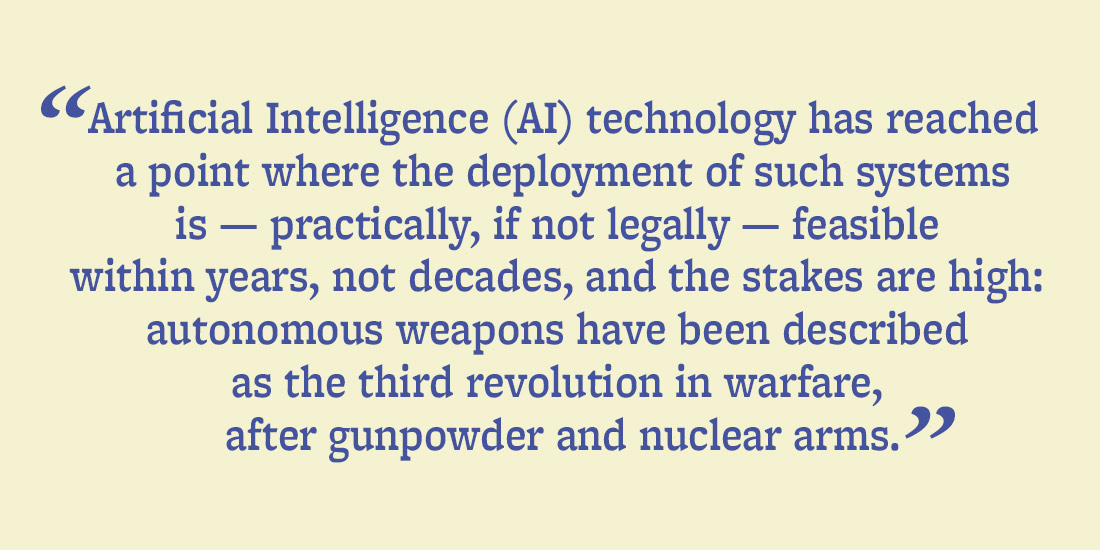
Hammes invokes Eric Schmidt’s comparison of autonomous systems to nuclear weapons as a historic technological inflection point. Taken seriously, that comparison argues against his own conclusion. The world’s answer to nuclear weapons was not an unregulated race to field them faster than anyone could govern; it was the Non-Proliferation Treaty, built specifically because the technology was judged too consequential to leave to unilateral speed.
And the speed case has not delivered what it promised even on its own terms. The Replicator initiative, which Hammes cites as evidence the Pentagon is finally moving with urgency, set a target in August 2023 of fielding “multiple thousands” of attritable autonomous systems within eighteen to twenty-four months. By its own August 2025 deadline, independent reporting found the program had delivered hundreds, not thousands, with exact figures still classified and disputed, and the program was subsequently reorganized under Special Operations Command. Racing past deliberate oversight has not, in practice, bought the speed its proponents promised. It has mostly bought disputed numbers and a program restructure.
What the real debate is actually about
The choice on the table in Geneva right now is not “field LAWS” versus “refuse to touch autonomy,” the binary Hammes presents. It is the two-tier approach already drafted into the rolling text: a narrow prohibition on systems that target humans directly or operate outside meaningful human control, paired with a regulatory regime for autonomous functions that fall short of that line, covering predictability, testing, traceability and defined human-machine interaction requirements. That is a considerably more serious proposal than the article ever engages with, and it is the one 76 states are currently negotiating over.
States will keep building increasingly autonomous systems regardless of how this argument goes. That was true in 1979, when the Captor mine entered service, and it remains true today. The question was never whether autonomy exists. It is whether the humans authorizing its use retain enough judgement, and enough accountability, to answer for what it does. That is the argument the Atlantic Council piece needed to make, and never did.

Avi is a researcher educated at the University of Cambridge, specialising in the intersection of AI Ethics and International Law. Recognised by the United Nations for his work on autonomous systems, he translates technical complexity into actionable global policy. His research provides a strategic bridge between machine learning architecture and international governance.