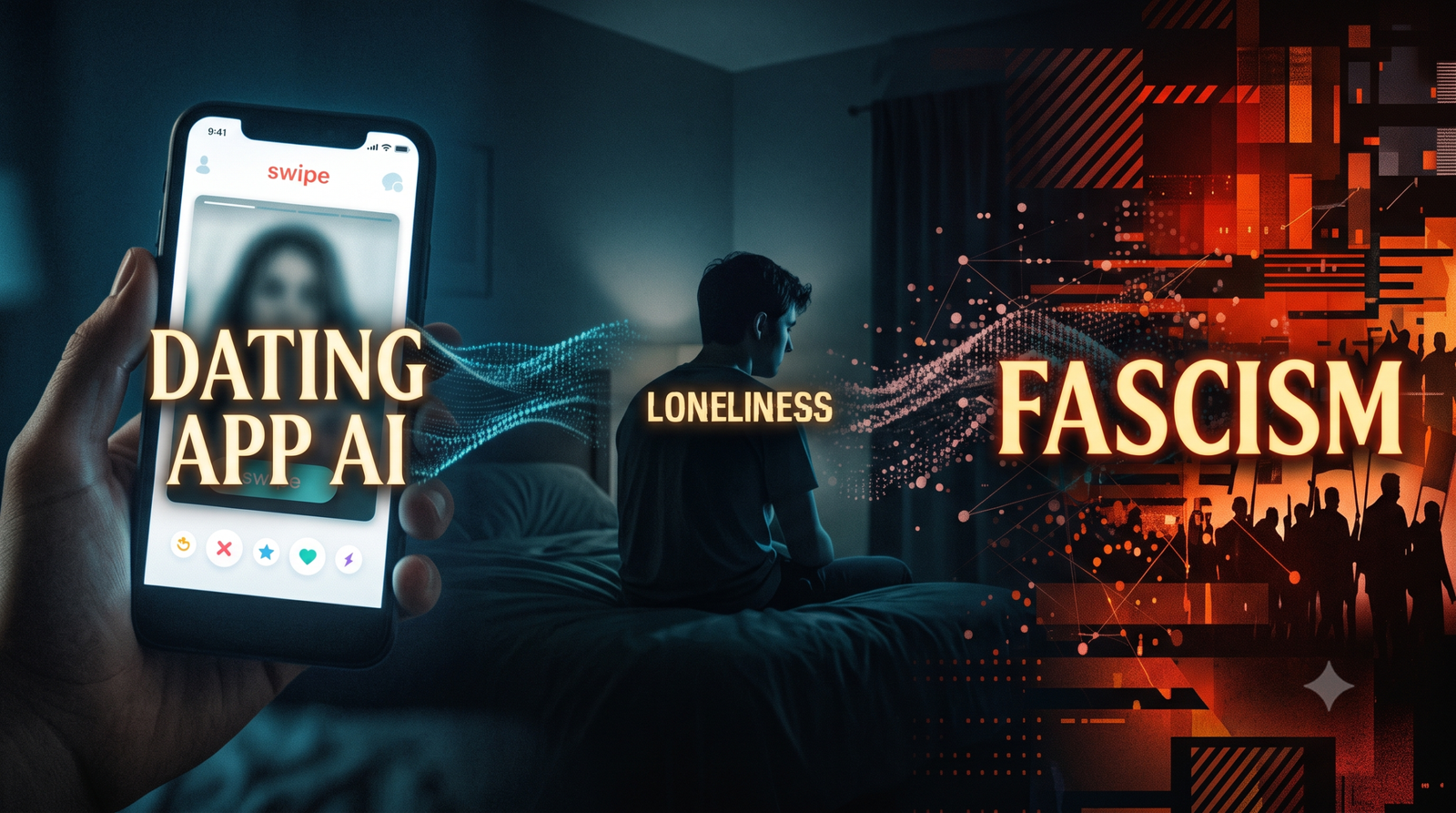
Dating Apps, Loneliness and the Pipeline to Extremism
Executive Summary
Dating apps borrowed ranking logic from chess and video games. What happens when that logic meets loneliness, recommender systems and the manosphere?
Dating apps rank people using scoring ideas borrowed from chess and video games. They operate in a world where about one in six people report loneliness, and the recommendation technology that fills a swipe queue can just as easily fill a lonely young man’s feed with grievance. This report sets out what my recent AI & Us session on dating apps found, then follows the consequences into loneliness, online radicalisation, the manosphere, racial hierarchy and international relations.
Key points
- Dating apps adopted ranking logic from the Elo chess rating and from video-game matchmaking, and the companies have rarely been open about what replaced it.
- The evidence is mixed. Online dating is now the most common way couples in the United States meet, and it also brings burnout, built-in bias, fraud, privacy harm and safety risk.
- Tinder users score higher on average than non-users on narcissism, Machiavellianism and psychopathy, most clearly among those seeking casual sex. The difference is real, the groups overlap heavily, and the direction of cause is unknown.
- Dark personality traits go with more deception, weaker affective empathy and more tolerance of lying, and a small number of studies link them to online sexual abuse. Insecurity also drives harmful behaviour on dating apps.
- The World Health Organization links loneliness to roughly 871,000 deaths a year. Recommendation systems can find lonely, rejected people and keep them engaged with content that sells them a grievance.
- Incel, manosphere and looksmaxxing communities convert private rejection into a public hierarchy of looks, race and sexual worth. Research finds real overlap with far-right content, and also finds that the route is narrow and varies by community.
- Femcel communities exist, and the evidence does not support treating them as a mirror image of incels.
- Governments already handle parts of this as a national security, trafficking, data protection and counter-extremism problem. The responses are fragmented.
Why a dating-app session belongs in an AI governance series
AI & Us is a public learning series I run to explain how algorithms shape ordinary life, with sources attached to every claim. Season 2 opened with a subject that looks lighter than autonomous weapons or treaty negotiations: who gets the match on a dating app. I chose it because a dating app is the most intimate place where a stranger’s code meets a person’s sense of their own worth. Hundreds of millions of people hand over their face, location, sexuality and loneliness to a system that ranks them, and almost none of them can see how.
My view of AI is the same in a Geneva conference room and in the meeting room in Da Nang where I presented this session. I am not against these technologies, and I do not accept that catastrophe is the only way to describe them, as I explain on my stance on AI page. What I insist on is that a system that decides things about people must be explainable, contestable and accountable. A swipe feed fails all three tests.
What the session found
A chess rating became a desirability score
Arpad Elo was a physicist and strong chess player whose rating method the US Chess Federation adopted in 1960 and FIDE in 1970. It estimates relative skill from results and nothing else. In 2016 Fast Company reported that Tinder’s chief executive had confirmed an internal desirability score, which staff called the Elo score, built on who swiped on whom plus factors such as profile completeness. In 2019 Tinder said it no longer relied on the Elo name and did not say what replaced it. Video games follow the same lineage. Matchmaking ratings in titles from Halo to League of Legends are hidden numbers, updated after every match, that decide who you face. The word that stays with me in all of this is hidden.

Hinge borrowed a Nobel Prize
Hinge took a different route. David Gale and Lloyd Shapley solved the stable marriage problem in 1962, and Shapley and Alvin Roth shared the 2012 Nobel Prize in Economic Sciences for work in that tradition. Hinge’s Most Compatible feature uses a machine-learning variant that infers preferences from behaviour instead of stated answers. The mathematics is elegant, and the lesson I drew in the room is that elegance says nothing about whether the output is fair.
The market is lopsided
Industry estimates put global dating-app use above 380 million people, although no company has published an audited monthly user count, and the widely repeated figure of 75 million Tinder users is an estimate. Commonly cited estimates put Tinder’s user base at roughly three quarters men. That imbalance shapes everything, because the average man receives far less attention than the average woman, and men make up the large majority of paying subscribers. One chart I showed compared the concentration of Tinder likes with the concentration of US income, and the likes were more unequally distributed. The customers with the lowest match rates are also the ones most likely to pay. That is my inference, and it explains a good deal about the product.

The psychological cost is documented, and causation is unclear
A study by Strübel and Petrie, first presented to the American Psychological Association in 2016, surveyed over 1,300 young adults and found that Tinder users reported lower body satisfaction, more body shame and more appearance comparison than non-users. Male users reported lower self-esteem. The authors are careful to say that people with lower self-esteem may simply be more drawn to the app. A 2019 study by Sevi found that Tinder users scored higher on narcissism, Machiavellianism and psychopathy, with the effect tied to short-term mating motives, a finding I examine in detail further down. Again, correlation. I presented both studies with that caveat on the slide, and I repeat it here because a great deal of bad commentary starts by dropping it.
Bias is built into the matching
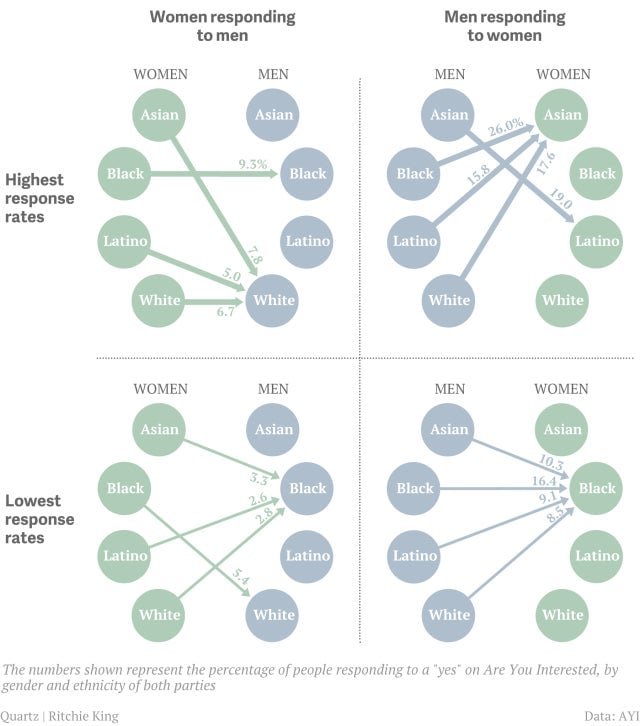
The “Debiasing Desire” research from Cornell found that algorithms trained on past swipe behaviour reinforce racial patterns even for users who state no preference. OkCupid’s own published data showed Black women and Asian men receiving systematically fewer messages. The sociologist Apryl Williams argues that these apps automate sexual racism and make it routine. I return to this below, because it connects directly to what happens in the manosphere.
Privacy, fraud and safety
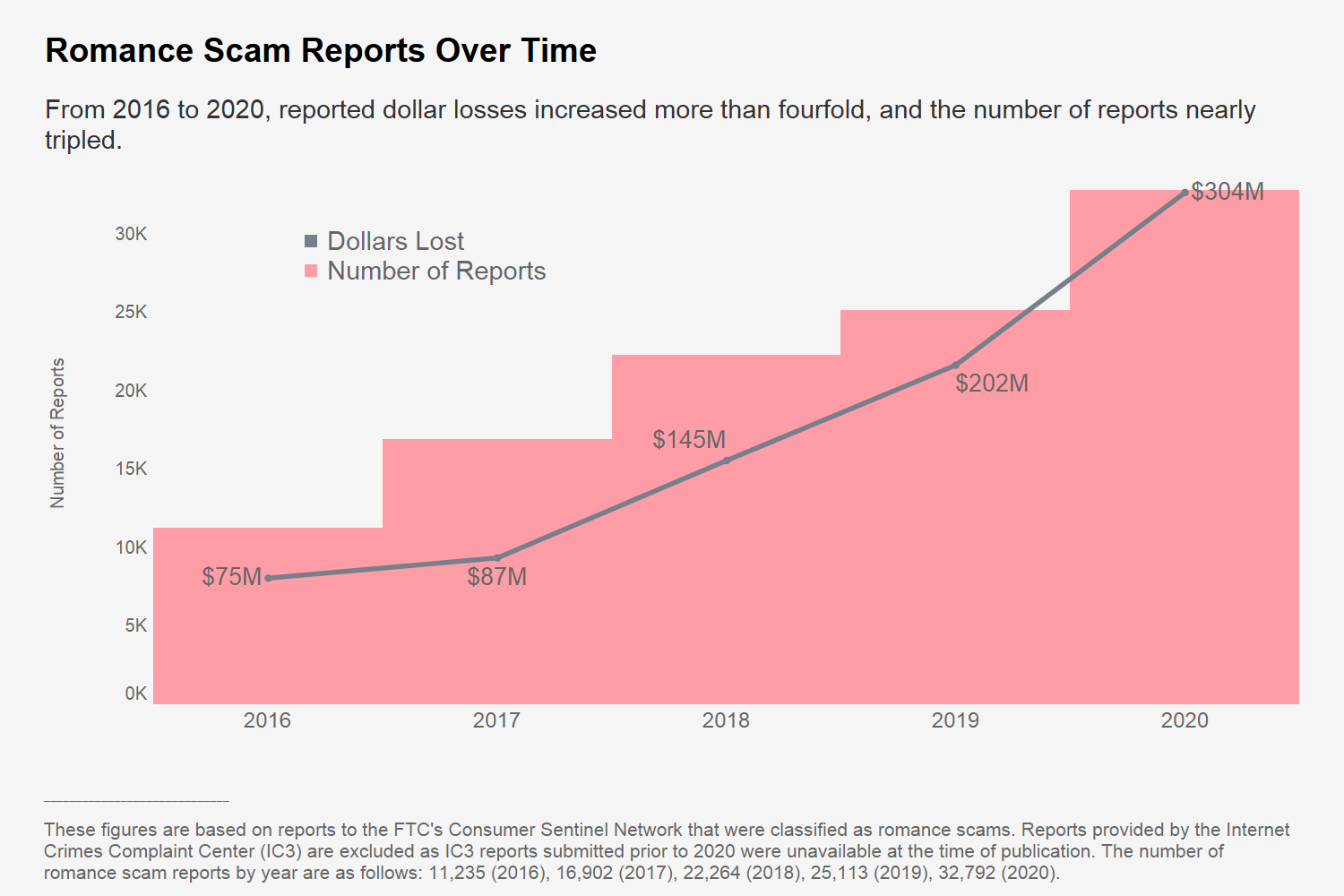
Grindr was fined by the Norwegian data protection authority for sharing users’ data with advertisers without valid consent. Location and orientation data has been resold for years. The FBI’s 2025 Internet Crime Report recorded about $929 million in confidence and romance fraud losses, up roughly 38 per cent in a year, and the FTC’s data indicates that most romance scams now begin on social media instead of dating apps. A 2019 investigation by ProPublica and Columbia Journalism Investigations, covering more than 150 assaults linked to dating apps, found that Match Group’s free apps did not screen users against sex-offender registries at that time.
The honest verdict
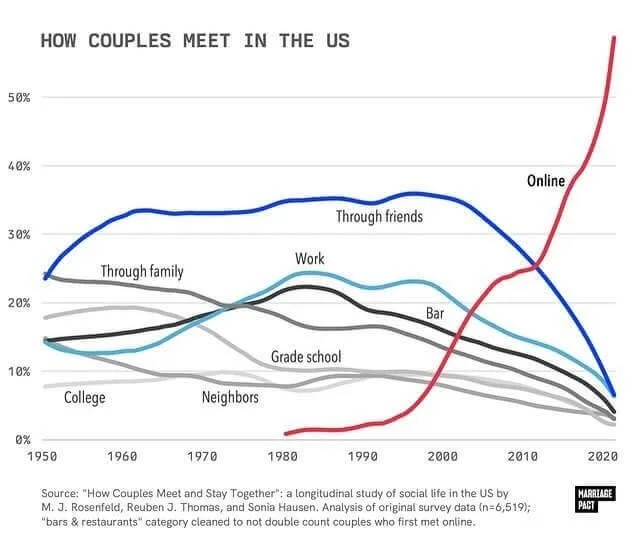
Here is the complication I wanted the audience to sit with. The Stanford “How Couples Meet and Stay Together” project, analysed by Rosenfeld, Thomas and Hausen in PNAS, shows that meeting online overtook meeting through friends as the most common route for heterosexual couples in the United States around 2013, and that how a couple met has no measurable effect on breakup rates or relationship quality. The apps work. They also exhaust people. Survey estimates of dating-app burnout run from just over half of users to more than three quarters depending on who asks, and Ofcom recorded Tinder losing 594,000 users between May 2023 and May 2024. Both findings are true at once, and a serious analysis has to hold both.
The dark side of the swipe: who is on the other end?
Everything so far concerns the system. A fair account also has to ask about the people using it. The research on that question is uncomfortable, and it has been misreported in both directions, so I want to set out what it supports and where it stops.
What the Dark Triad measures
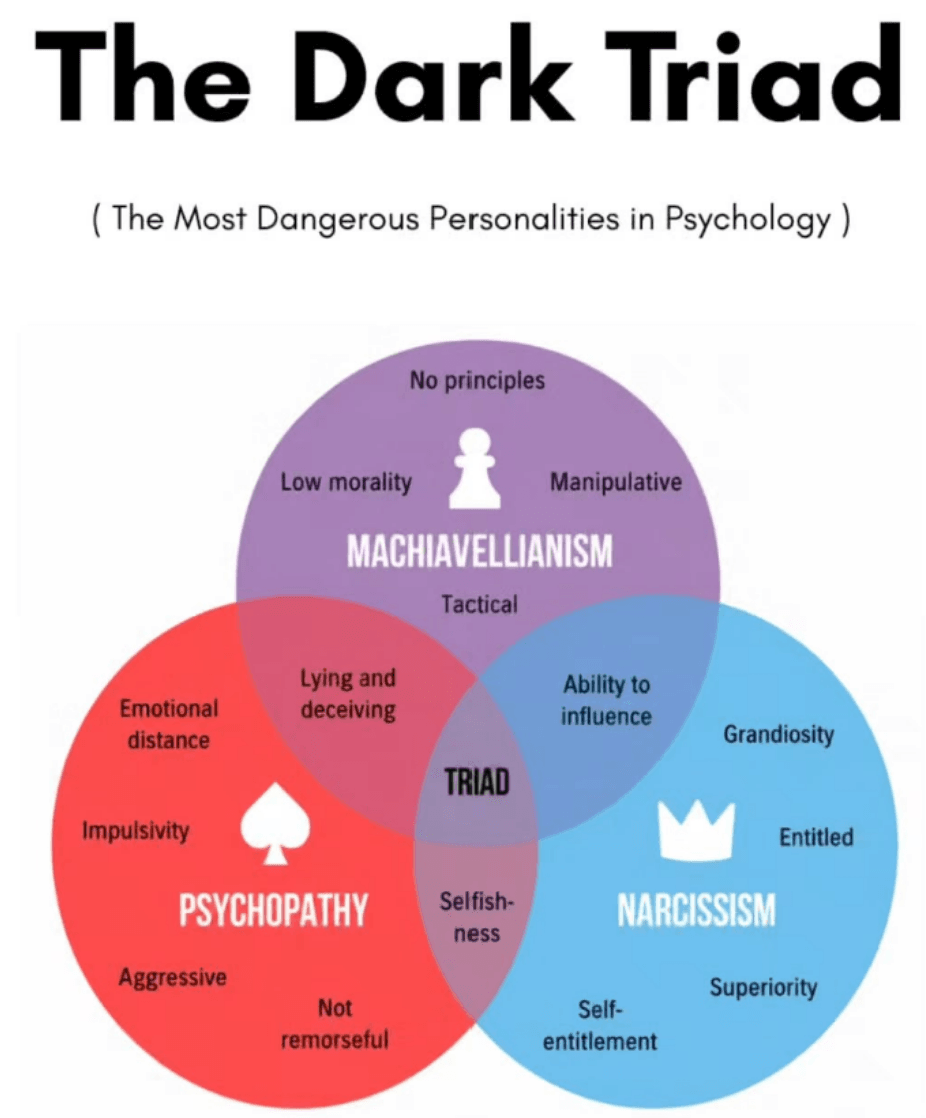
The Dark Triad is a set of three personality traits that psychologists measure on a scale across the general population. Narcissism covers entitlement, grandiosity and a need for admiration. Machiavellianism covers strategic manipulation and cynicism about other people. Psychopathy covers callousness, impulsivity and low remorse. These are dimensions, and a high questionnaire score is not a clinical diagnosis. I use the words in that sense throughout. Using “psychopath” as a casual label for anyone who treated you badly on a date makes the real research harder to hear.
Over-represented, with limits
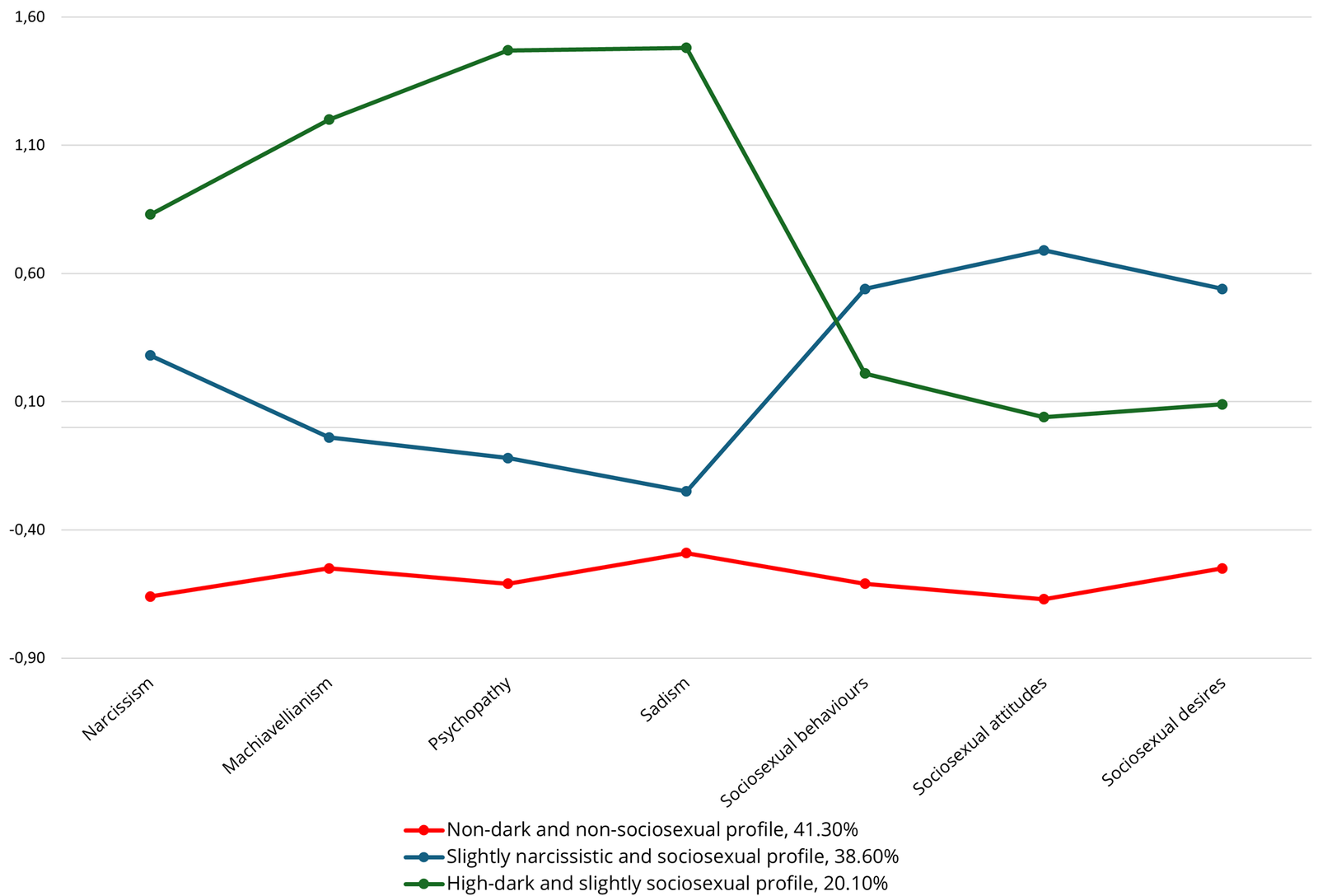
The evidence supports a clear claim about averages. In work published in the Journal of Individual Differences, Barış Sevi found that Tinder users scored higher than non-users on narcissism, Machiavellianism and psychopathy, and that users seeking casual sex scored higher again. No such relationship appeared among users looking for a relationship, as the author explained in this PsyPost interview. The effect sizes in the table I showed in the session were roughly 0.3 for narcissism and Machiavellianism and roughly 0.7 for psychopathy. If the scores are approximately normally distributed, a difference of 0.7 puts the average user at about the 76th percentile of non-users.
That is a real difference, and it comes with two limits. The groups overlap heavily, so most users are not high on any of these traits. And nobody yet knows the direction of cause. Sevi himself asks whether people high on these traits are drawn to the app or whether using it changes them. The sex pattern is also contested. Jonason and Bulyk, studying 581 people, found that male users were especially high in psychopathy and narcissism, while female users were higher in anxious attachment and rated themselves as unsuccessful at finding partners.
My position is this. Dating apps do not consist of predators, and I reject that picture. They do contain a measurably large group of people who treat others as instruments, and a product that connects strangers at scale with no shared friends and no reputational cost gives that group an efficient way to find a steady supply of targets. Rosenfeld and colleagues titled their PNAS paper “Disintermediating your friends” for a reason. The social web that used to vouch for a stranger has been removed.
Deception as a tool
Dark traits go with more lying, and the research is consistent on that even though it disagrees about which trait matters most. In a study of 447 people, Jonason and colleagues linked psychopathy and Machiavellianism to telling more lies, psychopathy to lying for no reason at all, and narcissism to lying for self-gain and to self-reported skill at it.
Olga Bogolyubova surveyed 796 dating-app users on how acceptable they found lies about age, gender, appearance, weight, social status and relationship status. A summary of the study, published in Behaviour & Information Technology, reports that psychopathy was the most consistent predictor of tolerance for deception. Most respondents strongly condemned lying about age, gender or appearance, whereas only 37.7 per cent strongly rejected lying about weight. A study of 342 people by McArthur and Dunsworth found a different pattern, with Machiavellianism as the unique predictor of fake names and altered ages, and the authors conclude that online identity deception is a calculated act. The honest summary is that the traits matter, the precise ranking does not yet settle, and most people still disapprove of the worst lies.
Cold empathy
The phrase “no empathy” is common in popular writing about these traits, and the research is more precise. A 2025 systematic review and meta-analysis in Frontiers in Psychiatry found that psychopathy had the strongest association with reduced affective empathy (r = -.347), that Machiavellianism was linked to reduced affective empathy (r = -.291) and, more weakly, to reduced cognitive empathy (r = -.089), and that narcissism was linked to reduced affective empathy (r = -.134) with no significant link to cognitive empathy. Affective empathy is feeling something of what another person feels. Cognitive empathy is working out what they think and want. The authors note some ambiguity, since clinical studies often find cognitive empathy intact in psychopathy while another meta-analysis found deficits in both.
The implication for a dating app is my own inference, and I offer it as such. A person who can work out what you want to hear without feeling what it costs you holds an advantage in a medium made of short messages and curated photographs.

From rudeness to harm
The behaviour is documented even where the personality data is thin. A Pew Research Center survey found that 60 per cent of female dating-app users aged 18 to 34 said someone kept contacting them after they said they were not interested, compared with 27 per cent of men in that age range, and 57 per cent of women in that group had received an unsolicited sexually explicit message or image. Pew measured behaviour and not personality, so I do not claim that these senders scored high on any trait.
The studies that link traits to online sexual abuse are small and should be read as pointers. In a community sample of 100 adults, Pina, Holland and James found that psychopathy was the only Dark Triad trait to independently predict a proclivity for revenge porn. A 2026 study of cyber dating abuse by Barros, Leite and Monteiro found that Dark Triad traits, hostility and loneliness were all associated with both perpetrating and experiencing it, and that perpetrators reported higher loneliness. That finding complicates any simple division into predator and prey, and it connects this section to the one that follows on loneliness.
The fragile side
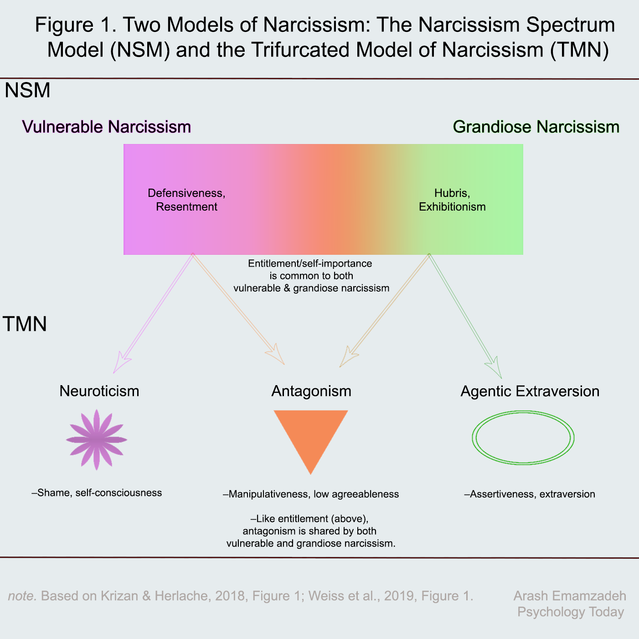
Not every harmful dater is cold and calculating. Willis, Oliver and March surveyed 313 online daters and found that vulnerable narcissism, the fragile and hypersensitive form as distinct from the grandiose form, predicted inauthentic self-presentation, while no other trait did. People who had ghosted someone scored higher on vulnerable narcissism and secondary psychopathy, and people who had breadcrumbed someone scored higher on vulnerable narcissism and Machiavellian views. Some of the conduct that hurts people on these apps comes from insecurity, and an interface that scores people publicly and rewards constant availability gives insecurity plenty to work with.
The counterweight
Sevi and Doğruyol tested the opposite end of the personality range. Studying current, past and never users of Tinder, they found that higher scores on the Light Triad of faith in humanity, humanism and Kantianism went with stronger motivation to use the app to find a long-term partner. People seeking love are out there, and they differ measurably from people seeking something else. The practical difficulty is that neither group announces itself in a profile.
Loneliness is the market
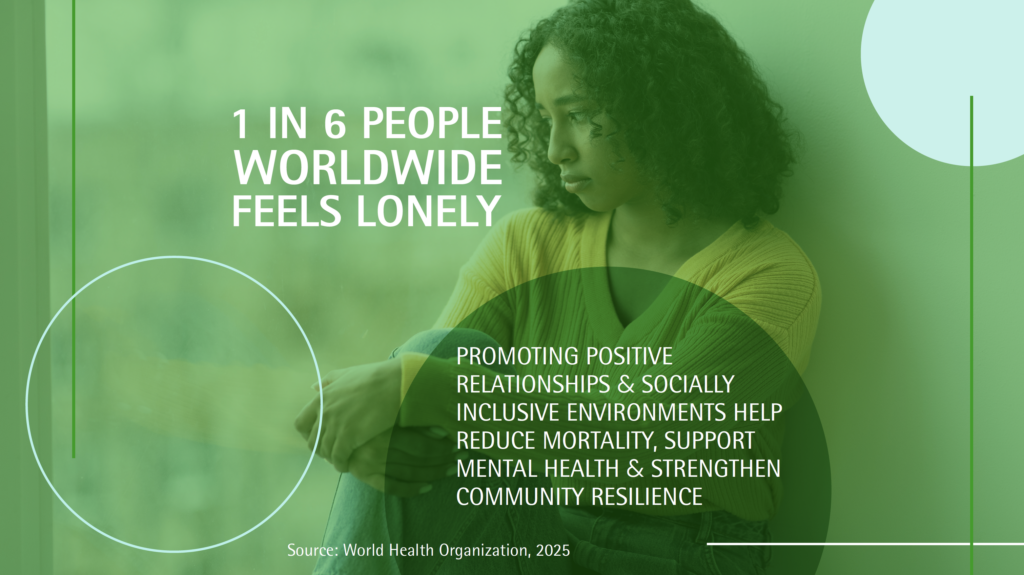
The WHO Commission on Social Connection reported in June 2025 that about one in six people worldwide experience loneliness and that loneliness is linked to around 871,000 deaths a year, roughly 100 every hour. The Commission treats social connection as a public health priority alongside physical and mental health. The US Surgeon General’s 2023 advisory reached a comparable conclusion.
Dating apps sell a remedy for one narrow kind of loneliness, romantic and sexual, through products whose revenue depends on continued use. A user who forms a lasting relationship leaves the platform. A user who stays on, swiping and paying, keeps the business alive. I make no claim about what any individual engineer intends. My claim concerns the business model. In my view, a product that loses a paying customer each time it works has an incentive problem that no mission statement removes, and incentive problems are what regulation exists to correct.
Loneliness has a second effect that matters for what follows. A person who feels excluded from the most valued form of belonging, and who has been told by an interface that he ranks low, becomes receptive to anyone offering an explanation.
How a feed finds a lonely boy: propaganda in the algorithmic age
I use the word propaganda in its older sense: organised communication designed to shape perception for the benefit of whoever produces it. Manosphere content fits that definition closely. It offers a single villain (women, feminism, “society”), a simple causal story, an in-group with its own vocabulary, and a product to buy. The creators have financial incentives. Researchers quoted by AFP describe looksmaxxing influencers promoting skin products, supplements and fragrances to an audience primed by insecurity.
The delivery mechanism is a recommender system. In a study led by Dr Kaitlyn Regehr at UCL with the University of Kent, researchers built TikTok accounts modelled on teenage boys interested in masculinity or loneliness and watched what the platform recommended. After five days, misogynistic content rose from 13 per cent to 56 per cent of recommended videos, a fourfold increase. Regehr’s reading is that these systems target vulnerabilities such as loneliness and loss of control and then gamify harmful material. The study used archetypal accounts, so it shows what the algorithm can do and says less about how many real boys follow that path. It is still a sobering design finding, since nobody at the platform needed to want that outcome. An engagement objective was sufficient.
This is the part of the story I care about most as an AI governance researcher. We spend a great deal of regulatory energy on what AI systems generate. We spend less on what ranking and recommendation systems select and amplify, and the second category reaches far more people.
From rejection to hierarchy: incels, the black pill and looksmaxxing
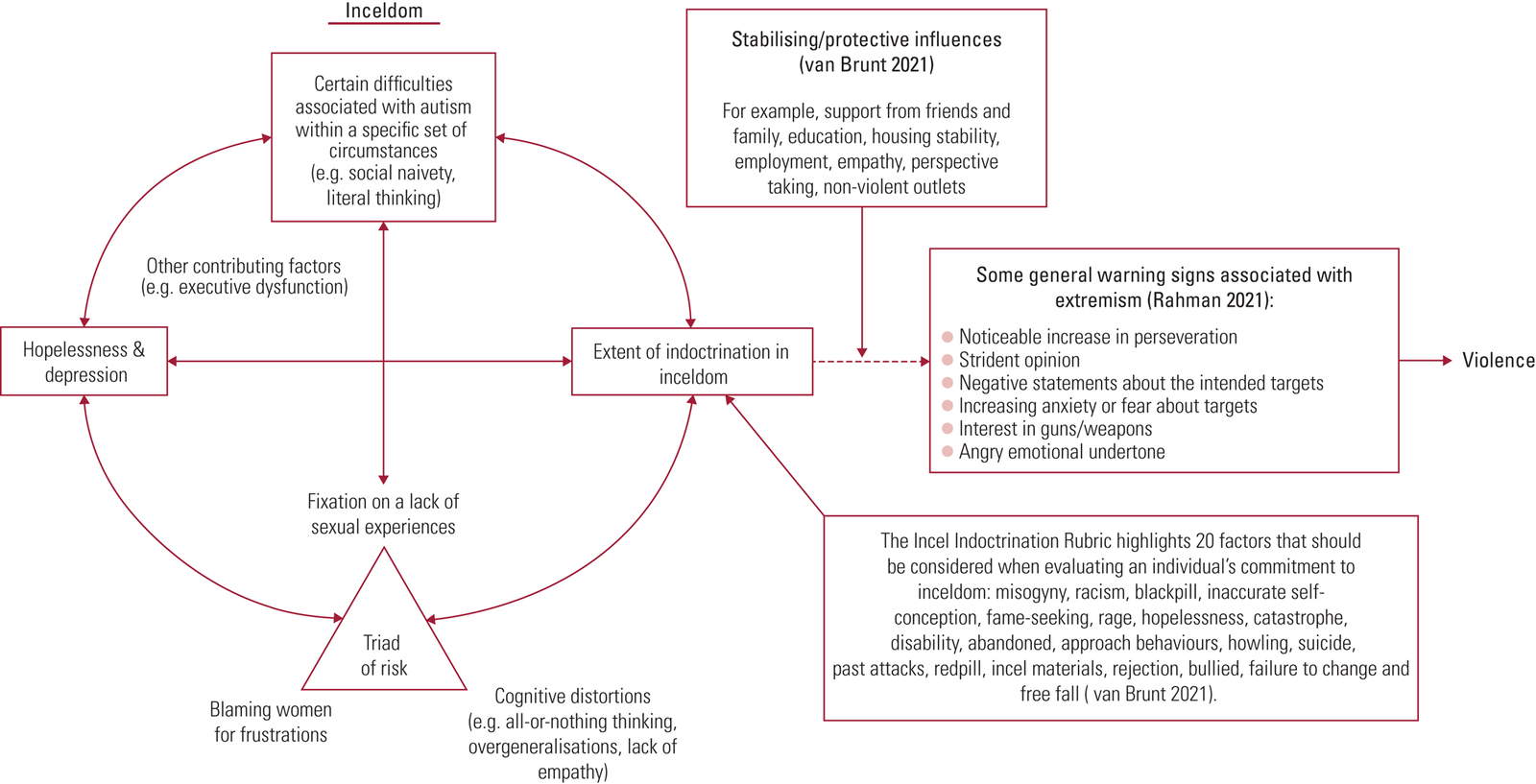
The word incel comes from “involuntary celibate”. It describes a community of mostly young men who feel excluded from romantic and sexual life and who frequently blame women and society. The manosphere is the wider ecosystem of male-oriented forums, channels and influencers, including pick-up artists, men’s rights activists and men who reject relationships altogether. The “black pill” is the incel belief that attractiveness is fixed by genetics and that effort is futile.
Looksmaxxing began in those same black-pill forums and has become mainstream on TikTok and YouTube. It means maximising one’s physical attractiveness, and the practices range from skincare and gym work to steroid use, surgery and, in the most extreme corners, deliberately breaking facial bones. A 2025 study in Sociology of Health & Illness analysed more than 5,000 comments on a looksmaxxing board. It found that the community applies a rigid masculine gaze to men’s bodies, ranks men on numerical scales and tiers, and harms the health of the men who take part, including through suicidal ideation. Researchers at the University of Portsmouth add that interest in looksmaxxing does not make someone an incel, many participants do not know its origins, and the overlap with incel spaces is nonetheless growing.
Anyone who attended my session will see the connection I am drawing. The central point of the first half was that Elo was built to rank chess players, not human beings, and that dating apps borrowed the logic anyway. Looksmaxxing forums do the same with faces. A hidden score becomes a public score, and the man who receives a low number is told to fix his bone structure instead of questioning the scoring.
The Dark Triad also appears in the dating practices the manosphere teaches. A study in Personal Relationships, reported by PsyPost, gathered accounts from women who had dated men affiliated with the Red Pill. It found significant overlap between Dark Triad traits and the behaviours the community promotes, with relationships organised around image, success and control. The sample was recruited from r/TheBluePill, a community that criticises the Red Pill, so the participants were self-selected and hostile to their subject. The author suggests that the teachings may amplify existing tendencies in some men and cultivate them in others by presenting them as virtues.
Sexist ideology sits close to the same traits. In a US sample of 295 adults, Gluck, Heesacker and Choi found that sexism correlated with Dark Triad scores for both sexes, that hostile sexism accounted for the link among men, and that sexism explained much of the gap between men’s and women’s scores. The British Psychological Society’s summary records the authors’ caution that the study cannot show whether sexist ideology cultivates these traits or whether people with these traits adopt sexist views.
My reading, which goes beyond what any single study shows, is that this is where the manosphere stops being only a story about lonely men and becomes a market. Lonely and rejected men are offered a ready-made set of manipulation tactics together with products to buy, and a feed delivers both.
Who ends up there? Explanation without excuse
Public commentary often treats incels as stupid or wicked. I understand the reflex, because the ideology at its worst endorses violence against women and cruelty is hard to forgive. I still think the reflex gets the evidence wrong, and that matters for policy.
The research I have found does not describe an uneducated population. It describes an unwell and isolated one. A survey of 274 active incels by Moskalenko and colleagues found that most reported mental health problems and trauma from bullying or persecution, and that commitment to incel ideology was only weakly correlated with radicalisation. An earlier survey of 54 self-identified incels reported depression in 91 per cent, anxiety in 85 per cent and a history of bullying in 91 per cent, with small-sample caveats. The largest survey to date, summarised by VOX-Pol (n=561), found exceptionally poor mental health and a loop in which poor mental health and ideological adherence reinforce each other. These samples are self-selected and should be read with care.
Let me be direct about where I stand. The ideology at the centre of these communities teaches men to regard women as a resource that has been unjustly withheld, and it has been used to justify murder. Nothing in the mental health data softens that, and no history of bullying entitles anyone to a grievance against half of humanity. Most men with these experiences never adopt the ideology and never hurt anyone, which is why those who do carry full responsibility for what they choose. I stress the entry conditions because contempt has been tried and has not worked. Isolation, shame and a feed that supplies a villain on the same day are the pattern in the research, and preventing it is the job of the people who design the feed. Responsibility for the act sits with the person, and responsibility for the pipeline sits with the platform. Former members of these spaces have started building counter-forums, which tells me that exit is possible and that exit routes deserve funding.
Race, whiteness and the arithmetic of desire
I was born in Asia and raised in Europe (Britain), and I find it hard to read this part of the research neutrally. The deck’s section on bias showed the structure plainly: response rates on a major app vary sharply by the race of the sender and the recipient, and OkCupid’s data showed the same patterns years earlier. One chart reported that Asian women receive more replies than other women, which sits beside evidence that Asian men receive fewer.
Sexual racism is racism. As the sociologist Apryl Williams argues, preferences are shaped by a society’s racial hierarchy, and when an algorithm learns from those preferences and serves them back as personalised results, the company has built that hierarchy into its product. Being messaged more often does not make the fetishising gaze kinder. It is prejudice that happens to generate engagement.
The manosphere takes this arithmetic and hardens it into doctrine. In the looksmaxxing community studied in Sociology of Health & Illness, white men rated highly are labelled “Chads”, and users assert that women of colour desire white men. Practices such as “whitemaxxing”, the use of creams to look more white, follow directly from that premise. Scholars of incel violence note that these communities frequently intersect with racism and white supremacy, and Hoffman, Ware and Shapiro describe incel ideology as having nascent connections with other extremist movements. The men who adopt the racial hierarchy are often asked to accept their own place at the bottom of it, and some respond by trying to erase themselves.
Colourism is older than any app. The preference for lighter skin has a long colonial history across South and Southeast Asia, and an algorithm trained on human behaviour inherits it without being told. That is why I describe algorithmic bias as a human rights question and not a technical glitch, a position I set out across my work on AI safety.
Is there a pipeline to fascism?
I choose my words carefully here, and I will not retreat from them. Most men who watch looksmaxxing videos hold no fascist politics. The ideas that circulate in the surrounding ecosystem are a different matter. Natural hierarchy, biological destiny, humiliation converted into grievance, worship of the strong male body and a scapegoat are the raw materials Umberto Eco catalogued in his 1995 essay on Ur-Fascism, and recommendation systems are delivering them to teenagers. The pipeline exists. Researchers measure it as narrow, and I accept the measurement. A narrow channel that feeds violent movements is still a security problem, and once published research has shown how a feed behaves, leaving it unchanged is a decision.
The empirical evidence supports a gateway with limits, and I think honesty requires saying both halves.
- Overlap exists. Mamié, Horta Ribeiro and West analysed over 300 million comments across 115 subreddits and 526 YouTube channels between 2006 and 2018. They found large overlap between the audiences of the manosphere and the alt-right, with the strength of the link varying across communities and platforms.
- The effect is narrow. A two-wave Austrian panel study by Weiß, Koban and Matthes (published in Information, Communication & Society) found that exposure to sexist content increased later contact with far-right content, particularly in fringe environments, and was related to behavioural measures of far-right extremism but not to attitudinal ones. The authors call it a narrow gateway.
- Violence is real and rare. Hoffman, Ware and Shapiro treat incel violence as an emerging terrorism trend, noting attacks in North America and connections to other extremist movements. Their central difficulty is that the attackers are lone actors with no organisation to disrupt.
- The numbers need proportion. In the year to September 2025, the UK’s Prevent programme received nearly 10,000 referrals. About 20 per cent concerned extreme right-wing ideology, 8 per cent Islamist extremism, 8 per cent a fascination with extreme violence, and 1 per cent incel extremism.
That last figure points to the policy lesson. The scale of dangerous incel extremism is small. The scale of normalised misogyny among young people is much larger, and the UCL and Kent researchers found hateful tropes moving out of feeds and into schools. The Home Office’s Key Principles of Prevent now state that a clear identifiable ideology is not mandatory for a referral, which reflects the shift from judging beliefs to judging behaviours of concern. I think that is the right direction, and it carries risks for civil liberties that deserve open debate.
Femcels and the question of symmetry
Femcels are women who say they want romantic and sexual relationships and cannot find them. People often describe them as the female equivalent of incels, and while they are not too dissimilar, the research complicates that comparison.
A study published in Archives of Sexual Behavior by Evans and Lankford, summarised by PsyPost, analysed femcel discussions. It found that the conversations focused on women’s own experiences more than on male grievances, contained much less support for aggression and violence than has been reported about male incels, and still included some extreme views. Commentary on the same study noted a strong strand of hostility toward men in the material. A Master’s thesis at Simon Fraser University by Ruby Ling found shared beliefs about looks and the opposite sex but a closer fit with radical feminism than with the incel movement. A quantitative comparison by Lola Cassidy found higher loneliness, social inhibition and problematic internet use among women who identify as femcels than among controls.
Hostility toward men is bigotry, and I will not soften that because the group involved is smaller or less violent. Content that casts men as a class as predators, or that treats women as entitled to revenge, belongs in the same moral category as its mirror image. The evidence does distinguish the two cases in scale and consequence. Femcel communities show far less support for violence than the incel material documented in the literature, and I found no pattern of comparable attacks. A smaller body count does not turn contempt into insight. I also reject the stereotype of the calculating, manipulative femcel, because the research does not support it, and I will not describe any group in terms the evidence does not bear out. Women also have documented reasons for wariness: in the session, 57 per cent of women surveyed said online dating does not feel safe to them, and the ProPublica and Pew findings suggest why.
Why this belongs in international relations
Intimate data is a national security question
A dating profile can reveal a person’s sexuality, location, routine and, for some users, their employment in government or the military. In 2019 the US Committee on Foreign Investment in the United States reportedly pushed Grindr’s Chinese owner to sell, and the sale completed in 2020. Lawfare’s analysis and a law-firm briefing both explain why personal data became an investment-screening matter. Separately, Norway fined Grindr 65 million kroner, roughly $6 million, for sharing data with advertisers without valid consent. The CMS GDPR enforcement tracker records that the Borgarting Court of Appeal dismissed Grindr’s appeal in August 2025 and that the fine stands. Two different legal instruments reached one app for different reasons. Neither exists in many of the countries where being outed carries criminal penalties.
Romance fraud is organised transnational crime
The FBI’s 2025 Internet Crime Report counted 23,159 confidence and romance complaints and about $929 million in reported losses, and reported losses understate the real total. On 14 October 2025 the United States and the United Kingdom announced coordinated sanctions against Cambodia’s Prince Group and its chairman Chen Zhi, with the US Treasury naming 146 targets. The two governments allege that the group ran scam compounds staffed by trafficked workers, and the group has denied wrongdoing. Radio Free Asia’s report sets out the allegations. Chen was later arrested in Cambodia and sent to China. Romance fraud has therefore become a matter for sanctions lawyers, trafficking investigators and foreign ministries as well as consumer regulators, and many of the people typing the false declarations of love are themselves victims of forced labour.
The psychology of the fraud itself is better documented than the psychology of the fraudsters. In a model built from interviews with victims, Monica Whitty described how offenders groom victims before any financial request and why the near-win dynamic keeps people engaged and sometimes leads to repeat victimisation. In a later comparison with people who had never been scammed, Whitty found that victims tended to be middle-aged, well-educated women who scored higher on impulsivity and trust and had an addictive disposition. Those are risk correlations from one study. They assign no fault to victims, and the fault lies entirely with the offender.
I looked for peer-reviewed measurement of Dark Triad traits in romance fraud offenders and did not find it. Many offenders belong to organised groups, and some of the people typing the messages are trafficked workers, so reaching for the word “psychopath” would be both unsupported and a distraction. The accurate frame is organised crime and exploitation, with individual personality as a secondary question.
Regulation is diverging
The European Union’s Digital Services Act requires very large platforms to assess systemic risks, including negative effects related to gender-based violence and to users’ mental wellbeing. The United Kingdom relies on the Online Safety Act and a counter-extremism system under revision. The United States leans on investment screening and consumer protection. At the global level there is no binding AI treaty among the 193 UN member states, and the UNESCO Recommendation on the Ethics of AI is the nearest thing to a universal norm without being enforceable. A teenager in Hanoi, Manchester and Ohio meets the same recommender design under three different legal regimes.
Counter-extremism lacks a shared vocabulary
Lone actors, mixed motives and no organisation to infiltrate is a hard profile for any security service. The UK now accepts that ideology should not be the only trigger for intervention. Other states categorise the same behaviour differently, which complicates intelligence sharing and platform cooperation. Hoffman and Ware made the point years ago that no obvious legal measures exist for mobilisation of this kind.
Loneliness as public health diplomacy
The WHO Commission highlights Sweden’s investment in local clubs, shops and neighbourhood initiatives as social infrastructure, and the World Health Assembly adopted a resolution on social connection in May 2025. Only a handful of member states had national policies on loneliness when the Commission reported. I expect social connection to appear in development finance, education policy and digital governance debates within a few years. A country that wants fewer radicalised young men will find the answer partly in libraries, sports clubs and youth services, and less in content moderation.
Scoring humans and meaningful human control
In my work on lethal autonomous weapons, I argue that a human being must retain real understanding of, and authority over, any system that makes consequential decisions about people. Dating apps are not weapons, and I am not comparing the stakes. The design question is the same. A hidden score, opaque to the person it concerns, shapes the options that person sees. If a platform cannot explain its ranking to the person being ranked, and cannot be audited by someone independent, it fails the standard I would apply anywhere else. The principle I defend in the AI ethics dashboard and in my published stance is that accountability has to be built in at the start and cannot be retrofitted.
What I think should happen
- Platforms: the ranking systems that decide who is seen should be disclosed to regulators and open to audit by independent researchers. Match and response outcomes should be audited by race and gender and the results published. Screening against sex-offender registries should apply on every tier, and the sale of location and orientation data should end. Voluntary commitments have had years to deliver, and the ProPublica findings show how far they fell short.
- Regulators: extend systemic-risk assessments to cover amplification of misogyny and body-shaming content, give independent researchers genuine data access, coordinate sanctions on scam compounds across jurisdictions, and treat social connection as a funded public health goal.
- Schools and parents: teach young people how recommender systems work, talk early about rating culture, and avoid ridicule, since shame is what these communities feed on. The UCL researchers recommend digital literacy for exactly this reason.
- Young men who recognise themselves in this: forum participation tends to reinforce poor mental health, and talking to a professional or a trusted person is a better route than another thread. Third places such as a class, a sport or a community project give you shared context that no ranking can supply.
- Everyone using apps: treat them as an introduction service, take breaks without guilt, share meeting plans with a friend, and run a reverse image search on profile photos, a step the FBI recommends.
Where I stand
People have a right to look for love without being ranked by a hidden score, deceived by someone who treats them as a resource, or handed to a recommendation system that profits from their loneliness. Individual bad actors will always exist. A society decides whether its platforms make victims harder or easier to find. I think they should be harder to find, that this should be required by law, and that the burden of proof should sit with the companies.
A note on sources and corrections
I hold my own slides to the standard I ask of others. Three points deserve tightening. First, the Grindr fine was reported at €10 million in early coverage, and as finally imposed and upheld it is 65 million kroner, about $6 million. Second, several widely repeated figures, including the 75 million Tinder users and a 0.6 per cent male match rate, trace to estimates and secondary blogs, and I labelled them as such on the slides. Third, I closed one slide with the line that the only winning move is not to play. The Stanford evidence in the same deck shows that for many people the apps work, so I would now say that the only way to win a ranking game is to refuse its terms. Two things can be true at once, which was the point of the session.
Frequently asked questions
Do dating apps use an Elo score?
Tinder’s chief executive confirmed in 2016 reporting that the app used an internal desirability score its staff called the Elo score. In 2019 the company said it no longer relied on it and did not disclose the replacement. Hinge uses a machine-learning variant of the Gale-Shapley stable marriage approach.
Do dating apps cause incel radicalisation?
No study shows that apps cause it. Apps create rejection at scale, especially for men in a male-skewed user base, and research points to forums and recommendation feeds as the places where that rejection becomes ideology. The evidence is correlational, and mental health and bullying history are stronger predictors than the apps themselves.
What is looksmaxxing and is it harmful?
Looksmaxxing means maximising physical attractiveness. It started in black-pill incel forums and is now mainstream. Peer-reviewed research finds that the community ranks men by appearance and race and harms participants’ health, and researchers stress that most people interested in it are not incels.
Are femcels the female equivalent of incels?
In many ways, yes, but it is unclear in the evidence so far. Research on femcel communities finds higher loneliness and some hostility toward men, with much less support for violence than is documented among male incels.
Is there a pipeline from the manosphere to the far right?
Research finds large audience overlap and a measurable gateway effect from sexist content to far-right content. It also finds that the route is narrow, varies by community and platform, and does not lead most people to extremism.
How big is romance fraud?
The FBI recorded about $929 million in confidence and romance fraud losses in 2025, up roughly 38 per cent on the previous year. Many victims never report, so the true total is higher. Some operations use trafficked workers in scam compounds in Southeast Asia.
Do relationships that begin online last as long as others?
Stanford-based research published in PNAS found that how a couple met has no measurable effect on breakup rates or relationship quality, even though online meeting is now the most common route among heterosexual couples in the United States.
Are dating apps full of narcissists and psychopaths?
Research finds that Tinder users score higher on average than non-users on narcissism, Machiavellianism and psychopathy, especially users seeking casual sex. The groups overlap heavily and most users are not high on these traits. Scores are not diagnoses, and the direction of cause is unknown.
Do people with dark personality traits lie more on dating apps?
Studies link dark traits to more lying and greater tolerance of deception in online dating. Psychopathy was the most consistent predictor in a survey of 796 app users, and Machiavellianism predicted fake names and altered ages in another study. Insecure, vulnerable narcissism also predicts inauthentic self-presentation.
Do narcissists and psychopaths lack empathy?
A 2025 meta-analysis found that these traits are most strongly linked to reduced affective empathy, meaning feeling what others feel. Links to cognitive empathy, meaning understanding what others think, are weaker or absent, although some findings for psychopathy are mixed.
Are romance scammers psychopaths?
There is no peer-reviewed evidence measuring personality traits in romance fraud offenders. Many offenders work in organised criminal groups, and some workers in scam compounds are trafficked. The psychology of victim grooming is better documented than the psychology of offenders.
Sources
- WHO Commission on Social Connection, From loneliness to social connection: charting a path to healthier societies (2025).
- US Surgeon General, Our Epidemic of Loneliness and Isolation (2023).
- UCL and University of Kent, Social media algorithms amplify misogynistic content to teens (2024).
- Hoffman, Ware and Shapiro, Assessing the Threat of Incel Violence, Studies in Conflict & Terrorism (2020).
- Moskalenko et al., Incel Ideology, Radicalization and Mental Health, Journal of Intelligence, Conflict, and Warfare (2022).
- Moskalenko et al., Predictors of Radical Intentions among Incels, Journal of Online Trust and Safety (2022).
- VOX-Pol, Understanding Incels’ Psychology, Ideology, and Networking.
- Mamié, Horta Ribeiro and West, Are Anti-Feminist Communities Gateways to the Far Right?, WebSci ’21.
- Weiß, Koban and Matthes, A narrow gateway from misogyny to the far right, Information, Communication & Society (2024).
- When Help Is Harm: Health, Lookism and Self-Improvement in the Manosphere, Sociology of Health & Illness (2025).
- University of Portsmouth, The Manosphere and Online Misogyny: Q&A.
- The Conversation, Looksmaxxing is the disturbing TikTok trend turning young men into incels.
- Evans and Lankford on femcels, PsyPost summary; Ling, Femcels and incels: a content analysis (SFU thesis, 2022).
- Rosenfeld, Thomas and Hausen, Disintermediating your friends, PNAS (2019).
- Hutson et al., Debiasing Desire, Proceedings of the ACM on Human-Computer Interaction (2018).
- CMS, GDPR Enforcement Tracker: Norway.
- Lawfare, How a Norwegian government report shows the limits of CFIUS data reviews.
- FBI Internet Crime Complaint Center, 2025 Internet Crime Report; PSA on romance fraud and money mules.
- Radio Free Asia, US, UK sanction Cambodian conglomerate (2025).
- UK Home Office, Response to Lessons for Prevent (2026); ASIS, record Prevent referrals.
- European Union, Regulation (EU) 2022/2065, Digital Services Act.
- UNESCO, Recommendation on the Ethics of Artificial Intelligence.
- Nobel Prize, Economic Sciences 2012.
- Sevi, B., The dark side of Tinder: The Dark Triad of personality as correlates of Tinder use, Journal of Individual Differences (2019).
- Jonason, P. and Bulyk, R., Who uses Tinder? The Dark Triad traits, attachment, and mate value, Studia Psychologica (2019).
- Sevi, B. and Doğruyol, B., Looking from the bright side: The Light Triad predicts Tinder use for love, Journal of Social and Personal Relationships (2020).
- Jonason, P., Lyons, M., Baughman, H. and Vernon, P., What a tangled web we weave: The Dark Triad traits and deception, Personality and Individual Differences (2014).
- Bogolyubova, O., Perceptions of deceptive self-presentation in online dating: unacceptable or not?, Behaviour & Information Technology (2026), via Leiden University repository and PsyPost summary.
- McArthur, J. and Dunsworth, Z., World wide web of lies: Personality and online deception, Telematics and Informatics Reports (2023).
- Willis, M., Oliver, E. and March, E., Dating in the dark: Vulnerable narcissism predicts inauthentic self-presentation in online dating (2023).
- Shukla, M. and Upadhyay, N., Cold hearts and dark minds: a systematic review and meta-analysis of empathy across Dark Triad personalities, Frontiers in Psychiatry (2025).
- Pina, A., Holland, J. and James, M., The malevolent side of revenge porn proclivity, International Journal of Technoethics (2017).
- Barros, V., Leite, A. and Monteiro, A., Cyber dating abuse and the Dark Triad, Journal of Psychopathology and Clinical Psychology (2026).
- Whitty, M., The Scammers Persuasive Techniques Model, British Journal of Criminology (2013); Whitty, M., Do you love me? Psychological characteristics of romance scam victims, Cyberpsychology, Behavior, and Social Networking (2018).
- Pew Research Center, Young women often face sexual harassment online, including on dating sites and apps (2020).
- Gluck, M., Heesacker, M. and Choi, H., How much of the Dark Triad is accounted for by sexism?, summarised by the British Psychological Society Research Digest.
- Study of Red Pill dating practices, Personal Relationships, summarised by PsyPost.
The full source list for the session, including the Fast Company, ProPublica, Strübel and Petrie, Sevi, Ofcom and FTC material, appears on the final slides of the deck.
Keep reading on this site
- My stance on artificial intelligence
- AI safety
- My story
- Articles and analysis
- AI ethics dashboard
- The definitive AI resources repository
About the author
Avi Perera is an AI governance researcher, consultant and founder specialising in lethal autonomous weapons systems, international security and AI policy. He studied International Relations at the University of Cambridge, conducted research at the UNIDIR Global Conference on AI, Security and Ethics in Geneva, contributes to the Campaign to Stop Killer Robots LAWS Disarmament Toolkit, and runs the public AI literacy series AI & Us. He is the founder of SovDash, an AI-powered governance intelligence platform.

Avi is a researcher educated at the University of Cambridge, specialising in the intersection of AI Ethics and International Law. Recognised by the United Nations for his work on autonomous systems, he translates technical complexity into actionable global policy. His research provides a strategic bridge between machine learning architecture and international governance.