
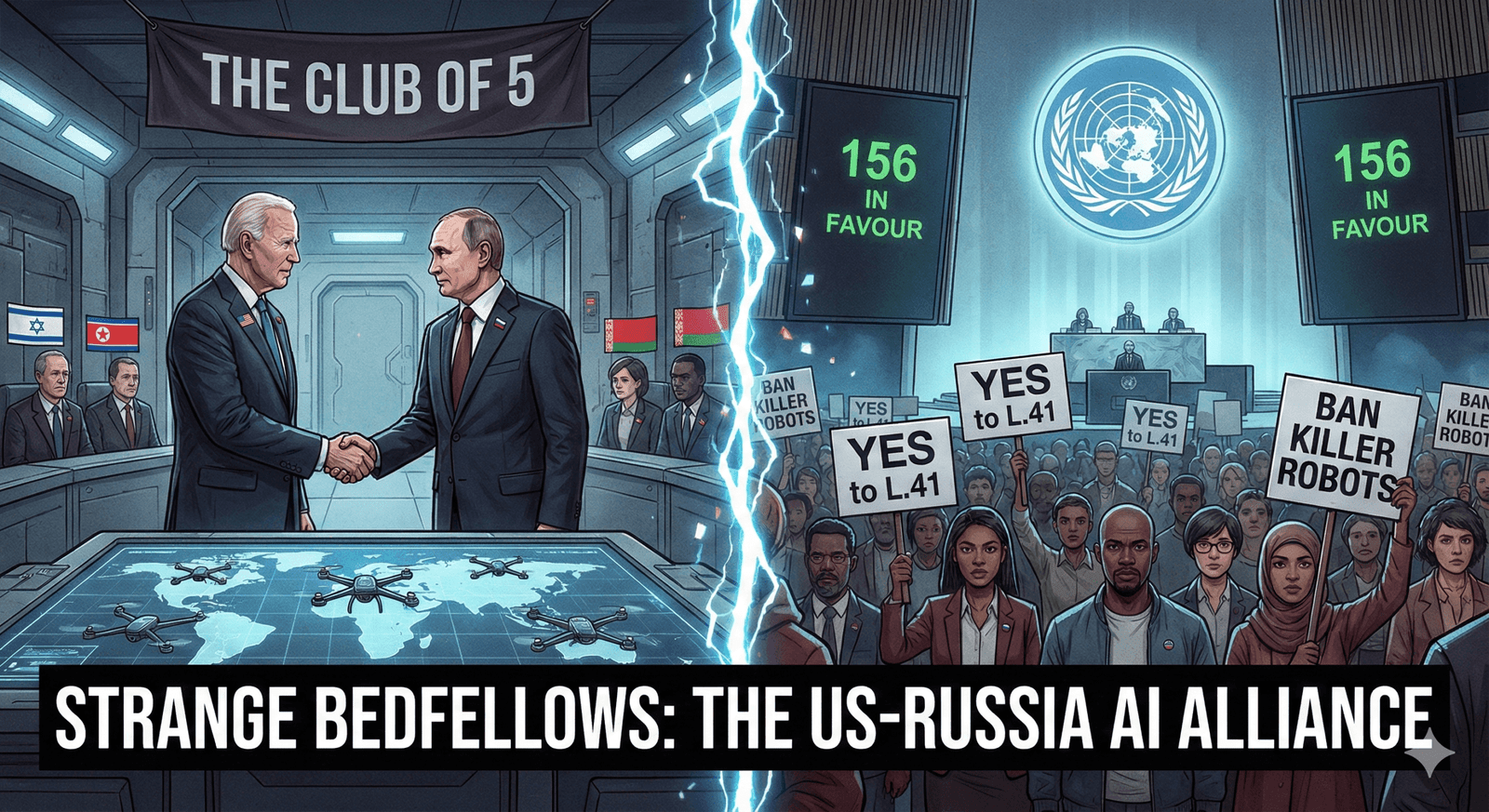
The 5 Against the World: Why the US, Russia, and North Korea Just United to Protect “Killer Robots”
In a stunning display of “strange bedfellows,” the mask of the liberal international order slipped on November 6, 2025. When the world demanded a stop to the unchecked rise of artificial intelligence in warfare, the United States didn’t lead the charge for human rights. Instead, it joined Russia, North Korea, and Israel in a lonely coalition of five to say “No.”
The Vote That Redefined “The Bad Guys”
On November 6, 2025, inside the United Nations Headquarters, the First Committee (Disarmament and International Security) concluded its work for the 80th Session. The agenda was packed, but one item stood out: Draft Resolution L.41 (formally Lethal Autonomous Weapons Systems or LAWS).
The resolution was simple. It sought to affirm that international law applies to autonomous weapons, ensure human control over the use of force, and place the issue permanently on the UN General Assembly’s agenda.
The result was a landslide victory for humanity—and a shocking exposure of the “Hegemon’s Club.”
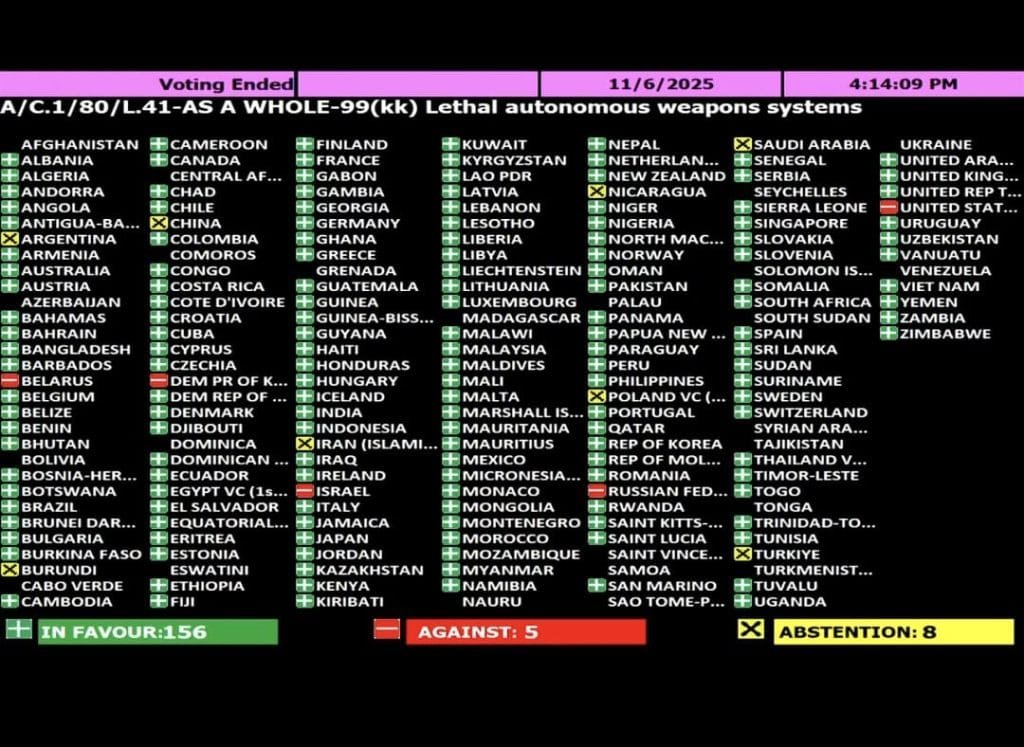
- In Favour (Green): 156 (The UK, France, India, and the entire Global South)
- Abstained (Yellow): 8 (Including China)
- Against (Red): 5
Who were the five?
- Russian Federation
- North Korea (DPRK)
- Belarus
- Israel
- United States of America
The “Villain” Alignment: A New Geopolitical Reality
For decades, we have been sold a narrative of “Democracy vs. Autocracy.” We are told the US stands for a “Rules-Based International Order” while Russia and North Korea are rogue states.
This vote shatters that illusion.
When it comes to the future of warfare, the ideological divide evaporates. It is replaced by a divide of Capability vs. Morality. The US, Russia, and Israel are the world’s leading developers of AI-powered military tech. They view “Killer Robots”—machines that select and engage targets without human intervention—not as a horror to be banned, but as an asset to be protected.
By voting “No,” the United States aligned itself with the very regimes it calls “savages” and “warmongers.” Why? Because maintaining military supremacy now outweighs moral standing.
The India Pivot: Why the “Global South” is Waking Up
Perhaps the most critical takeaway from the Official Report of the First Committee (A/80/534) is the vote of India.
Historically, India has been cautious about arms control, protecting its own developing military interests. But on L.41, India voted YES.
This is a massive strategic pivot. India, along with 155 other nations, has realised that an unregulated AI arms race favors no one but the established powers. By breaking away from the “Hegemons,” India is positioning itself as the true leader of the Global South, advocating for a future where technology serves humanity rather than slaughtering it efficiently.
China’s Strategic Silence
China, the world’s other AI superpower, voted to Abstain. This was a masterclass in geopolitical maneuvering. Beijing knows the US and Russia will block any treaty. By abstaining, China avoids the diplomatic fallout of voting “No” while quietly continuing its own military AI development. They let the US take the reputational hit for being the “obstructionist,” further isolating Washington from the developing world.
What is at Stake? The “Two-Tier” Approach
The resolution (which you can read in full in the UN archives under A/C.1/80/L.41) pushes for what the UN Secretary-General calls a “Two-Tier Approach”-a framework strongly advocated for by the global Stop Killer Robots coalition:
- Prohibition: A total ban on autonomous weapons that cannot be used in compliance with international humanitarian law (i.e., unpredictable algorithms).
- Regulation: Strict human oversight for all other autonomous systems.
The “Club of 5” voted against this because they want zero oversight from the General Assembly. They prefer these discussions to remain in the CCW (Convention on Certain Conventional Weapons) in Geneva, a forum that operates by consensus—meaning the US or Russia can single-handedly veto any progress forever.
The Toxic Export: Militarism Over Humanity
The implications of this vote are chilling for civil society. The United States is signaling that it is willing to sacrifice its soft power to keep its “kill chain” automated.
We are witnessing a dangerous transition. The US is acting less like a “Leader of the Free World” and more like a paranoid superpower clinging to hegemony at any cost. By validating the stance of North Korea and Russia, the US validates their behaviour. It sends a message to the world: Might makes Right.
Conclusion: The Battle for 2026
Despite the opposition of the “Warmongering 5,” the resolution passed. The issue of Lethal Autonomous Weapons Systems is now officially on the agenda for the 81st Session (2026).
The world has spoken: 156 nations want to stop the dehumanisation of warfare. But as long as the nations building the weapons refuse to listen, the future remains uncertain. The “strange bedfellows” have revealed themselves. Now, civil society must hold them accountable.
What do you think? Does the US alignment with North Korea and Russia on this issue prove that military supremacy now matters more than human rights? Or is this a necessary evil in a dangerous world? Let me know in the comments below.
FAQ
A: It is a 2025 resolution titled “Lethal autonomous weapons systems” that affirms international law applies to AI weapons and places the issue on the permanent UN agenda.
A: The US argues that existing international law is sufficient and fears that a binding treaty would handicap its military capabilities against rivals like China.
A: The 5 countries were the United States, Russian Federation, Israel, North Korea (DPRK), and Belarus.

Avi is a researcher educated at the University of Cambridge, specialising in the intersection of AI Ethics and International Law. Recognised by the United Nations for his work on autonomous systems, he translates technical complexity into actionable global policy. His research provides a strategic bridge between machine learning architecture and international governance.