
Two Years in Thailand, and the Idiocracy I Refuse to Entertain
I moved to Thailand from London almost two years ago. The trip was meant to be two weeks—maybe a month at most—but I fell headlong in love with the country and simply didn’t get on my return flight.
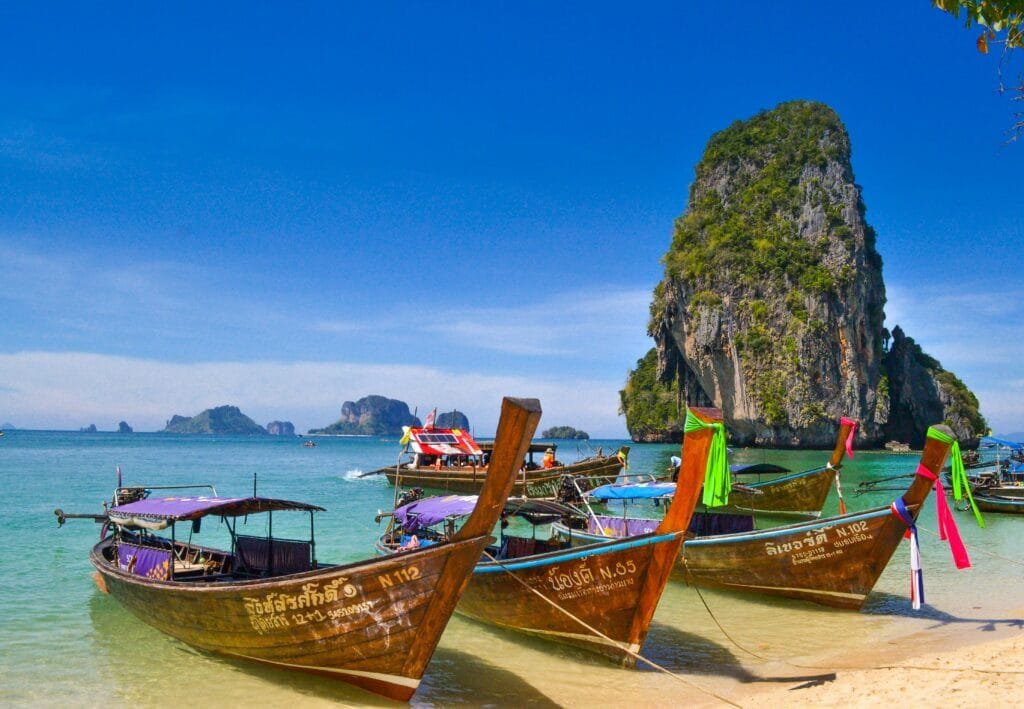
The culture, the cuisine, the weather, the wildlife, the sheer generosity of people I met—everything felt like the opposite of the inhospitable, ignorant, discriminatory norm I had gotten used to in the UK. I knew Thai food was good from London restaurants, but in London they often toned dishes down for local palates. In Thailand, I discovered the real thing: proper spice, proper seasoning, and flavours that rewired my brain. The weather felt like a balm after the UK’s grey misery. The nature was marvellous. The culture was rich and vibrant. I extended my stay, got a condo and study visa, and spent more than a year learning the language and culture.
Then came the ugliness.
Within weeks of settling in, I was bombarded by extremely ignorant, racist, and gender-prejudiced people who seemed obsessed with one topic: “ladyboys.”
I arrived with no preconceptions about Thailand beyond beaches, temples, restaurants, and historical sites. I didn’t know about sex work, didn’t know about the cannabis policy at the time, and I certainly hadn’t come for any of that. But some people (many of whom had never set foot in Thailand) decided that Thailand could be reduced to a red‑light caricature and that I must be part of it.
At first, I tried diplomacy. I’d say Thailand is one of (if not the) most beautiful, vibrant countries I’ve known—the closest thing to paradise on Earth—and I’d clarify that I didn’t come for, engage in, or have any interest in what they kept sniggering about. For months, I attempted to correct them, to push back on defamation aimed at me and the ignorance aimed at a country they’d never visited.
About six months in, I learned more. Of course, there are darker parts to Thailand: governance gaps, regulatory quirks, complicated attitudes toward foreigners. I’m not naïve. But the vapid suggestion that Thailand is nothing but a red-light nation full of sex workers and “ladyboys” isn’t just wrong—it reveals a profound lack of statistical literacy and critical thinking. It tells me more about their obsessions than about Thailand.
The Malice Behind the “Jokes”
Despite my efforts to shut it down, they doubled down. The more I ignored it, the more certain people tried to provoke me—sending dehumanising videos, repeating the same “jokes,” spreading rumours when I wasn’t in the room. Some were people I had once called friends and even respected. Over time, it became clear this wasn’t ignorance. It was malice.
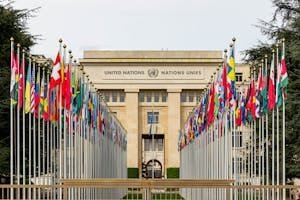
Meanwhile, Thailand was doing the exact opposite for me. I found peace and focus. I got into the best shape of my life. My mental clarity soared. I rode that energy into an acceptance at the University of Cambridge and earned recognition from major multinationals, including the UN.

And still, the same stagnant people—people frozen in the lives they had before I ever left London—kept harping on prostitutes and “ladyboys.”
If all they see in Thailand is sex work, that’s because that’s all they were looking for.
The Evidence: A Statistical Rebuttal
Most of these morally and intellectually bankrupt individuals perpetuating these stereotypes have never been to Thailand. Many have never left their own country. If all they see in Thailand is sex work or transfeminine people, that’s because they were looking for exactly that. There is so much more here.
But let’s look at the facts. These people, often from the USA, UK, India, or Turkey, love to claim Thailand is “obsessed” with these topics. But if we look at the data, we find that the obsession—and the prevalence—is actually in their own backyards.
Exhibit A: The “Glass House” Comparison
The following tables compare Thailand against the home countries of those who frequently cast judgment.
| Country | Estimated Trans Population | % of Population | Source |
| USA | ~2,100,000 | 0.62% | Williams Institute (2025) |
| India | ~488,000 (Official) / ~2M+ (Est) | Unknown | India Census 2011 / Activist Est. |
| Mexico | ~909,000 | 0.69% | ENDISEG (2021) |
| Turkey | ~510,000 (Modelled) | ~0.60% | Extrapolated from Global Prevalence* |
| UK | ~262,000 | 0.50% | ONS (Census 2021) |
| Thailand | ~314,808 | 0.44% | AIDS Data Hub |
The Verdict: The data shows that all the countries listed above (besides the UK) have a larger trans population than Thailand. The US and UK have a higher density of transgender individuals than Thailand. The USA (0.62%) and the UK (0.50%) have a statistically higher percentage of transgender people than Thailand (0.44%). If Thailand is to be mocked for this, why are they not mocking themselves?
The “Glass House” Statistics
Comparing the estimated percentage of transgender population by country.
(Thailand is statistically lower than the US or UK)
Exhibit B: The “Red Light” Myth
They suggest the entire country is a brothel. Yet, simply due to population size, the absolute numbers elsewhere are staggering.
Note on the data: While Thailand is famous for visibility, countries like Turkey have massive “unregistered” numbers (estimated at over 100,000) that often exceed Thailand’s estimates. Meanwhile, the USA and India’s absolute numbers are in a different stratosphere entirely.
| Country | Estimated Sex Workers (n) | % of Population | Source |
| USA | ~1,000,000 | 0.29% | PMC Research / Reviews |
| Mexico | ~240,000 | 0.18% | UNAIDS |
| Thailand | ~43k – 144k | ~0.15% | UNAIDS |
| Turkey | ~100,000+ | ~0.12% | Hürriyet Daily News |
| India | ~995,499 | ~0.07% | PLOS Global Public Health |
The Verdict: The USA has nearly double the percentage of sex workers per capita compared to Thailand. India has nearly one million sex workers in absolute numbers—almost ten times the Thai estimate. Turkey, often cited by researchers as having over 100,000 unregistered workers, likely rivals or exceeds Thailand’s actual numbers.
They are mocking a country for a phenomenon that is statistically more prevalent in their own nations.
The Hypocrisy of “Darker” Stereotypes
Here is where the hypocrisy becomes truly damning. These bullies feel comfortable labelling me (and an entire country) based on the existence of sex workers and transgender people.
I’ve been tempted to mirror their logic back to them. Many of the loudest voices come from countries like India, Turkey and the USA. If they think it is fair to label every human being in Thailand based on a narrow stereotype, surely they would be comfortable if others labelled them based on the worst statistics of their own countries?
If we were to look at data regarding sexual interest in children (a proxy for pedophilia), there is no national registry for this in any country. However, applying the standard clinical prevalence models (approx. 0.5%–3.0% of the population) used by researchers reveals a stark truth about the volume of danger in these countries compared to Thailand.
- India: In a population of 1.4 billion, statistical modeling suggests there are between 7 million and 43 million people with these inclinations.
- USA: In a population of 340 million, this model suggests between 1.7 million and 10 million people fit this profile.
- Turkey: In a population of 85 million, the model suggests between 400,000 and 2.5 million people fit this profile.
The Contrast: Even if we assume the rate of “sickness” is the same everywhere, the sheer scale of the population means that India hosts nearly 20 to 40 times more potential predators than Thailand. The USA hosts almost 5 times more.
Exhibit C: The “Official Record” of Crimes Against Children
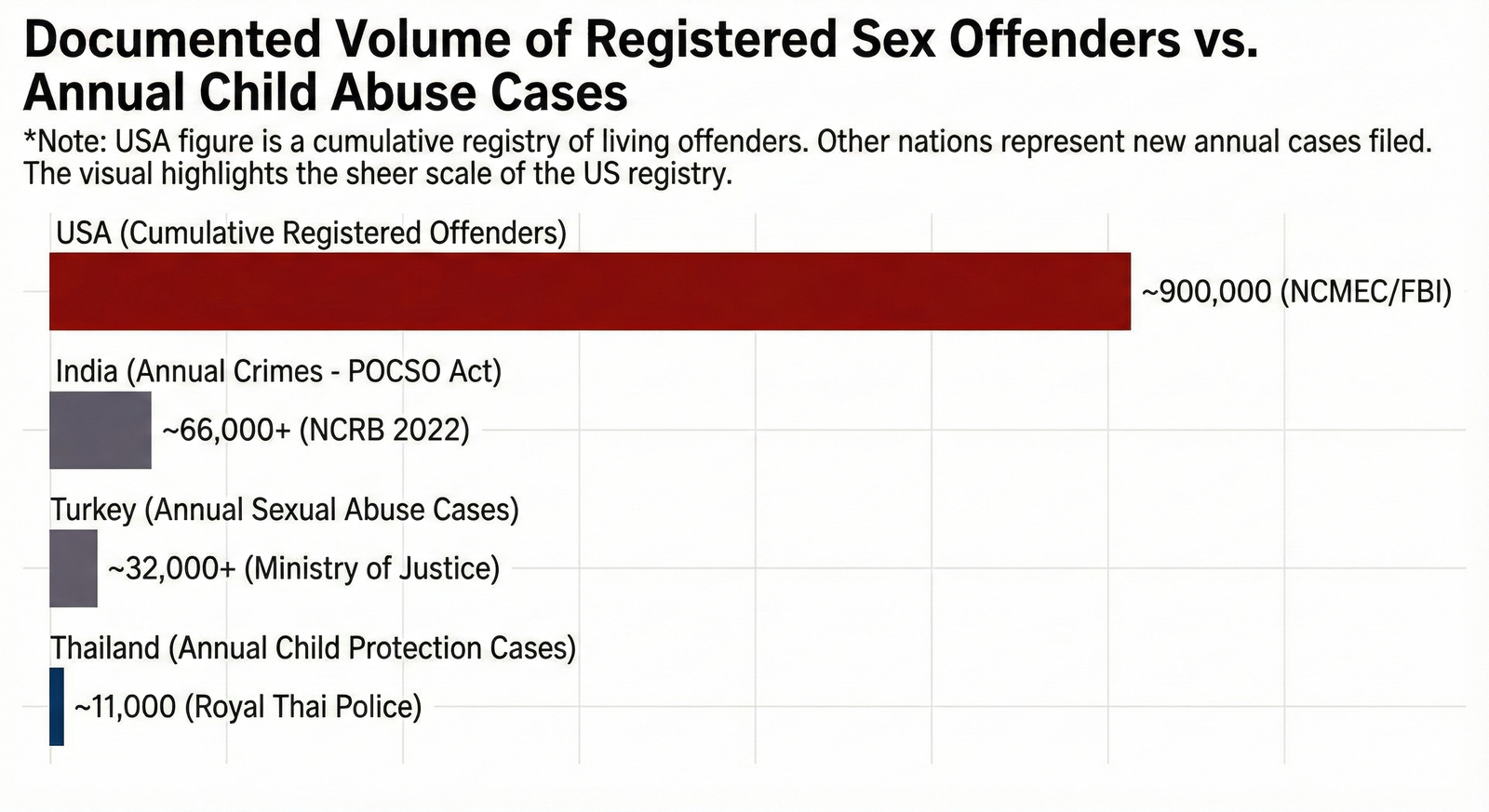
This table compares the number of individuals the government has officially flagged as sex offenders (USA) or the annual volume of child sexual abuse cases officially filed by police (India, Turkey, Thailand).
| Country | Statistic Type | The Number | Source |
| USA | Registered Sex Offenders | ~800,000 – 900,000 | NCMEC / FBI |
| India | Annual Crimes Against Children (POCSO Act) | ~66,000+ (per year) | NCRB (2022) |
| Turkey | Annual Child Sexual Abuse Cases | ~32,000+ (per year) | Ministry of Justice |
| Thailand | Annual Child Protection Cases | ~11,000 (per year) | Royal Thai Police |
1. The USA Number is Staggering: While the US tracks cumulative offenders and other nations track annual cases, the sheer volume of the US registry (nearly 1 million) indicates a systemic scale of danger that dwarfs the rest. The United States has nearly one million registered sex offenders. These are not estimates; these are names on a government list. The sheer population of legally recognised sex offenders in the US is larger than the population of some entire cities. If Thailand is ‘deviant’ or ‘unsafe,’ what do you call a country with nearly a million registered predators?
2. The India/Turkey Volume: In India, over 60,000 cases are filed every single year. In Turkey, it’s over 30,000. And remember—these are just the ones reported to the police. In conservative cultures, underreporting is massive. The actual number is likely exponentially higher.
3. The Thai Contrast: Thailand records significantly fewer official cases annually than India or Turkey. While underreporting exists everywhere, the official data does not support the idea that Thailand is the world’s center for this crime. In fact, statistically, a child is far more likely to encounter a predator in the US, Turkey or India simply due to the sheer volume of offenders living there.
How would they feel? How would an Indian or Turkish person feel if, the moment they joined a conversation, people blurted out comments implying or directly stating that due to where they live they must be obsessed with molesting children? How would they feel if people labelled their entire nation as rapists or scammers based on the actions of a segment of their population?
It sounds unfair, doesn’t it? In fact, it sounds incredibly racist, ignorant, and defamatory.
But that is exactly what they do to Thailand. They ignore the reality that there are likely more prostitutes and sexual deviants in numbers in the USA, Turkey and India than there are here. Perhaps the people choosing to live in those countries are the ones truly “obsessed,” as they have chosen to reside in nations with a statistically higher quantity of the very things they claim to hate.
Why I’m Publishing This
When this harassment bled into a community where I was a regular and a leader, I finally messaged the main facilitator. I explained that the harassment was constant, that the comments were racist and gender‑prejudiced, that they were linking an entire nation—and me—to a narrow, derogatory stereotype. He suggested I address it directly with the worst offender. We both knew I’d already tried diplomacy. The harassment hadn’t stopped. In fact, my silence seemed to lure them on. We eventually agreed: if someone can’t respect clear boundaries after many chances, the sane move is to step away from the toxicity.
I’ve largely done that. But I also want to put my experience in the open for anyone considering a move to Thailand.
1. The “Joke” isn’t funny. It is racism and gender‑based prejudice. They reduce an entire country to a slur and pretend it is humour.
2. The Hypocrisy is real. They project their own countries’ issues onto you.
3. The Reality is beautiful. Thailand gave me the energy to do the best work of my life.
If you’re moving here, expect beauty. Expect warmth. And, sadly, expect that some ignorant bully somewhere will try to reduce all of it to a slur. Don’t let them. You don’t have to argue with them. You can simply refuse to carry their ignorance any further.
Here’s what I’ve learned and what I want on the record:
- The people making these jokes are not “being funny.” The people who laugh along and encourage it are perhaps even more uninformed. They are without a doubt being racist and gender‑prejudiced. They reduce an entire country to a slur and then pretend their dehumanisation is humour.
- Many of the loudest voices are from places that carry their own painful stereotypes—places like the US, Turkey, or India. They would not tolerate being stereotyped by their countries’ worst headlines, yet they’re happy to smear Thais in exactly that way.
- I’ve been tempted to mirror their logic back to them—to say, “If you can smear Thailand, imagine if someone slapped the ugliest labels onto your entire nation.” But that kind of stereotyping is exactly what I reject. I will not become what I despise.
- What I will do is refuse to engage in idiocracy. I will set boundaries. I will walk away when needed. And I will keep loving the country that has given me so much.
A note on language: “Ladyboy” is a term many outsiders throw around; it is commonly used in tourist circles, but it’s stigmatising. The Thai cultural term “kathoey” is more specific to transfeminine identity, and, like everywhere, trans people here are human beings who deserve dignity, not punchlines. Thailand has warmth and visibility around gender diversity—and like every country, it also has real issues to fix. Both can be true at once. (aidsdatahub.org)
Receipts: context and data that put lazy stereotypes in the bin
- Read this carefully: I’m not saying any of these countries are “about” sex work. I’m saying the lazy urge to reduce Thailand to sex work is both ignorant and statistically illiterate. Sex work exists globally, with large absolute numbers appearing in large countries. That’s it.
- On the specific smear that tries to link Thailand, trans people, and sexual deviance:
- Trans ≠ sex work, and neither has anything to do with criminality. Public‑health and human‑rights literature treats transgender people and sex workers as distinct key populations with distinct needs and risks. Thailand’s visibility around gender diversity coexists with documented discrimination that trans people are working to change—just like in the US, UK, Mexico, India, and Turkey. (aidsdatahub.org)
- If someone tries to drag the conversation into “who has more child abusers,” the only honest answer is that there are no reliable national “headcounts” of pedophilic disorder in any country (besides from official legal cases). Research reviews report wide prevalence ranges for “sexual interest in children” in anonymous surveys, and they emphasise that sexual interest, a clinical diagnosis, and criminal behavior are not the same thing. It is both scientifically wrong and morally grotesque to smear any nationality with that brush. (pubmed.ncbi.nlm.nih.gov)
Data Sources and Evidence:
Transgender Populations: USA: Williams Institute (2025 Update); UK: Office for National Statistics (Census 2021); Mexico: ENDISEG (2021/Gaceta Parlamentaria); India: Census 2011 (Social Justice Dept) & Activist Estimates; Thailand: HIV/AIDS Data Hub for the Asia-Pacific Region.
Sex Work Estimates: India: PLOS Global Public Health (NACO 2025 Mapping); USA: PMC Reviews & Justice Dept. Estimates; Turkey: Hürriyet Daily News (Academic/Chamber of Commerce Reports); UK: House of Commons Home Affairs Committee; Thailand: UNAIDS Programmatic Data.
Crime, Safety & Prevalence: USA: National Center for Missing & Exploited Children (NCMEC) Registered Offender Map; India: National Crime Records Bureau (NCRB) “Crime in India 2022” / POCSO Act Data; Turkey: Ministry of Justice (Adli Sicil ve İstatistik Genel Müdürlüğü); Clinical Prevalence Models: Systematic review of sexual interest in children (Savoie et al., 2021, PubMed).
Context and Further Reading:
- Being LGBT in Asia: Thailand Country Report | HIV/AIDS Data Hub for the Asia-Pacific Region
- How Many Adults and Youth Identify as Transgender in the United States? – Williams Institute
- First census estimates on gender identity and sexual orientation – Office for National Statistics
- Gaceta Parlamentaria, año XXVII, número 6460-IV-1, jueves 8 de febrero de 2024
- State/UT wise Population of Others(TG) as per Census 2011 | Department of Social Justice and Empowerment – Government of India
- Bangkok Post – Transgender services get 145-million-baht boost
- Programmatic mapping and population size estimation of key population in India: Method and findings | PLOS Global Public Health
- House of Commons – Prostitution – Home Affairs Committee
- Academic highlights high prostitution figures in Turkey’s $4 billion industry – Türkiye News
- Prostitution in Thailand
- Tolerance but Not Inclusion: A National Survey on Experiences of Discrimination and Social Attitudes towards LGBT People in Thailand | HIV/AIDS Data Hub for the Asia-Pacific Region
- Prevalence and correlates of individuals with sexual interest in children: A systematic review – PubMed

Avi is a researcher educated at the University of Cambridge, specialising in the intersection of AI Ethics and International Law. Recognised by the United Nations for his work on autonomous systems, he translates technical complexity into actionable global policy. His research provides a strategic bridge between machine learning architecture and international governance.